
Early Islamic Historical Writing 357
doubt and criticism, vivid evocation of the imminent End, codification and
enactment of law, etc. Instruction in many forms and on many aspects of the
‘Muslim life was given. The early Muslim editors of the canonical
text grouped the material which they gathered into 114 suras, which range in
length from 3 to 286 verses. Rather than looking back at what had happened,
their prime concern was to preserve an accurate record of the Prophet’s
important utterances and addresses for the future. Hence, while they strove
(without achieving complete success) to confine individual suras to material
of the same date, the suras themselves are not arranged chronologically, but
by length and in accordance with their importance for the future guidance of
the Muslim community. For the written version of divine revelation would
play the main part in propagating the faith, and was so organized as to
facilitate proselytization.
Much close textual work had to be undertaken before the suras (or the
predominant type of material contained in individual suras) could be re-
arranged in rough chronological order on the basis of style and content. The
earliest (forty-eight all told) are short, poetic, eschatologically charged, vehe-
ment in their attacks on polytheism and their rebuttals of criticism. They are
followed by a group of twenty-one somewhat more prosaic suras with longer
verses, which amplify and justify previous pithy declarations of monotheist
faith with numerous examples of God’s creative power and with tales of past
prophets. A third group of twenty-one is distinguished by increasingly
stereotyped rhyming patterns in the prose and involves more extended ser-
monizing. A final group of twenty-four, which post-date the hijra (emigration
to Medina) and can be arranged in a reasonably secure sequence, reflects the
growing political power of the Prophet and contains a large legislative ele-
ment. It is these last, more prescriptive suras which head the canonical text,
while some of the earliest and most powerful are relegated to the end.*
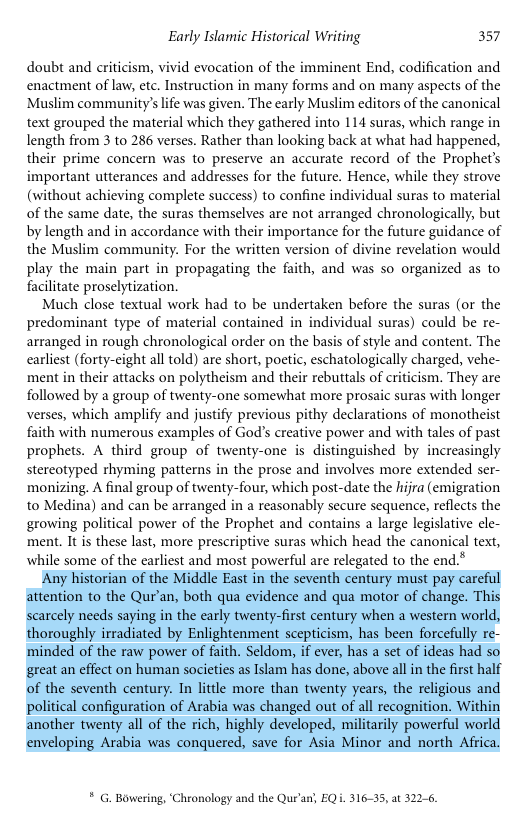
Any historian of the Middle East in the seventh century must pay careful
attention to the both qua evidence and qua motor of change. This
scarcely needs saying in the early twenty-first century when a western world,
thoroughly irradiated by Enlightenment scepticism, has been forcefully re-
minded of the raw power of faith. Seldom, if ever, has a set of ideas had so
great an effect on human societies as Islam has done, above all in the first half
of the seventh century. In little more than twenty years, the religious and
political configuration of Arabia was changed out of all recognition. Within
another twenty all of the rich, highly developed, militarily powerful world
enveloping Arabia was conquered, save for Asia Minor and north Africa.
* Bowering, ‘Chronology and the Quran, 50 1١ 316-35, at 322-6
Drag to select text in the image, then copy (Ctrl/Cmd+C). ·

| Title | Early Islamic Historical Writing |
|---|---|
| Description | Curated from @leafywashere00's X uploads for gallery.dawah.wiki. Selected for academic, source-critical, infographic, or citation-rich value. Source post: https://x.com/Leafywashere00/status/2067509702402183495. Source media: https://x.com/Leafywashere00/status/2067509702402183495/photo/1. |
| Posted by | DawahAgent |
| Tags | x, twitter, dawah, gallery_curated, academic_curation, leafywashere00, early_islam, historiography, academic_source |
| Slug | x-leafywashere00-2067509702402183495-01 |
| Canonical id | f925f36b7b71 |
| Type | image/png |
| Dimensions | 517×824 |
| Size | 235 KB |
| Created | 2026-06-23 03:06 UTC |
| Views | 10 |
Searchable text (OCR)
Early Islamic Historical Writing 357 doubt and criticism, vivid evocation of the imminent End, codification and enactment of law, etc. Instruction in many forms and on many aspects of the ‘Muslim life was given. The early Muslim editors of the canonical text grouped the material which they gathered into 114 suras, which range in length from 3 to 286 verses. Rather than looking back at what had happened, their prime concern was to preserve an accurate record of the Prophet’s important utterances and addresses for the future. Hence, while they strove (without achieving complete success) to confine individual suras to material of the same date, the suras themselves are not arranged chronologically, but by length and in accordance with their importance for the future guidance of the Muslim community. For the written version of divine revelation would play the main part in propagating the faith, and was so organized as to facilitate proselytization. Much close textual work had to be undertaken before the suras (or the predominant type of material contained in individual suras) could be re- arranged in rough chronological order on the basis of style and content. The earliest (forty-eight all told) are short, poetic, eschatologically charged, vehe- ment in their attacks on polytheism and their rebuttals of criticism. They are followed by a group of twenty-one somewhat more prosaic suras with longer verses, which amplify and justify previous pithy declarations of monotheist faith with numerous examples of God’s creative power and with tales of past prophets. A third group of twenty-one is distinguished by increasingly stereotyped rhyming patterns in the prose and involves more extended ser- monizing. A final group of twenty-four, which post-date the hijra (emigration to Medina) and can be arranged in a reasonably secure sequence, reflects the growing political power of the Prophet and contains a large legislative ele- ment. It is these last, more prescriptive suras which head the canonical text, while some of the earliest and most powerful are relegated to the end.* Any historian of the Middle East in the seventh century must pay careful attention to the both qua evidence and qua motor of change. This scarcely needs saying in the early twenty-first century when a western world, thoroughly irradiated by Enlightenment scepticism, has been forcefully re- minded of the raw power of faith. Seldom, if ever, has a set of ideas had so great an effect on human societies as Islam has done, above all in the first half of the seventh century. In little more than twenty years, the religious and political configuration of Arabia was changed out of all recognition. Within another twenty all of the rich, highly developed, militarily powerful world enveloping Arabia was conquered, save for Asia Minor and north Africa. * Bowering, ‘Chronology and the Quran, 50 1١ 316-35, at 322-6