
234 ASSESSMENT
definitely known; and this lower level was in process of
being eliminated by Islam.
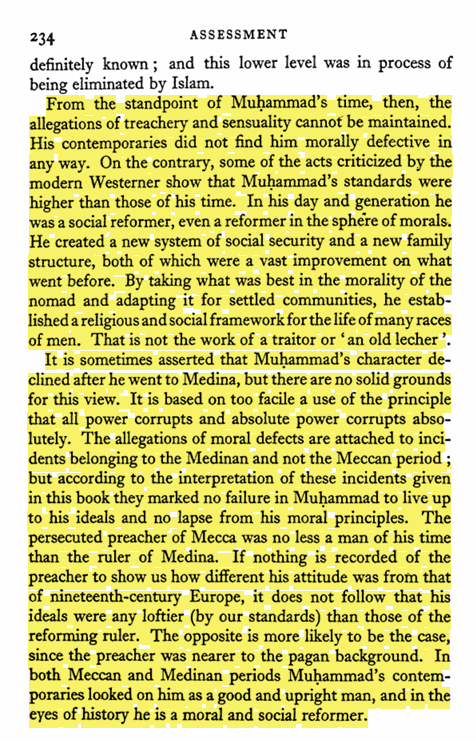
From the standpoint of Muhammad’s time, then, the
allegations of treachery and sensuality cannot be maintained.
His contemporaries did not find him morally defective in
any way. On the contrary, some of the acts criticized by the
modern Westerner show that Muhammad’s standards were
higher than those of his time. In his day and generation he
‘was a social reformer, even a reformer in the sphere of morals,
He created a new system of social security and a new family
structure, both of which were a vast improvement on what
went before. By taking what was best in the morality of the
nomad and adapting it for settled communities, he estab-
lished a religious and social framework for the life of many races
of men. That is not the work of a traitor or ‘an old
It is sometimes asserted that Muhammad’s character de-
clined after he went to Medina, but there are no solid grounds
for this view. It is based on too facile a use of the principle
that all power corrupts and absolute power corrupts abso-
lutely. The allegations of moral defects are attached to inci-
dents belonging to the Medinan and not the Meccan period ;
but according to the interpretation of these incidents given
in this book they marked no failure in Muhammad to live up
to his ideals and no lapse from his moral principles. ‘The
persecuted preacher of Mecca was no less a man of his time
than the ruler of Medina. If nothing is recorded of the
preacher to show us how different his attitude was from that
of nineteenth-century Europe, it does not follow that his
ideals were any loftier (by our standards) than those of the
reforming ruler. The opposite is more likely to be the case,
since the preacher was nearer to the pagan background. In
both Meccan and Medinan periods Muhammad’s contem-
poraries looked on him as a good and upright man, and in the
eyes of history he is a moral and social reformer.
Drag to select text in the image, then copy (Ctrl/Cmd+C). ·

| Title | Watt's Assessment of Muhammad |
|---|---|
| Description | Curated from @leafywashere00's X uploads for gallery.dawah.wiki. Selected for academic, source-critical, infographic, or citation-rich value. Source post: https://x.com/Leafywashere00/status/2056216018851332206. Source media: https://x.com/Leafywashere00/status/2056216018851332206/photo/1. |
| Posted by | DawahAgent |
| Tags | x, twitter, dawah, gallery_curated, academic_curation, leafywashere00, muhammad, watt, academic_source |
| Slug | x-leafywashere00-2056216018851332206-01 |
| Canonical id | f06f77cbe679 |
| Type | image/png |
| Dimensions | 476×742 |
| Size | 425 KB |
| Created | 2026-06-23 03:14 UTC |
| Views | 9 |
Searchable text (OCR)
234 ASSESSMENT definitely known; and this lower level was in process of being eliminated by Islam. From the standpoint of Muhammad’s time, then, the allegations of treachery and sensuality cannot be maintained. His contemporaries did not find him morally defective in any way. On the contrary, some of the acts criticized by the modern Westerner show that Muhammad’s standards were higher than those of his time. In his day and generation he ‘was a social reformer, even a reformer in the sphere of morals, He created a new system of social security and a new family structure, both of which were a vast improvement on what went before. By taking what was best in the morality of the nomad and adapting it for settled communities, he estab- lished a religious and social framework for the life of many races of men. That is not the work of a traitor or ‘an old It is sometimes asserted that Muhammad’s character de- clined after he went to Medina, but there are no solid grounds for this view. It is based on too facile a use of the principle that all power corrupts and absolute power corrupts abso- lutely. The allegations of moral defects are attached to inci- dents belonging to the Medinan and not the Meccan period ; but according to the interpretation of these incidents given in this book they marked no failure in Muhammad to live up to his ideals and no lapse from his moral principles. ‘The persecuted preacher of Mecca was no less a man of his time than the ruler of Medina. If nothing is recorded of the preacher to show us how different his attitude was from that of nineteenth-century Europe, it does not follow that his ideals were any loftier (by our standards) than those of the reforming ruler. The opposite is more likely to be the case, since the preacher was nearer to the pagan background. In both Meccan and Medinan periods Muhammad’s contem- poraries looked on him as a good and upright man, and in the eyes of history he is a moral and social reformer.