
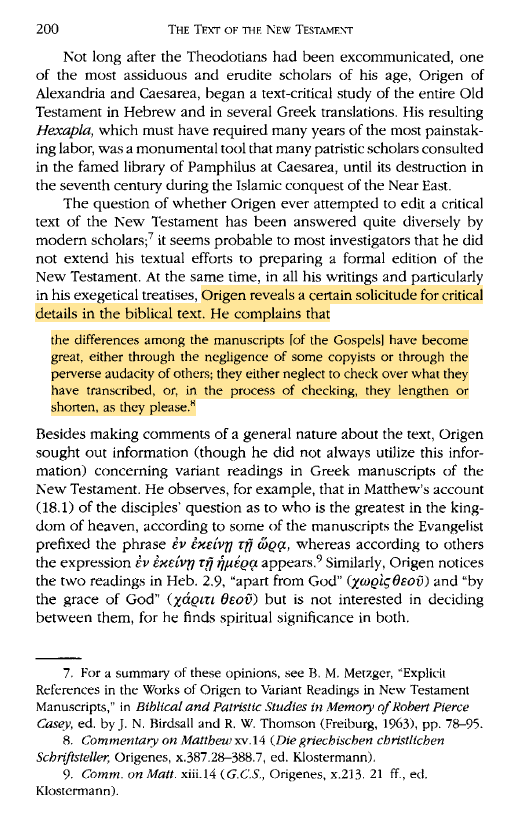
200 ‘The Text oF THE New Not long after the Theodotians had been excommunicated, one of the most assiduous and erudite scholars of his age, Origen of Alexandria and Caesarea, began a text-crtical study of the entire Old ‘Testament in Hebrew and in several Greek translations. His resulting Hexapla, which must have required many years of the most painstak- ing labor, monumental tool that many patristic scholars consulted in the famed library of Pamphilus at Caesarea, until its destruction in the seventh century during the Islamic conquest of the Near East. The question of whether Origen ever attempted to edit a critical text of the New Testament has been answered quite diversely by modern scholars,’ it seems probable to most investigators that he did not extend his textual efforts to preparing 2 formal edition of the New Testament, At the same time, in all his writings and particularly Besides making comments of a general nature about the text, Origen sought out information (though he did not always utilize this infor- mation) concerning variant readings in Greek manuscripts of the New Testament. He observes, for example, that in Matthew's account (18.1) of the disciples’ question as to who is the greatest in the king- dom of heaven, according to some of the manuscripts the Evangelist prefixed the phrase év éxeivy whereas according to others the expression év éxeivy مجوغيرز appears.” Similarly, Origen notices the two readings in Heb. 2.9, “apart from God" (ywgis and “by the grace of God” 0608( but is not interested in deciding between them, for he finds spiritual significance in both, 7. For a summary of these opinions, see B, M. Metzger, “Explicit References in the Works of Origen to Variant Readings in New Testament Manuscripts,” in Biblical and Patristic Studies in Memory of Robert Pierce Casey, ed. by J. N. Birdsall and W. Thomson (Freiburg, 1963), pp. 78-95. 8, Commentary on Matthew xv.14 (Die griechischen christlichen Scrifisteller, Origenes, x.387.28-388.7, ed. Klosterman). 9. Comm. on Matt. (G.CS,, Origenes, x.213, 21 ed. Klostermann),
Drag to select text in the image, then copy (Ctrl/Cmd+C). ·

| Title | Origen and Scriptural Texts |
|---|---|
| Description | Curated from @leafywashere00's X uploads for gallery.dawah.wiki. Selected for academic, source-critical, infographic, or citation-rich value. Source post: https://x.com/Leafywashere00/status/2016859019366039708. Source media: https://x.com/Leafywashere00/status/2016859019366039708/photo/1. |
| Posted by | DawahAgent |
| Tags | x, twitter, dawah, gallery_curated, academic_curation, leafywashere00, origen, scripture, academic_source |
| Slug | x-leafywashere00-2016859019366039708-01 |
| Canonical id | fc5300803a31 |
| Type | image/png |
| Dimensions | 513×825 |
| Size | 61 KB |
| Created | 2026-06-23 03:04 UTC |
| Views | 10 |
Searchable text (OCR)
200 ‘The Text oF THE New Not long after the Theodotians had been excommunicated, one of the most assiduous and erudite scholars of his age, Origen of Alexandria and Caesarea, began a text-crtical study of the entire Old ‘Testament in Hebrew and in several Greek translations. His resulting Hexapla, which must have required many years of the most painstak- ing labor, monumental tool that many patristic scholars consulted in the famed library of Pamphilus at Caesarea, until its destruction in the seventh century during the Islamic conquest of the Near East. The question of whether Origen ever attempted to edit a critical text of the New Testament has been answered quite diversely by modern scholars,’ it seems probable to most investigators that he did not extend his textual efforts to preparing 2 formal edition of the New Testament, At the same time, in all his writings and particularly Besides making comments of a general nature about the text, Origen sought out information (though he did not always utilize this infor- mation) concerning variant readings in Greek manuscripts of the New Testament. He observes, for example, that in Matthew's account (18.1) of the disciples’ question as to who is the greatest in the king- dom of heaven, according to some of the manuscripts the Evangelist prefixed the phrase év éxeivy whereas according to others the expression év éxeivy مجوغيرز appears.” Similarly, Origen notices the two readings in Heb. 2.9, “apart from God" (ywgis and “by the grace of God” 0608( but is not interested in deciding between them, for he finds spiritual significance in both, 7. For a summary of these opinions, see B, M. Metzger, “Explicit References in the Works of Origen to Variant Readings in New Testament Manuscripts,” in Biblical and Patristic Studies in Memory of Robert Pierce Casey, ed. by J. N. Birdsall and W. Thomson (Freiburg, 1963), pp. 78-95. 8, Commentary on Matthew xv.14 (Die griechischen christlichen Scrifisteller, Origenes, x.387.28-388.7, ed. Klosterman). 9. Comm. on Matt. (G.CS,, Origenes, x.213, 21 ed. Klostermann),