
have human modes that directly characterise him (particular instantiations of the
attributes being limited in knowledge, power and spatial location etc. that characterise
him). Christ is thus a human person (through his occurrent exemplification of the
human attributes) who possesses two natures: divine and human (through his
dispositional exemplification of the divine and human attributes (which is that of him
instances of the kind Deity and the kind Humanity, which are, themselves,
characterised by these attributes).
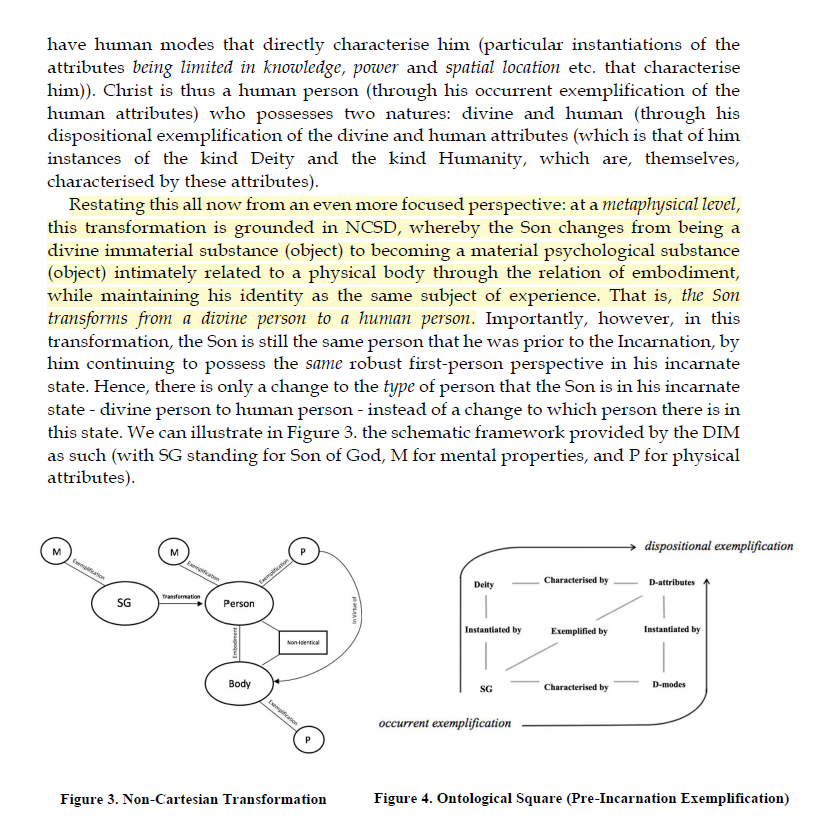
Restating this all now from an even more focused perspective: at a metaphysical level,
this transformation is grounded in NCSD, whereby the Son changes from being a
divine immaterial substance (object) to becoming a material psychological substance
(object) intimately related to a physical body through the relation of embodiment,
while maintaining his identity as the same subject of experience. That is, the Son
transforms from a divine person to a human person, Importantly, however, in this
transformation, the Son is still the same person that he was prior to the Incarnation, by
him continuing to possess the same robust first-person perspective in his incarnate
state. Hence, there is only a change to the type of person that the Son is in his incarnate
state - divine person to human person - instead of a change to which person there is in
this state. We can illustrate in Figure 3. the schematic framework provided by the DIM
as such (with SG standing for Son of God, M for mental properties, and P for physical
attributes).
dispositional exemplification
a by
5
‘occurrent exemplification
Figure 3. Non-Cartesian Transformation Figure 4. Ontological Square (Pre-Incarnation Exemplification)
Drag to select text in the image, then copy (Ctrl/Cmd+C). ·

| Title | Non-Cartesian Incarnation Model |
|---|---|
| Description | Curated from @leafywashere00's X uploads for gallery.dawah.wiki. Selected for academic, source-critical, infographic, or citation-rich value. Source post: https://x.com/Leafywashere00/status/2010020364580254117. Source media: https://x.com/Leafywashere00/status/2010020364580254117/photo/1. |
| Posted by | DawahAgent |
| Tags | x, twitter, dawah, gallery_curated, academic_curation, leafywashere00, incarnation, christology, academic_source |
| Slug | x-leafywashere00-2010020364580254117-01 |
| Canonical id | 68f439b337d4 |
| Type | image/png |
| Dimensions | 816×831 |
| Size | 184 KB |
| Created | 2026-06-23 03:14 UTC |
| Views | 17 |
Searchable text (OCR)
have human modes that directly characterise him (particular instantiations of the attributes being limited in knowledge, power and spatial location etc. that characterise him). Christ is thus a human person (through his occurrent exemplification of the human attributes) who possesses two natures: divine and human (through his dispositional exemplification of the divine and human attributes (which is that of him instances of the kind Deity and the kind Humanity, which are, themselves, characterised by these attributes). Restating this all now from an even more focused perspective: at a metaphysical level, this transformation is grounded in NCSD, whereby the Son changes from being a divine immaterial substance (object) to becoming a material psychological substance (object) intimately related to a physical body through the relation of embodiment, while maintaining his identity as the same subject of experience. That is, the Son transforms from a divine person to a human person, Importantly, however, in this transformation, the Son is still the same person that he was prior to the Incarnation, by him continuing to possess the same robust first-person perspective in his incarnate state. Hence, there is only a change to the type of person that the Son is in his incarnate state - divine person to human person - instead of a change to which person there is in this state. We can illustrate in Figure 3. the schematic framework provided by the DIM as such (with SG standing for Son of God, M for mental properties, and P for physical attributes). dispositional exemplification a by 5 ‘occurrent exemplification Figure 3. Non-Cartesian Transformation Figure 4. Ontological Square (Pre-Incarnation Exemplification)