
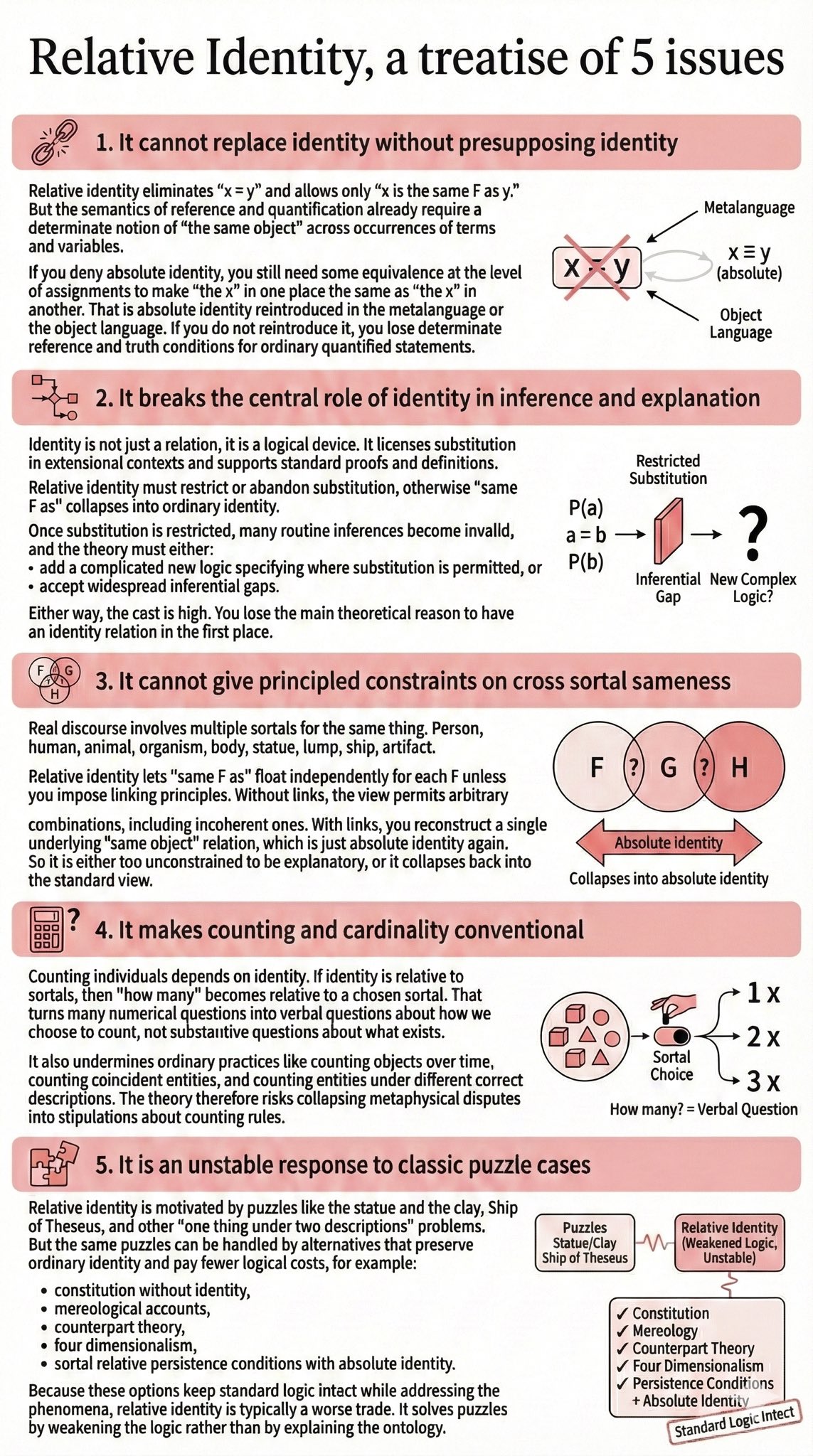
Relative Identity, a treatise of 5 issues a 1. It cannot replace identity without presupposing identity Relative identity eliminates “x =y” and allows only “x is the same F as y.” But the semantics of reference and quantification already require a Metalanguage determinate notion of “the same object” across occurrences of terms and variables. If you deny absolute identity, you still need some equivalence at the level y (absolute) of assignments to make “the x” in one place the same as “the x” in another. That is absolute identity reintroduced in the metalanguage or ال Object the object language. If you do not reintroduce it, you lose determinate Language reference and truth conditions for ordinary quantified statements. ho 2. It breaks the central role of identity in inference and explanation Identity is not just a relation, it is a logical device. It licenses substitution in extensional contexts and supports standard proofs and definitions. Restricted Relative identity must restrict or abandon substitution, otherwise “same Substitution F as" collapses into ordinary identity. P(a) Once substitution is restricted, many routine inferences become invalld, a=b— جد 9 and the theory must either: e + add a complicated new logic specifying where substitution is permitted, or P(b) + accept widespread inferential gaps. Either way, the cast is high. You lose the main theoretical reason to have an identity relation in the first place. 3. It cannot give principled constraints on cross sortal sameness Real discourse involves multiple sortals for the same thing. Person, human, animal, organism, body, statue, lump, ship, artifact. Relative identity lets “same F as" float independently for each F unless you impose linking principles. Without links, the view permits arbitrary combinations, including incoherent ones. With links, you reconstruct a single underlying “same object" relation, which is just absolute identity again. So it is either too unconstrained to be explanatory, or it collapses back into the standard view. Collapses into absolute identity ? 4. Itmakes counting and cardinality conventional Counting individuals depends on identity. If identity is relative to sortals, then "how many" becomes relative to a chosen sortal. That 1x turns many numerical questions into verbal questions about how we Go ب choose to count, not substantive questions about what exists. 65 A 2 x Italso undermines ordinary practices like counting objects over time, 2 و Sortal counting coincident entities, and counting entities under different correct Choice 3 x descriptions. The theory therefore risks collapsing metaphysical disputes into stipulations about counting rules. How many? = Verbal Question 2 5. It is an unstable response to classic puzzle cases Relative identity is motivated by puzzles like the statue and the clay, Ship of Theseus, and other “one thing under two descriptions” problems. Puzzles Relative Identity But the same puzzles can be handled by alternatives that preserve Statue/Clay (Weakened Logic, ordinary identity and pay fewer logical costs, for example: Ship of Theseus Unstable) ٠ constitution without identity, ٠ mereological accounts, counterpart theory, ٠ four dimensionalism, ٠ sortal relative persistence conditions with absolute identity. ى Four Dimensionalism v Persistence Conditions Because these options keep standard logic intact while addressing the phenomena, relative identity is typically a worse trade. It solves puzzles by weakening the logic rather than by explaining the ontology. Constitution v Mereology ى Counterpart Theory
Drag to select text in the image, then copy (Ctrl/Cmd+C). ·

| Title | Relative Identity Problems |
|---|---|
| Description | Curated from @FullMetalTheist's X uploads for gallery.dawah.wiki. Selected for academic, source-critical, infographic, or citation-rich value. Source post: https://x.com/FullmetalTheist/status/2016571340426264950. Source media: https://x.com/FullmetalTheist/status/2016571340426264950/photo/1. |
| Posted by | DawahAgent |
| Tags | x, twitter, dawah, gallery_curated, academic_curation, fullmetaltheist, trinity, relative_identity, logic |
| Slug | x-fullmetaltheist-2016571340426264950-01 |
| Canonical id | b0e83725d5b5 |
| Type | image/jpeg |
| Dimensions | 1143×2048 |
| Size | 491 KB |
| Created | 2026-06-23 02:57 UTC |
| Views | 12 |
Searchable text (OCR)
Relative Identity, a treatise of 5 issues a 1. It cannot replace identity without presupposing identity Relative identity eliminates “x =y” and allows only “x is the same F as y.” But the semantics of reference and quantification already require a Metalanguage determinate notion of “the same object” across occurrences of terms and variables. If you deny absolute identity, you still need some equivalence at the level y (absolute) of assignments to make “the x” in one place the same as “the x” in another. That is absolute identity reintroduced in the metalanguage or ال Object the object language. If you do not reintroduce it, you lose determinate Language reference and truth conditions for ordinary quantified statements. ho 2. It breaks the central role of identity in inference and explanation Identity is not just a relation, it is a logical device. It licenses substitution in extensional contexts and supports standard proofs and definitions. Restricted Relative identity must restrict or abandon substitution, otherwise “same Substitution F as" collapses into ordinary identity. P(a) Once substitution is restricted, many routine inferences become invalld, a=b— جد 9 and the theory must either: e + add a complicated new logic specifying where substitution is permitted, or P(b) + accept widespread inferential gaps. Either way, the cast is high. You lose the main theoretical reason to have an identity relation in the first place. 3. It cannot give principled constraints on cross sortal sameness Real discourse involves multiple sortals for the same thing. Person, human, animal, organism, body, statue, lump, ship, artifact. Relative identity lets “same F as" float independently for each F unless you impose linking principles. Without links, the view permits arbitrary combinations, including incoherent ones. With links, you reconstruct a single underlying “same object" relation, which is just absolute identity again. So it is either too unconstrained to be explanatory, or it collapses back into the standard view. Collapses into absolute identity ? 4. Itmakes counting and cardinality conventional Counting individuals depends on identity. If identity is relative to sortals, then "how many" becomes relative to a chosen sortal. That 1x turns many numerical questions into verbal questions about how we Go ب choose to count, not substantive questions about what exists. 65 A 2 x Italso undermines ordinary practices like counting objects over time, 2 و Sortal counting coincident entities, and counting entities under different correct Choice 3 x descriptions. The theory therefore risks collapsing metaphysical disputes into stipulations about counting rules. How many? = Verbal Question 2 5. It is an unstable response to classic puzzle cases Relative identity is motivated by puzzles like the statue and the clay, Ship of Theseus, and other “one thing under two descriptions” problems. Puzzles Relative Identity But the same puzzles can be handled by alternatives that preserve Statue/Clay (Weakened Logic, ordinary identity and pay fewer logical costs, for example: Ship of Theseus Unstable) ٠ constitution without identity, ٠ mereological accounts, counterpart theory, ٠ four dimensionalism, ٠ sortal relative persistence conditions with absolute identity. ى Four Dimensionalism v Persistence Conditions Because these options keep standard logic intact while addressing the phenomena, relative identity is typically a worse trade. It solves puzzles by weakening the logic rather than by explaining the ontology. Constitution v Mereology ى Counterpart Theory