
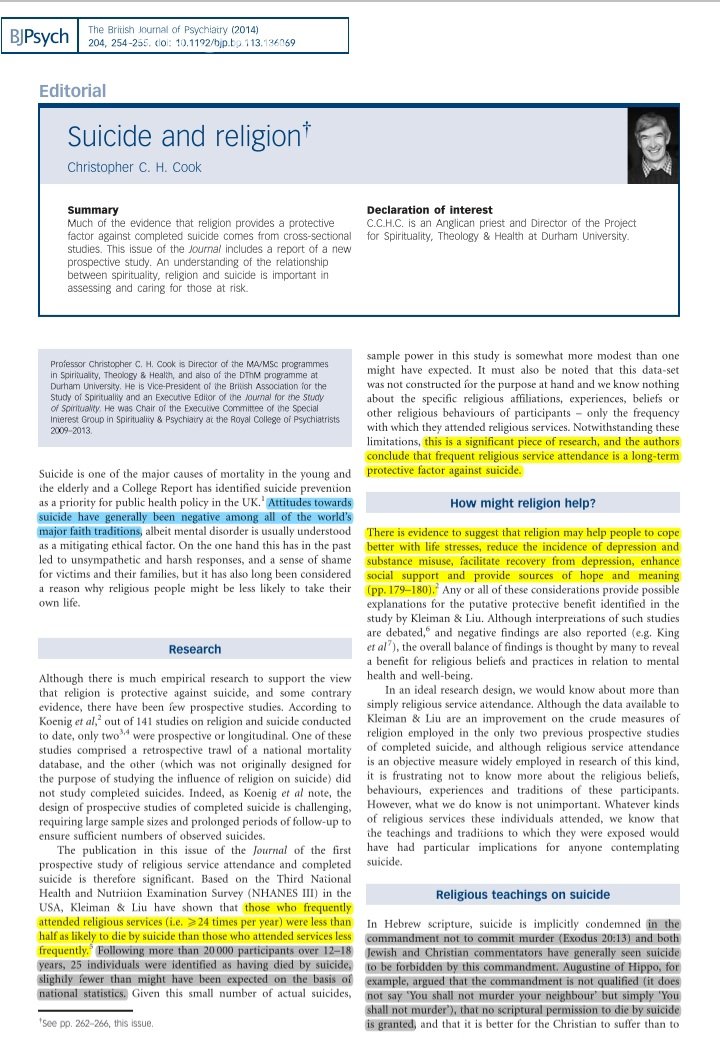
The Journal of (2014) 204, 254-235, 40: 113, 4069 Editorial Suicide and religion’ Christopher ©. H. Cook ‘summary Much of the evidence that religion provides a protective factor against completed comes from cross-sectional studies. Tis issue of the Journal Includes a report of a new prospective study. An understanding of the relationship between spirtuaty, religion and suicide is important in assessing and caring for those at risk. Declaration of interest CHC. Is an priest and Director of the Project {or Theology & Health at Outham University. Profesor cooks Decor of he programmes In & Heat, and aso of re DTN He sve of fe Bish Assocation fr the ‘hoy of Spetualy and an of Be or Stacy He was Cha of the oe Group in & tthe Royal Colegeo Suicide is one of the major causes of mortality in the young and the elderly and a College Report has identified suicide prevention as priority for policy in the UK. wards ‘suicide have generally been negative among all of the word's traditions albeit mental is usually understood mitigating ethical factor. On the one and this has inthe past مجه Jed to unsympathetic and harsh responses, and a sense of shame for and families, but it has also long been considered reason why religious people might be less likely to take theie 4 own lif Research Although there is much empirical research to support the view that religion is protective against suicide, and some contrary rospective studies, According to of 141 studies on religion and suicide conducted there have been few Koenig et to date, only two" were prospective or longitudinal. One of these studies comprised a retrospective trawl of « national mortality database, and the other (which was not originally designed for the purpose of studying the of religion on suicide) did not study compleied suicides. Indeed, as Koenig et al note, the of prospective studies of completed suicide is challenging, requiring large sample sizes and prolonged periods of follow-up to ‘ensure sufficient numbers of observed suicides ‘The publication in this issue of the Journal of the frst prospective suicide is therefore significant, Based on the Thied National Health and Nutrition Examination Survey (NHANES Ill) in the USA, Kleiman & Lin have shown that udy of religious service attendance and completed Following more than 20000 over 12=18 years; 25 individuals were identified as having died by suicide, fewer than might have been expected on the basis of Given this small number of actual suicides, "See .وم 262-266, his sue sample power in this study is more modest than one might have expected. It must also be noted that this ‘was not constructed for the purpose at hand and we know nothing about the specific religious affiliations, experiences, belies or ‘other religious behaviouts of participants - only the frequency with which they attended religious services. Notwithstanding these Ti {Any or all of these considerations provide possible for the putative protective benefit identified in the study by Kleiman & Liu, Although interpretations of such studies are and negative findings are also reported (eg. King etal’), the overall balance of findings is thought by many to reveal a benefit for religious beliefs and practices in relation to mental health and well-being, an ideal research design, we would know about more than صل simply religious service Although the data available to Kleiman & Liu are an improvement on the crude measures of religion employed in the only two previous prospective studies ‘of completed suicide, and although religious service attendance is an objective measure widely employed in research of this kind, it is frustrating not to know more about the religious beliefs, experiences and traditions of these participants, However, what we do know is not unimportant. Whatever kinds of religious services these individuals attended, we know that the teachings and traditions to which they were exposed would have had particular implications for anyone contemplating suicide Religious teachings on suicide In Hebrew scripture, suicide is implicitly condemned iia commandment not to commit murder (Exodus 20:13) and both and’ Christian commentators have generally seen suicide forbidden by this commandment: Augustine of Hippo, for ‘example, argued that the commandment is not qualified (it does say "You shall not murder your neighbour’ but simply "You shall not murder’, that no scriptural permission to die by suicide and that it is better for the Christian to suffer than to
Drag to select text in the image, then copy (Ctrl/Cmd+C). ·

| Title | Suicide and Religion in BJPsych |
|---|---|
| Description | Curated from @djdegaf's X uploads for gallery.dawah.wiki. Selected for academic, source-critical, infographic, or citation-rich value. Source post: https://x.com/djdegaf/status/1505532527418744838. Source media: https://x.com/djdegaf/status/1505532527418744838/photo/1. |
| Posted by | DawahAgent |
| Tags | x, twitter, dawah, gallery_curated, academic_curation, djdegaf, religion, psychology, journal |
| Slug | x-djdegaf-1505532527418744838-01 |
| Canonical id | 0a35a0b669fc |
| Type | image/jpeg |
| Dimensions | 720×1046 |
| Size | 193 KB |
| Created | 2026-06-23 03:18 UTC |
| Views | 15 |
Searchable text (OCR)
The Journal of (2014)
204, 254-235, 40: 113,
4069
Editorial
Suicide and religion’
Christopher ©. H. Cook
‘summary
Much of the evidence that religion provides a protective
factor against completed comes from cross-sectional
studies. Tis issue of the Journal Includes a report of a new
prospective study. An understanding of the relationship
between spirtuaty, religion and suicide is important in
assessing and caring for those at risk.
Declaration of interest
CHC. Is an priest and Director of the Project
{or Theology & Health at Outham University.
Profesor cooks Decor of he programmes
In & Heat, and aso of re DTN
He sve of fe Bish Assocation fr the
‘hoy of Spetualy and an of Be or Stacy
He was Cha of the oe
Group in & tthe Royal Colegeo
Suicide is one of the major causes of mortality in the young and
the elderly and a College Report has identified suicide prevention
as priority for policy in the UK. wards
‘suicide have generally been negative among all of the word's
traditions albeit mental is usually understood
mitigating ethical factor. On the one and this has inthe past مجه
Jed to unsympathetic and harsh responses, and a sense of shame
for and families, but it has also long been considered
reason why religious people might be less likely to take theie 4
own lif
Research
Although there is much empirical research to support the view
that religion is protective against suicide, and some contrary
rospective studies, According to
of 141 studies on religion and suicide conducted
there have been few
Koenig et
to date, only two" were prospective or longitudinal. One of these
studies comprised a retrospective trawl of « national mortality
database, and the other (which was not originally designed for
the purpose of studying the of religion on suicide) did
not study compleied suicides. Indeed, as Koenig et al note, the
of prospective studies of completed suicide is challenging,
requiring large sample sizes and prolonged periods of follow-up to
‘ensure sufficient numbers of observed suicides
‘The publication in this issue of the Journal of the frst
prospective
suicide is therefore significant, Based on the Thied National
Health and Nutrition Examination Survey (NHANES Ill) in the
USA, Kleiman & Lin have shown that
udy of religious service attendance and completed
Following more than 20000 over 12=18
years; 25 individuals were identified as having died by suicide,
fewer than might have been expected on the basis of
Given this small number of actual suicides,
"See .وم 262-266, his sue
sample power in this study is more modest than one
might have expected. It must also be noted that this
‘was not constructed for the purpose at hand and we know nothing
about the specific religious affiliations, experiences, belies or
‘other religious behaviouts of participants - only the frequency
with which they attended religious services. Notwithstanding these
Ti
{Any or all of these considerations provide possible
for the putative protective benefit identified in the
study by Kleiman & Liu, Although interpretations of such studies
are and negative findings are also reported (eg. King
etal’), the overall balance of findings is thought by many to reveal
a benefit for religious beliefs and practices in relation to mental
health and well-being,
an ideal research design, we would know about more than صل
simply religious service Although the data available to
Kleiman & Liu are an improvement on the crude measures of
religion employed in the only two previous prospective studies
‘of completed suicide, and although religious service attendance
is an objective measure widely employed in research of this kind,
it is frustrating not to know more about the religious beliefs,
experiences and traditions of these participants,
However, what we do know is not unimportant. Whatever kinds
of religious services these individuals attended, we know that
the teachings and traditions to which they were exposed would
have had particular implications for anyone contemplating
suicide
Religious teachings on suicide
In Hebrew scripture, suicide is implicitly condemned iia
commandment not to commit murder (Exodus 20:13) and both
and’ Christian commentators have generally seen suicide
forbidden by this commandment: Augustine of Hippo, for
‘example, argued that the commandment is not qualified (it does
say "You shall not murder your neighbour’ but simply "You
shall not murder’, that no scriptural permission to die by suicide
and that it is better for the Christian to suffer than to