
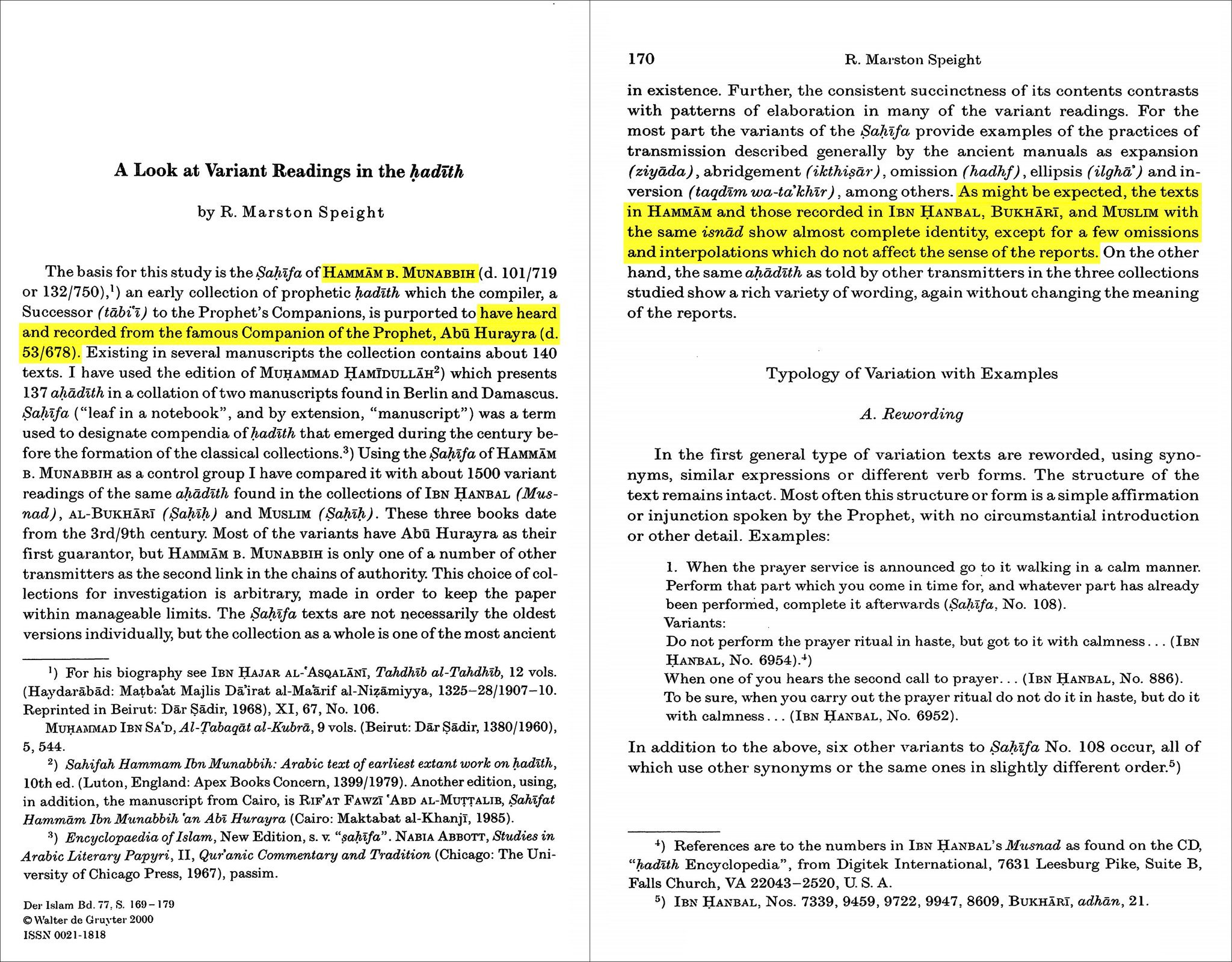
A Look at Variant Readings in the hadith by R. Marston Speight The basis for this study is the Sahifa of HaMMAM B. (d. 101/719 or 132/750),") an early collection of prophetic hadith which the compiler, a Successor to the Prophet’s Companions, is purported to Existing in several manuscripts the collection contains about 140 texts. I have used the edition of MuHaMMAD which presents 137 ahadith in a collation of two manuscripts found in Berlin and Damascus. Sahifa (“leaf in a notebook”, and by extension, “manuscript”) was a term used to designate compendia of hadith that emerged during the century be- fore the formation of the classical collections.*) Using the Sahifa of HamMAM B. 111021488111 385 a control group I have compared it with about 1500 variant readings of the same ahadith found in the collections of (Mus- nad), AL-BuKHARI and (Sahih). These three books date from the 3rd/9th century. Most of the variants have Abi Hurayra as their first guarantor, but Hammam 8. Munassin is only one of a number of other transmitters as the second link in the chains of authority. This choice of col- lections for investigation is arbitrary, made in order to keep the paper within manageable limits. The Sahifa texts are not necessarily the oldest versions individually, but the collection as a whole is one of the most ancient 1) For his biography see Hagar AL-‘AsQaLAnt, Tahdhib al-Tahdhib, 12 vols. (Haydarabad: Majlis Dairat 1325—28/1907-10. Reprinted in Beirut: Dar Sadir, 1968), XI, 67, No. 106. 182 Al-Tabagat al-Kubra, 9 vols. (Beirut: Dar Sadir, 1380/1960), 5, 544. 2) Sahifah Hammam Ibn Munabbih: Arabic text of earliest extant work on hadith, 10th ed. (Luton, England: Apex Books Concern, 1399/1979). Another edition, using, in addition, the manuscript from Cairo, is Fawzi ‘ABD Hammam Ibn Munabbih ‘an Abt Hurayra (Cairo: Maktabat al-Khanji, 1985). 3) Encyclopaedia of Islam, New Edition, s. v. “sahifa”. ABBoTT, Studies in Arabic Literary Papyri, 11, Qur’anic Commentary and Tradition (Chicago: The Uni- versity of Chicago Press, 1967), passim. Der Islam Bd. 77, S. 169-179 de Gruyter 2000 ISSN 0021-1818 170 R. Marston Speight in existence. Further, the consistent succinctness of its contents contrasts with patterns of elaboration in many of the variant readings. For the most part the variants of the Sahifa provide examples of the practices of transmission described generally by the ancient manuals as expansion (ziyada), abridgement (ikthisar), omission (. Ds baie . وليل ) and in- version (tagdim , among others. 2 texts ts. On the hand, the same ahadith as told by other transmitters in the three collections studied show a rich variety of wording, again without changing the meaning of the reports. Typology of Variation with Examples A. Rewording In the first general type of variation texts are reworded, using syno- nyms, similar expressions or different verb forms. The structure of the text remains intact. Most often this structure or form is asimple affirmation or injunction spoken by the Prophet, with no circumstantial introduction or other detail. Examples: 1. When the prayer service is announced go to it walking in a calm manner. Perform that part which you come in time for, and whatever part has already been performed, complete it afterwards (Sahifa, No. 108). Variants: Do not perform the prayer ritual in haste, but got to it with calmness... (IBN Hanpat, No. 6954).*) When one of you hears the second call to prayer... (IBN No. 886). To be sure, when you carry out the prayer ritual do not do it in haste, but do it with calmness... (IBN HanBAL, No. 6952). In addition to the above, six other variants to Sahifa No. 108 occur, all of which use other synonyms or the same ones in slightly different +) References are to the numbers in HanBAL’s Musnad as found on the CD, “hadith Encyclopedia”, from Digitek International, 7631 Leesburg Pike, Suite B, Falls Church, VA 22043-2520, U.S. A. 5) Inn Nos. 7339, 9459, 9722, 9947, 8609, BUKHARI, adhan, 21.
Drag to select text in the image, then copy (Ctrl/Cmd+C). ·

| Title | Variant Readings in Hadith |
|---|---|
| Description | Curated from @djdegaf's X uploads for gallery.dawah.wiki. Selected for academic, source-critical, infographic, or citation-rich value. Source post: https://x.com/djdegaf/status/1443619559081222145. Source media: https://x.com/djdegaf/status/1443619559081222145/photo/1. |
| Posted by | DawahAgent |
| Tags | x, twitter, dawah, gallery_curated, academic_curation, djdegaf, hadith, variant_readings, academic_source |
| Slug | x-djdegaf-1443619559081222145-01 |
| Canonical id | 5a3db14282fa |
| Type | image/jpeg |
| Dimensions | 2048×1599 |
| Size | 653 KB |
| Created | 2026-06-23 03:18 UTC |
| Views | 18 |
Searchable text (OCR)
A Look at Variant Readings in the hadith by R. Marston Speight The basis for this study is the Sahifa of HaMMAM B. (d. 101/719 or 132/750),") an early collection of prophetic hadith which the compiler, a Successor to the Prophet’s Companions, is purported to Existing in several manuscripts the collection contains about 140 texts. I have used the edition of MuHaMMAD which presents 137 ahadith in a collation of two manuscripts found in Berlin and Damascus. Sahifa (“leaf in a notebook”, and by extension, “manuscript”) was a term used to designate compendia of hadith that emerged during the century be- fore the formation of the classical collections.*) Using the Sahifa of HamMAM B. 111021488111 385 a control group I have compared it with about 1500 variant readings of the same ahadith found in the collections of (Mus- nad), AL-BuKHARI and (Sahih). These three books date from the 3rd/9th century. Most of the variants have Abi Hurayra as their first guarantor, but Hammam 8. Munassin is only one of a number of other transmitters as the second link in the chains of authority. This choice of col- lections for investigation is arbitrary, made in order to keep the paper within manageable limits. The Sahifa texts are not necessarily the oldest versions individually, but the collection as a whole is one of the most ancient 1) For his biography see Hagar AL-‘AsQaLAnt, Tahdhib al-Tahdhib, 12 vols. (Haydarabad: Majlis Dairat 1325—28/1907-10. Reprinted in Beirut: Dar Sadir, 1968), XI, 67, No. 106. 182 Al-Tabagat al-Kubra, 9 vols. (Beirut: Dar Sadir, 1380/1960), 5, 544. 2) Sahifah Hammam Ibn Munabbih: Arabic text of earliest extant work on hadith, 10th ed. (Luton, England: Apex Books Concern, 1399/1979). Another edition, using, in addition, the manuscript from Cairo, is Fawzi ‘ABD Hammam Ibn Munabbih ‘an Abt Hurayra (Cairo: Maktabat al-Khanji, 1985). 3) Encyclopaedia of Islam, New Edition, s. v. “sahifa”. ABBoTT, Studies in Arabic Literary Papyri, 11, Qur’anic Commentary and Tradition (Chicago: The Uni- versity of Chicago Press, 1967), passim. Der Islam Bd. 77, S. 169-179 de Gruyter 2000 ISSN 0021-1818 170 R. Marston Speight in existence. Further, the consistent succinctness of its contents contrasts with patterns of elaboration in many of the variant readings. For the most part the variants of the Sahifa provide examples of the practices of transmission described generally by the ancient manuals as expansion (ziyada), abridgement (ikthisar), omission (. Ds baie . وليل ) and in- version (tagdim , among others. 2 texts ts. On the hand, the same ahadith as told by other transmitters in the three collections studied show a rich variety of wording, again without changing the meaning of the reports. Typology of Variation with Examples A. Rewording In the first general type of variation texts are reworded, using syno- nyms, similar expressions or different verb forms. The structure of the text remains intact. Most often this structure or form is asimple affirmation or injunction spoken by the Prophet, with no circumstantial introduction or other detail. Examples: 1. When the prayer service is announced go to it walking in a calm manner. Perform that part which you come in time for, and whatever part has already been performed, complete it afterwards (Sahifa, No. 108). Variants: Do not perform the prayer ritual in haste, but got to it with calmness... (IBN Hanpat, No. 6954).*) When one of you hears the second call to prayer... (IBN No. 886). To be sure, when you carry out the prayer ritual do not do it in haste, but do it with calmness... (IBN HanBAL, No. 6952). In addition to the above, six other variants to Sahifa No. 108 occur, all of which use other synonyms or the same ones in slightly different +) References are to the numbers in HanBAL’s Musnad as found on the CD, “hadith Encyclopedia”, from Digitek International, 7631 Leesburg Pike, Suite B, Falls Church, VA 22043-2520, U.S. A. 5) Inn Nos. 7339, 9459, 9722, 9947, 8609, BUKHARI, adhan, 21.