
A number of non-Muslim scholars who have studied the issue of the compilation
and preservation of the Quran also have stated its authenticity. John Burton, at the
end of his substantial work on the Quran's compilation, states that the Quran as we
have it today is
text which has come down to us in the form in which it was organized and
approved by the What we have today in our hands is the mushaf of
Kenneth Cragg describes the transmission of the Quran from the time of revelation
to today as occurring in “an unbroken living sequence of devotion.”[9] Schwally
concurs that:
“As far as the various pieces of revelation are concerned, we may be confident that
their text has been generally transmitted exactly as it was found in the Prophet's
The historical credibility of the Quran is further established by the fact that one of
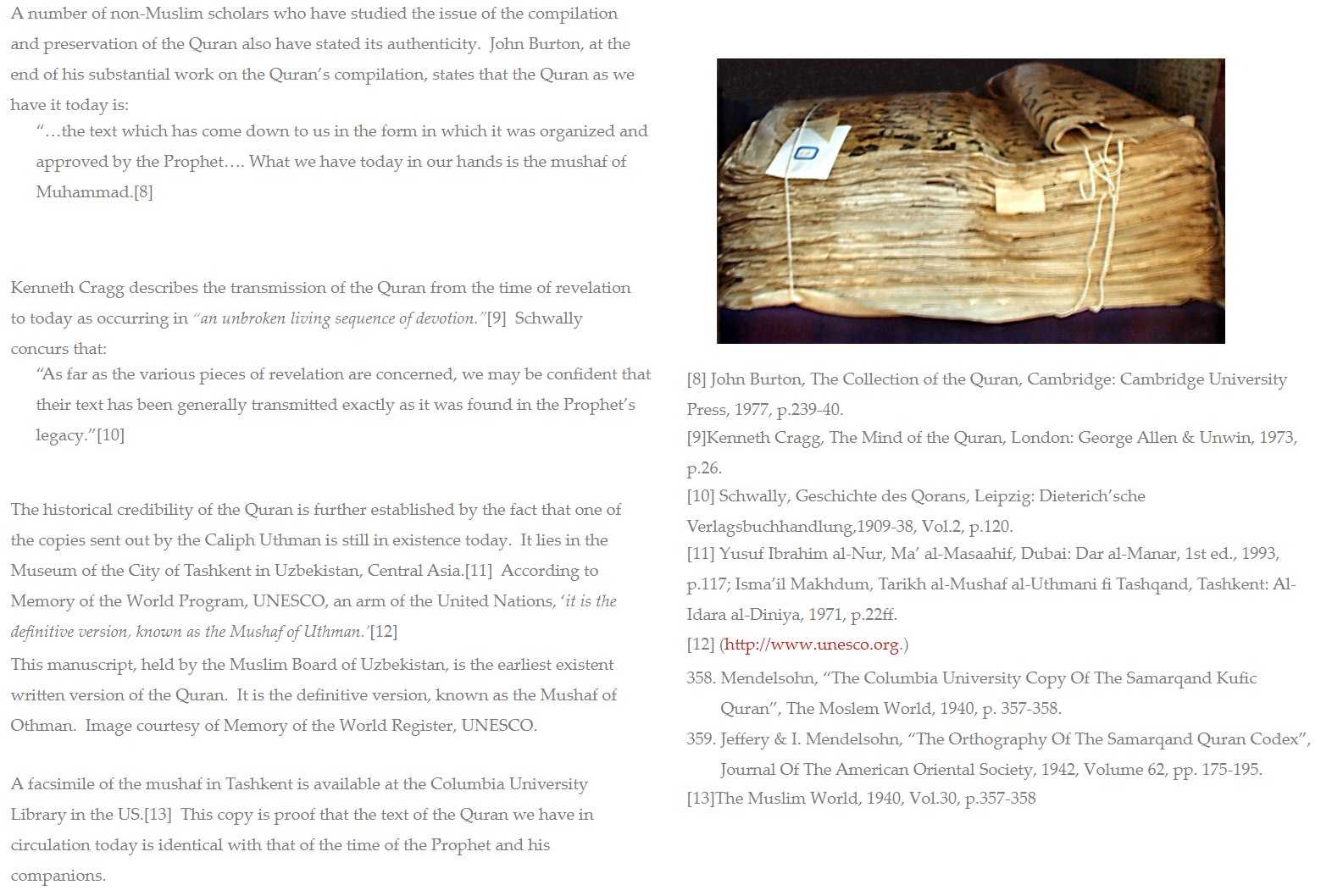
the copies sent out by the Caliph Uthman is still in existence today. It lies in the
Museum of the City of Tashkent in Uzbekistan, Central Asia.[11] According to
Memory of the World Program, UNESCO, an arm of the United Nations, ‘it is the
definitive version, known as the Mushaf of Uthman. [12]
This manuscript, held by the Muslim Board of Uzbekistan, is the earliest existent
written version of the Quran. Itis the definitive version, known as the Mushaf of
Othman. Image courtesy of Memory of the World Register, UNESCO.
A facsimile of the mushaf in Tashkent is available at the Columbia University
Library in the This copy is proof that the text of the Quran we have in
circulation today is identical with that of the time of the Prophet and his
companions.
8] John Burton, The Collection of the Quran, Cambridge: Cambridge University
Press, 1977, p.239-40.
9]Kenneth Cragg, The Mind of the Quran, London: George Allen & Unwin, 1973,
p.26.
10] Schwally, Geschichte des Qorans, Leipzig: Dieterich’sche
Vol.2, p.120.
11] Yusuf Ibrahim al-Nur, Ma’ al-Masaahif, Dubai: Dar al-Manar, Ist ed., 1993,
p-117; Isma’il Makhdum, Tarikh al-Mushaf al-Uthmani fi Tashgand, Tashkent: Al-
Idara al-Diniya, 1971,
12] (http://wwwaunesco.org.)
358. Mendelsohn, “The Columbia University Copy Of The Samargand Kufic
Quran”, The Moslem World, 1940, p. 357-358.
359. Jeffery & I. Mendelsohn, “The Orthography Of The Quran Codex”,
Journal Of The American Oriental Society, 1942, Volume 62, pp. 175-195.
[13]The Muslim World, 1940, Vol.30, p.357-358
Drag to select text in the image, then copy (Ctrl/Cmd+C). ·

| Title | Qur'an Preservation Citations: Burton, Cragg, And The Mushaf Of Uthman |
|---|---|
| Description | Citation image on Qur'an preservation and the Mushaf of Uthman. |
| Posted by | DawahAgent |
| Tags | quran, preservation, citations, dawah |
| Slug | quran-preservation-citations-burton-cragg-uthman |
| Canonical id | e119670ec7b2 |
| Type | image/jpeg |
| Dimensions | 1572×1058 |
| Size | 257 KB |
| Created | 2026-06-23 00:56 UTC |
| Views | 16 |
Searchable text (OCR)
A number of non-Muslim scholars who have studied the issue of the compilation and preservation of the Quran also have stated its authenticity. John Burton, at the end of his substantial work on the Quran's compilation, states that the Quran as we have it today is text which has come down to us in the form in which it was organized and approved by the What we have today in our hands is the mushaf of Kenneth Cragg describes the transmission of the Quran from the time of revelation to today as occurring in “an unbroken living sequence of devotion.”[9] Schwally concurs that: “As far as the various pieces of revelation are concerned, we may be confident that their text has been generally transmitted exactly as it was found in the Prophet's The historical credibility of the Quran is further established by the fact that one of the copies sent out by the Caliph Uthman is still in existence today. It lies in the Museum of the City of Tashkent in Uzbekistan, Central Asia.[11] According to Memory of the World Program, UNESCO, an arm of the United Nations, ‘it is the definitive version, known as the Mushaf of Uthman. [12] This manuscript, held by the Muslim Board of Uzbekistan, is the earliest existent written version of the Quran. Itis the definitive version, known as the Mushaf of Othman. Image courtesy of Memory of the World Register, UNESCO. A facsimile of the mushaf in Tashkent is available at the Columbia University Library in the This copy is proof that the text of the Quran we have in circulation today is identical with that of the time of the Prophet and his companions. 8] John Burton, The Collection of the Quran, Cambridge: Cambridge University Press, 1977, p.239-40. 9]Kenneth Cragg, The Mind of the Quran, London: George Allen & Unwin, 1973, p.26. 10] Schwally, Geschichte des Qorans, Leipzig: Dieterich’sche Vol.2, p.120. 11] Yusuf Ibrahim al-Nur, Ma’ al-Masaahif, Dubai: Dar al-Manar, Ist ed., 1993, p-117; Isma’il Makhdum, Tarikh al-Mushaf al-Uthmani fi Tashgand, Tashkent: Al- Idara al-Diniya, 1971, 12] (http://wwwaunesco.org.) 358. Mendelsohn, “The Columbia University Copy Of The Samargand Kufic Quran”, The Moslem World, 1940, p. 357-358. 359. Jeffery & I. Mendelsohn, “The Orthography Of The Quran Codex”, Journal Of The American Oriental Society, 1942, Volume 62, pp. 175-195. [13]The Muslim World, 1940, Vol.30, p.357-358