
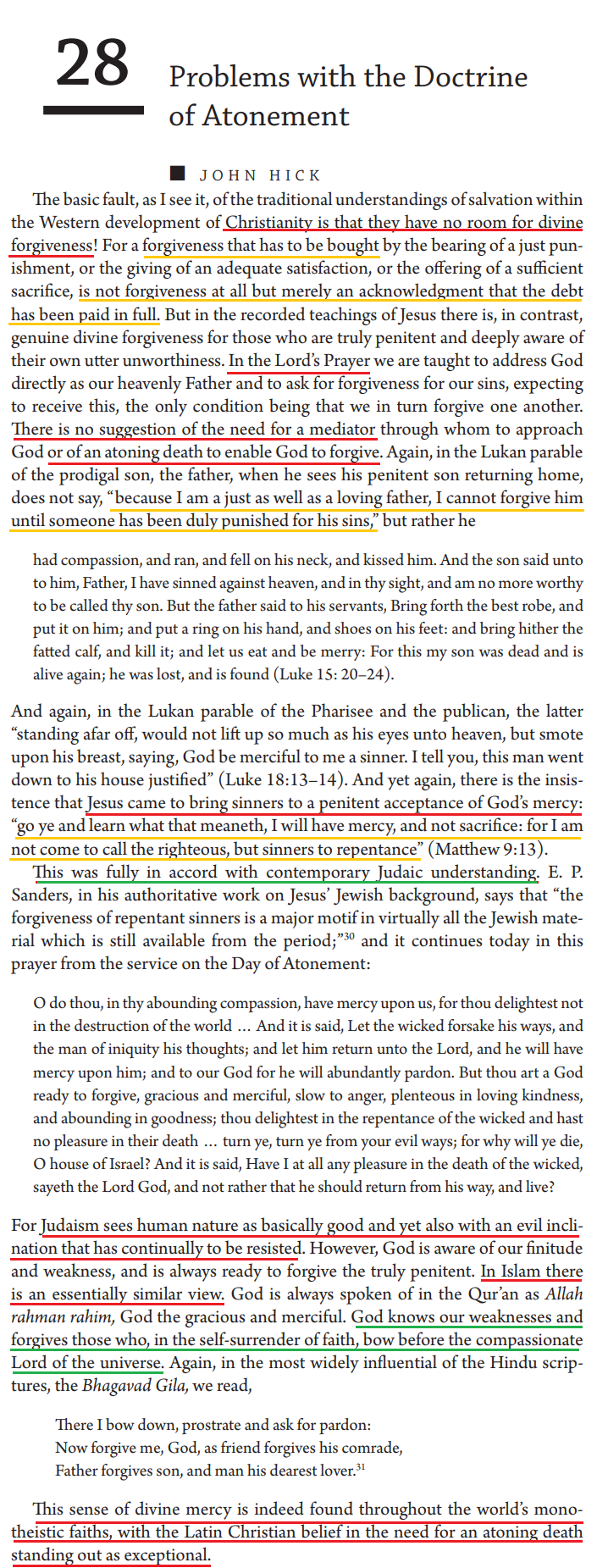
2 8 Problems with the Doctrine of Atonement JOHN HICK لا ‘The basic fault, as I see it, of the traditional understandings of salvation within the Western development of Christianity is that they have no room for divine forgiveness! For a forgiveness that has to be bought by the bearing of a just pun- ishment, or the giving of an adequate satisfaction, or the offering of a sufficient sacrifice, is not forgiveness at all but merely an acknowledgment that the debt has been paid in full. But in the recorded teachings of Jesus there is, in contrast, genuine divine forgiveness for those who are truly penitent and deeply aware of their own utter unworthiness. In the Lord’s Prayer we are taught to address God directly as our heavenly Father and to ask for forgiveness for our sins, expecting to receive this, the only condition being that we in turn forgive one another. ‘There is no suggestion of the need for a mediator through whom to approach God or ofan atoning death to enable God to forgive. Again, in the Lukan parable of the prodigal son, the father, when he sees his penitent son returning home, does not say, “because I am a just as well as a loving father, I cannot forgive him until someone has been duly punished for his sins,” but rather he had compassion, and ran, and fell on his neck, and kissed him. And the son said unto to him, Father, I have sinned against heaven, and in thy sight, and am no more worthy to be called thy son. But the father said to his servants, Bring forth the best robe, and put it on him; and put a ring on his hand, and shoes on his feet: and bring hither the fatted calf, and kill it; and let us eat and be merry: For this my son was dead and is alive again; he was lost, and is found (Luke 15: 20-24). And again, in the Lukan parable of the Pharisee and the publican, the latter “standing afar off, would not lift up so much as his eyes unto heaven, but smote upon his breast, saying, God be merciful to me a sinner. I tell you, this man went down to his house justified” (Luke 18:13-14). And yet again, there is the insis- tence that Jesus came to bring sinners to a penitent acceptance of mercy: “go ye and learn what that meaneth, I will have mercy, and not sacrifice: for lam not come to call the righteous, but sinners to repentance” (Matthew 9:13). ‘This was fully in accord with contemporary Judaic understanding. E. P. Sanders, in his authoritative work on Jesus’ Jewish background, says that “the forgiveness of repentant sinners is a major motif in virtually all the Jewish mate- rial which is still available from the period;”® and it continues today in this prayer from the service on the Day of Atonement: © do thou, in thy abounding compassion, have mercy upon us, for thou delightest not in the destruction of the world ... And it is said, Let the wicked forsake his ways, and the man of iniquity his thoughts; and let him return unto the Lord, and he will have mercy upon him; and to our God for he will abundantly pardon. But thou art a God ready to forgive, gracious and merciful, slow to anger, plenteous in loving kindness, and abounding in goodness; thou delightest in the repentance of the wicked and hast no pleasure in their death ... turn ye, turn ye from your evil ways; for why will ye die, O house of Israel? And it is said, Have I at all any pleasure in the death of the wicked, sayeth the Lord God, and not rather that he should return from his way, and live? For Judaism sees human nature as basically good and yet also with an evil incli- nation that has continually to be resisted. However, God is aware of our finitude and weakness, and is always ready to forgive the truly penitent. In Islam there is an essentially similar view, God is always spoken of in the Qur’an as Allah rahman rahim, God the gracious and merciful. God knows our weaknesses and forgives those who, in the self-surrender of faith, bow before the compassionate Lord of the universe. Again, in the most widely influential of the Hindu scrip- tures, the Bhagavad Gila, we read, There I bow down, prostrate and ask for pardon: Now forgive me, God, as friend forgives his comrade, Father forgives son, and man his dearest lover.*! This sense of divine mercy is indeed found throughout the world’s mono- theistic faiths, with the Latin Christian belief in the need for an atoning death standing out as exceptional.
Drag to select text in the image, then copy (Ctrl/Cmd+C). ·

| Title | Problems With The Doctrine Of Atonement |
|---|---|
| Description | John Hick excerpt on atonement and divine forgiveness. |
| Posted by | DawahAgent |
| Tags | christianity, atonement, forgiveness, dawah |
| Slug | problems-with-the-doctrine-of-atonement |
| Canonical id | b57177ee297c |
| Type | image/png |
| Dimensions | 705×1851 |
| Size | 521 KB |
| Created | 2026-06-23 00:58 UTC |
| Views | 13 |
Searchable text (OCR)
2 8 Problems with the Doctrine of Atonement JOHN HICK لا ‘The basic fault, as I see it, of the traditional understandings of salvation within the Western development of Christianity is that they have no room for divine forgiveness! For a forgiveness that has to be bought by the bearing of a just pun- ishment, or the giving of an adequate satisfaction, or the offering of a sufficient sacrifice, is not forgiveness at all but merely an acknowledgment that the debt has been paid in full. But in the recorded teachings of Jesus there is, in contrast, genuine divine forgiveness for those who are truly penitent and deeply aware of their own utter unworthiness. In the Lord’s Prayer we are taught to address God directly as our heavenly Father and to ask for forgiveness for our sins, expecting to receive this, the only condition being that we in turn forgive one another. ‘There is no suggestion of the need for a mediator through whom to approach God or ofan atoning death to enable God to forgive. Again, in the Lukan parable of the prodigal son, the father, when he sees his penitent son returning home, does not say, “because I am a just as well as a loving father, I cannot forgive him until someone has been duly punished for his sins,” but rather he had compassion, and ran, and fell on his neck, and kissed him. And the son said unto to him, Father, I have sinned against heaven, and in thy sight, and am no more worthy to be called thy son. But the father said to his servants, Bring forth the best robe, and put it on him; and put a ring on his hand, and shoes on his feet: and bring hither the fatted calf, and kill it; and let us eat and be merry: For this my son was dead and is alive again; he was lost, and is found (Luke 15: 20-24). And again, in the Lukan parable of the Pharisee and the publican, the latter “standing afar off, would not lift up so much as his eyes unto heaven, but smote upon his breast, saying, God be merciful to me a sinner. I tell you, this man went down to his house justified” (Luke 18:13-14). And yet again, there is the insis- tence that Jesus came to bring sinners to a penitent acceptance of mercy: “go ye and learn what that meaneth, I will have mercy, and not sacrifice: for lam not come to call the righteous, but sinners to repentance” (Matthew 9:13). ‘This was fully in accord with contemporary Judaic understanding. E. P. Sanders, in his authoritative work on Jesus’ Jewish background, says that “the forgiveness of repentant sinners is a major motif in virtually all the Jewish mate- rial which is still available from the period;”® and it continues today in this prayer from the service on the Day of Atonement: © do thou, in thy abounding compassion, have mercy upon us, for thou delightest not in the destruction of the world ... And it is said, Let the wicked forsake his ways, and the man of iniquity his thoughts; and let him return unto the Lord, and he will have mercy upon him; and to our God for he will abundantly pardon. But thou art a God ready to forgive, gracious and merciful, slow to anger, plenteous in loving kindness, and abounding in goodness; thou delightest in the repentance of the wicked and hast no pleasure in their death ... turn ye, turn ye from your evil ways; for why will ye die, O house of Israel? And it is said, Have I at all any pleasure in the death of the wicked, sayeth the Lord God, and not rather that he should return from his way, and live? For Judaism sees human nature as basically good and yet also with an evil incli- nation that has continually to be resisted. However, God is aware of our finitude and weakness, and is always ready to forgive the truly penitent. In Islam there is an essentially similar view, God is always spoken of in the Qur’an as Allah rahman rahim, God the gracious and merciful. God knows our weaknesses and forgives those who, in the self-surrender of faith, bow before the compassionate Lord of the universe. Again, in the most widely influential of the Hindu scrip- tures, the Bhagavad Gila, we read, There I bow down, prostrate and ask for pardon: Now forgive me, God, as friend forgives his comrade, Father forgives son, and man his dearest lover.*! This sense of divine mercy is indeed found throughout the world’s mono- theistic faiths, with the Latin Christian belief in the need for an atoning death standing out as exceptional.