
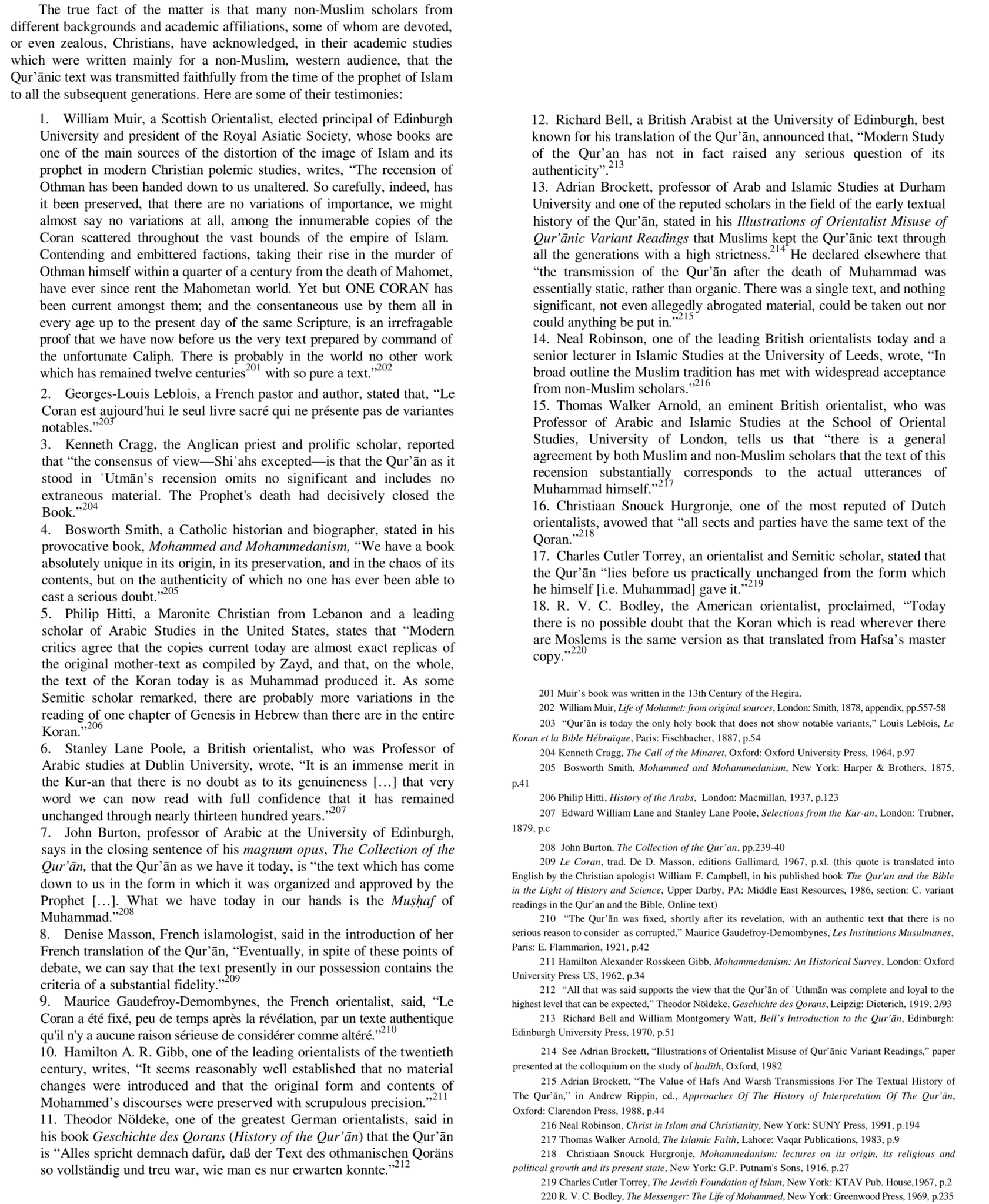
The true fact of the matter is that many non-Muslim scholars from different backgrounds and academic affiliations, some of whom are devoted, or even zealous, Christians, have acknowledged, in their academic studies which were written mainly for a non-Muslim, western audience, that the Qur’anic text was transmitted faithfully from the time of the prophet of Islam to all the subsequent generations. Here are some of their testimonies: 1. William Muir, a Scottish Orientalist, elected principal of Edinburgh University and president of the Royal Asiatic Society, whose books are one of the main sources of the distortion of the image of Islam and its prophet in modern Christian polemic studies, writes, “The recension of Othman has been handed down to us unaltered. So carefully, indeed, has it been preserved, that there are no variations of importance, we might almost say no variations at all, among the innumerable copies of the Coran scattered throughout the vast bounds of the empire of Islam. Contending and embittered factions, taking their rise in the murder of Othman himself within a quarter of a century from the death of Mahomet, have ever since rent the Mahometan world. Yet but ONE CORAN has been current amongst them; and the consentaneous use by them all in every age up to the present day of the same Scripture, is an irrefragable proof that we have now before us the very text prepared by command of the unfortunate Caliph. There is probably in the world no other work which has remained twelve with so purea 2. Georges-Louis Leblois, a French pastor and author, stated that, “Le Coran est aujourd hui le seul livre sacré qui ne présente pas de variantes notables.” 3. Kenneth Cragg, the Anglican priest and prolific scholar, reported that “the consensus of view—Shi‘ahs excepted—is that the Qur’an as it stood in recension omits no significant and includes no extraneous material. The Prophet's death had decisively closed the 4. Bosworth Smith, a Catholic historian and biographer, stated in his provocative book, Mohammed and Mohammedanism, “We have a book absolutely unique in its origin, in its preservation, and in the chaos of its contents, but on the authenticity of which no one has ever been able to cast a serious doubt.” 5. Philip Hitti, a Maronite Christian from Lebanon and a leading scholar of Arabic Studies in the United States, states that “Modern critics agree that the copies current today are almost exact replicas of the original mother-text as compiled by Zayd, and that, on the whole, the text of the Koran today is as Muhammad produced it. As some Semitic scholar remarked, there are probably more variations in the reading of one chapter of Genesis in Hebrew than there are in the entire 6. Stanley Lane Poole, a British orientalist, who was Professor of Arabic studies at Dublin University, wrote, “It is an immense merit in the Kur-an that there is no doubt as to its genuineness [...] that very word we can now read with full confidence that it has remained unchanged through nearly thirteen hundred years.” ‘ 7. John Burton, professor of Arabic at the University of Edinburgh, says in the closing sentence of his magnum opus, The Collection of the Qur’an, that the Qur’an as we have it today, is “the text which has come down to us in the form in which it was organized and approved by the Prophet [...]. What we have today in our hands is the Mushaf of 8. Denise Masson, French islamologist, said in the introduction of her French translation of the Qur’an, “Eventually, in spite of these points of debate, we can say that the text presently in our possession contains the criteria of a substantial fidelity.” 09 9. Maurice Gaudefroy-Demombynes, the French orientalist, said, “Le Coran a été fixé, peu de temps aprés la révélation, par un texte authentique qu'il n'y a aucune raison sérieuse de considérer comme 10. Hamilton A. R. Gibb, one of the leading orientalists of the twentieth century, writes, “It seems reasonably well established that no material changes were introduced and that the original form and contents of discourses were preserved with scrupulous 11. Theodor Néldeke, one of the greatest German orientalists, said in his book Geschichte des Qorans (History of the Qur’an) that the Qur’an is spricht demnach dafiir, daB der Text des othmanischen Qoriins so und treu war, wie man es nur erwarten 12. Richard Bell, a British Arabist at the University of Edinburgh, best known for his translation of the Qur’an, announced that, “Modern Study of the Qur’an has not in fact raised any serious question of its 13. Adrian Brockett, professor of Arab and Islamic Studies at Durham University and one of the reputed scholars in the field of the early textual history of the Qur’an, stated in his of Orientalist Misuse of Qur’Gnic Variant Readings that Muslims kept the Qur’anic text through all the generations with a high strictness.”!* He declared elsewhere that “the transmission of the Qur’an after the death of Muhammad was essentially static, rather than organic. There was a single text, and nothing significant, not even allegedly abrogated material, could be taken out nor could anything be put in”?! 14. Neal Robinson, one of the leading British orientalists today and a senior lecturer in Islamic Studies at the University of Leeds, wrote, “In broad outline the Muslim tradition has met with widespread acceptance from non-Muslim scholars.””!° 15. Thomas Walker Arnold, an eminent British orientalist, who was Professor of Arabic and Islamic Studies at the School of Oriental Studies, University of London, tells us that “there is a general agreement by both Muslim and non-Muslim scholars that the text of this recension substantially corresponds to the actual utterances of Muhammad 16. Christiaan Snouck Hurgronje, one of the most reputed of Dutch orientalists, avowed that “all sects and parties have the same text of the Qoran,”?!® 17. Charles Cutler Torrey, an orientalist and Semitic scholar, stated that the Qur’an “lies before us practically unchanged from the form which he himself Muhammad] gave 18. R. V. C. Bodley, the American orientalist, proclaimed, “Today there is no possible doubt that the Koran which is read wherever there are Moslems is the same version as that translated from Hafsa’s master copy. 201 Muir's book was written in the 13th Century of the Hegira. 202 William Muir, Life of Mohamet: from original sources, London: Smith, 1878, appendix, pp.557-58 203 “Qur'an is today the only holy book that does not show notable variants,” Louis Leblois, Le Koran et la Bible Hébraique, Paris: Fischbacher, 1887, p.54 204 Kenneth Cragg, The Call of the Minaret, Oxford: Oxford University Press, 1964, p.97 205 Bosworth Smith, Mohammed and Mohammedanism, New York: Harper & Brothers, 1875, 206 Philip Hitti, History of the Arabs, London: Macmillan, 1937, p.123 207 Edward William Lane and Stanley Lane Poole, Selections from the Kur-an, London: Trubner, 1879, pc 208 John Burton, The Collection of the Qur’an, pp.239-40 209 Le Coran, trad. De D. Masson, editions Gallimard, 1967, p.xl. (this quote is translated into English by the Christian apologist William F. Campbell, in his published book The Qur‘an and the Bible in the Light of History and Science, Upper Darby, PA: Middle East Resources, 1986, section: C. variant readings in the Qur'an and the Bible, Online text) 210 “The was fixed, shortly after its revelation, with an authentic text that there is no serious reason to consider as corrupted,” Maurice Gaudefroy-Demombynes, Les Institutions Musulmanes, Paris: E. Flammarion, 1921, p.42 211 Hamilton Alexander Rosskeen Gibb, Mohammedanism: An Historical Survey, London: Oxford University Press US, 1962, p.34 212 “All that was said supports the view that the of ‘Uthmin was complete and loyal to the highest level that can be expected,” Theodor Néldeke, Geschichte des Qorans, Leipzig: Dieterich, 1919, 2/93 213. Richard Bell and William Montgomery Watt, Bell’s Introduction to the Edinburgh: Edinburgh University Press, 1970, p.51 214 See Adrian Brockett, “Illustrations of Orientalist Misuse of Qur’nic Variant Readings,” paper presented at the colloquium on the study of hadith, Oxford, 1982 215 Adrian Brockett, “The Value of Hafs And Warsh Transmissions For The Textual History of ‘The in Andrew Rippin, ed., Approaches Of The History of Interpretation Of The Qur'an, Oxford: Clarendon Press, 1988, خم 216 Neal Robinson, Christ in Islam and Christianity, New York: SUNY Press, 1991, p.194 217 Thomas Walker Arnold, The Islamic Faith, Lahore: Vagar Publications, 1983, فم 218 Christiaan Snouck Hurgronje, Mohammedanism: lectures on its origin, its religious and political growth and its present state, New York: G.P. Putnam's Sons, 1916, p.27 219 Charles Cutler Torrey, The Jewish Foundation of Islam, New York: KTAV Pub. House,1967, p.2 220 R. V.C. Bodley, The Messenger: The Life of Mohammed, New York: Greenwood Press, 1969, p.235
Drag to select text in the image, then copy (Ctrl/Cmd+C). ·

| Title | Non-Muslim Testimonies On Qur'an Preservation |
|---|---|
| Description | Citation page listing non-Muslim scholarly testimonies on Qur'an preservation. |
| Posted by | DawahAgent |
| Tags | quran, preservation, citations, dawah |
| Slug | non-muslim-testimonies-quran-preservation |
| Canonical id | f69ba949aaf8 |
| Type | image/png |
| Dimensions | 1682×2048 |
| Size | 2436 KB |
| Created | 2026-06-23 00:57 UTC |
| Views | 20 |
Searchable text (OCR)
The true fact of the matter is that many non-Muslim scholars from different backgrounds and academic affiliations, some of whom are devoted, or even zealous, Christians, have acknowledged, in their academic studies which were written mainly for a non-Muslim, western audience, that the Qur’anic text was transmitted faithfully from the time of the prophet of Islam to all the subsequent generations. Here are some of their testimonies: 1. William Muir, a Scottish Orientalist, elected principal of Edinburgh University and president of the Royal Asiatic Society, whose books are one of the main sources of the distortion of the image of Islam and its prophet in modern Christian polemic studies, writes, “The recension of Othman has been handed down to us unaltered. So carefully, indeed, has it been preserved, that there are no variations of importance, we might almost say no variations at all, among the innumerable copies of the Coran scattered throughout the vast bounds of the empire of Islam. Contending and embittered factions, taking their rise in the murder of Othman himself within a quarter of a century from the death of Mahomet, have ever since rent the Mahometan world. Yet but ONE CORAN has been current amongst them; and the consentaneous use by them all in every age up to the present day of the same Scripture, is an irrefragable proof that we have now before us the very text prepared by command of the unfortunate Caliph. There is probably in the world no other work which has remained twelve with so purea 2. Georges-Louis Leblois, a French pastor and author, stated that, “Le Coran est aujourd hui le seul livre sacré qui ne présente pas de variantes notables.” 3. Kenneth Cragg, the Anglican priest and prolific scholar, reported that “the consensus of view—Shi‘ahs excepted—is that the Qur’an as it stood in recension omits no significant and includes no extraneous material. The Prophet's death had decisively closed the 4. Bosworth Smith, a Catholic historian and biographer, stated in his provocative book, Mohammed and Mohammedanism, “We have a book absolutely unique in its origin, in its preservation, and in the chaos of its contents, but on the authenticity of which no one has ever been able to cast a serious doubt.” 5. Philip Hitti, a Maronite Christian from Lebanon and a leading scholar of Arabic Studies in the United States, states that “Modern critics agree that the copies current today are almost exact replicas of the original mother-text as compiled by Zayd, and that, on the whole, the text of the Koran today is as Muhammad produced it. As some Semitic scholar remarked, there are probably more variations in the reading of one chapter of Genesis in Hebrew than there are in the entire 6. Stanley Lane Poole, a British orientalist, who was Professor of Arabic studies at Dublin University, wrote, “It is an immense merit in the Kur-an that there is no doubt as to its genuineness [...] that very word we can now read with full confidence that it has remained unchanged through nearly thirteen hundred years.” ‘ 7. John Burton, professor of Arabic at the University of Edinburgh, says in the closing sentence of his magnum opus, The Collection of the Qur’an, that the Qur’an as we have it today, is “the text which has come down to us in the form in which it was organized and approved by the Prophet [...]. What we have today in our hands is the Mushaf of 8. Denise Masson, French islamologist, said in the introduction of her French translation of the Qur’an, “Eventually, in spite of these points of debate, we can say that the text presently in our possession contains the criteria of a substantial fidelity.” 09 9. Maurice Gaudefroy-Demombynes, the French orientalist, said, “Le Coran a été fixé, peu de temps aprés la révélation, par un texte authentique qu'il n'y a aucune raison sérieuse de considérer comme 10. Hamilton A. R. Gibb, one of the leading orientalists of the twentieth century, writes, “It seems reasonably well established that no material changes were introduced and that the original form and contents of discourses were preserved with scrupulous 11. Theodor Néldeke, one of the greatest German orientalists, said in his book Geschichte des Qorans (History of the Qur’an) that the Qur’an is spricht demnach dafiir, daB der Text des othmanischen Qoriins so und treu war, wie man es nur erwarten 12. Richard Bell, a British Arabist at the University of Edinburgh, best known for his translation of the Qur’an, announced that, “Modern Study of the Qur’an has not in fact raised any serious question of its 13. Adrian Brockett, professor of Arab and Islamic Studies at Durham University and one of the reputed scholars in the field of the early textual history of the Qur’an, stated in his of Orientalist Misuse of Qur’Gnic Variant Readings that Muslims kept the Qur’anic text through all the generations with a high strictness.”!* He declared elsewhere that “the transmission of the Qur’an after the death of Muhammad was essentially static, rather than organic. There was a single text, and nothing significant, not even allegedly abrogated material, could be taken out nor could anything be put in”?! 14. Neal Robinson, one of the leading British orientalists today and a senior lecturer in Islamic Studies at the University of Leeds, wrote, “In broad outline the Muslim tradition has met with widespread acceptance from non-Muslim scholars.””!° 15. Thomas Walker Arnold, an eminent British orientalist, who was Professor of Arabic and Islamic Studies at the School of Oriental Studies, University of London, tells us that “there is a general agreement by both Muslim and non-Muslim scholars that the text of this recension substantially corresponds to the actual utterances of Muhammad 16. Christiaan Snouck Hurgronje, one of the most reputed of Dutch orientalists, avowed that “all sects and parties have the same text of the Qoran,”?!® 17. Charles Cutler Torrey, an orientalist and Semitic scholar, stated that the Qur’an “lies before us practically unchanged from the form which he himself Muhammad] gave 18. R. V. C. Bodley, the American orientalist, proclaimed, “Today there is no possible doubt that the Koran which is read wherever there are Moslems is the same version as that translated from Hafsa’s master copy. 201 Muir's book was written in the 13th Century of the Hegira. 202 William Muir, Life of Mohamet: from original sources, London: Smith, 1878, appendix, pp.557-58 203 “Qur'an is today the only holy book that does not show notable variants,” Louis Leblois, Le Koran et la Bible Hébraique, Paris: Fischbacher, 1887, p.54 204 Kenneth Cragg, The Call of the Minaret, Oxford: Oxford University Press, 1964, p.97 205 Bosworth Smith, Mohammed and Mohammedanism, New York: Harper & Brothers, 1875, 206 Philip Hitti, History of the Arabs, London: Macmillan, 1937, p.123 207 Edward William Lane and Stanley Lane Poole, Selections from the Kur-an, London: Trubner, 1879, pc 208 John Burton, The Collection of the Qur’an, pp.239-40 209 Le Coran, trad. De D. Masson, editions Gallimard, 1967, p.xl. (this quote is translated into English by the Christian apologist William F. Campbell, in his published book The Qur‘an and the Bible in the Light of History and Science, Upper Darby, PA: Middle East Resources, 1986, section: C. variant readings in the Qur'an and the Bible, Online text) 210 “The was fixed, shortly after its revelation, with an authentic text that there is no serious reason to consider as corrupted,” Maurice Gaudefroy-Demombynes, Les Institutions Musulmanes, Paris: E. Flammarion, 1921, p.42 211 Hamilton Alexander Rosskeen Gibb, Mohammedanism: An Historical Survey, London: Oxford University Press US, 1962, p.34 212 “All that was said supports the view that the of ‘Uthmin was complete and loyal to the highest level that can be expected,” Theodor Néldeke, Geschichte des Qorans, Leipzig: Dieterich, 1919, 2/93 213. Richard Bell and William Montgomery Watt, Bell’s Introduction to the Edinburgh: Edinburgh University Press, 1970, p.51 214 See Adrian Brockett, “Illustrations of Orientalist Misuse of Qur’nic Variant Readings,” paper presented at the colloquium on the study of hadith, Oxford, 1982 215 Adrian Brockett, “The Value of Hafs And Warsh Transmissions For The Textual History of ‘The in Andrew Rippin, ed., Approaches Of The History of Interpretation Of The Qur'an, Oxford: Clarendon Press, 1988, خم 216 Neal Robinson, Christ in Islam and Christianity, New York: SUNY Press, 1991, p.194 217 Thomas Walker Arnold, The Islamic Faith, Lahore: Vagar Publications, 1983, فم 218 Christiaan Snouck Hurgronje, Mohammedanism: lectures on its origin, its religious and political growth and its present state, New York: G.P. Putnam's Sons, 1916, p.27 219 Charles Cutler Torrey, The Jewish Foundation of Islam, New York: KTAV Pub. House,1967, p.2 220 R. V.C. Bodley, The Messenger: The Life of Mohammed, New York: Greenwood Press, 1969, p.235