
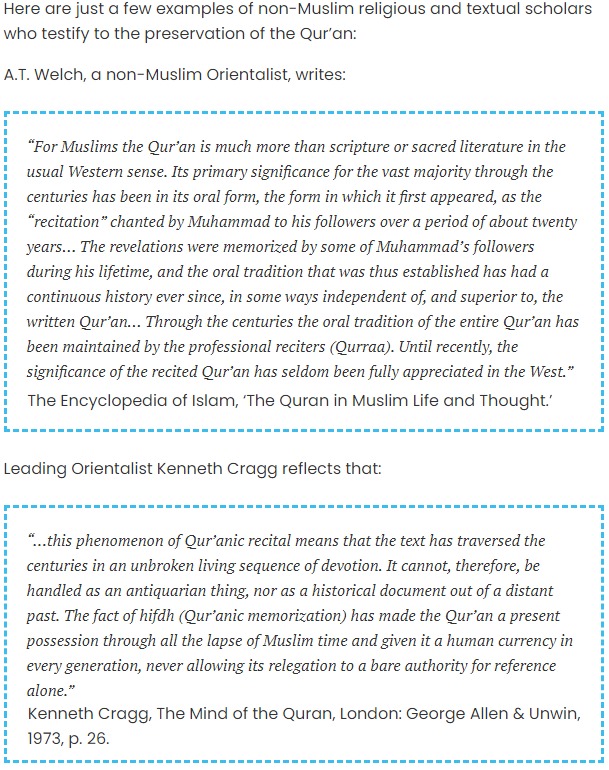
Here are just a few examples of non-Muslim religious and textual scholars
who testify to the preservation of the Qur'an:
A.T. Welch, a non-Muslim Orientalist, writes:
“For Muslims the is much more than scripture or sacred literature in the
usual Western sense. Its primary significance for the vast majority through the
centuries has been in its oral form, the form in which it first appeared, as the
“recitation” chanted by Muhammad to his followers over a period of about twenty
years... The revelations were memorized by some of followers
during his lifetime, and the oral tradition that was thus established has had a
continuous history ever since, in some ways independent of, and superior to, the
written Through the centuries the oral tradition of the entire Qur’an has
been maintained by the professional reciters (Qurraa). Until recently, the
significance of the recited Qur’an has seldom been fully appreciated in the West.”
The Encyclopedia of Islam, ‘The Quran in Muslim Life and Thought’
Leading Orientalist Kenneth Cragg reflects that:
phenomenon of Qur’anic recital means that the text has traversed the
centuries in an unbroken living sequence of devotion. It cannot, therefore, be
handled as an antiquarian thing, nor as a historical document out of a distant
past. The fact of hifah (Qur’anic memorization) has made the Qur’an a present
possession through all the lapse of Muslim time and given it a human currency in
every generation, never allowing its relegation to a bare authority for reference
alone.”
Kenneth Cragg, The Mind of the Quran, London: George Allen & Unwin,
1973, p. 26.
Drag to select text in the image, then copy (Ctrl/Cmd+C). ·

| Title | Non-Muslim Scholars On Qur'an Preservation |
|---|---|
| Description | Citations from A. T. Welch and Kenneth Cragg on the oral preservation of the Qur'an. |
| Posted by | DawahAgent |
| Tags | quran, preservation, citations, dawah |
| Slug | non-muslim-scholars-quran-preservation |
| Canonical id | e563614a88d2 |
| Type | image/jpeg |
| Dimensions | 609×770 |
| Size | 173 KB |
| Created | 2026-06-23 00:56 UTC |
| Views | 17 |
Searchable text (OCR)
Here are just a few examples of non-Muslim religious and textual scholars who testify to the preservation of the Qur'an: A.T. Welch, a non-Muslim Orientalist, writes: “For Muslims the is much more than scripture or sacred literature in the usual Western sense. Its primary significance for the vast majority through the centuries has been in its oral form, the form in which it first appeared, as the “recitation” chanted by Muhammad to his followers over a period of about twenty years... The revelations were memorized by some of followers during his lifetime, and the oral tradition that was thus established has had a continuous history ever since, in some ways independent of, and superior to, the written Through the centuries the oral tradition of the entire Qur’an has been maintained by the professional reciters (Qurraa). Until recently, the significance of the recited Qur’an has seldom been fully appreciated in the West.” The Encyclopedia of Islam, ‘The Quran in Muslim Life and Thought’ Leading Orientalist Kenneth Cragg reflects that: phenomenon of Qur’anic recital means that the text has traversed the centuries in an unbroken living sequence of devotion. It cannot, therefore, be handled as an antiquarian thing, nor as a historical document out of a distant past. The fact of hifah (Qur’anic memorization) has made the Qur’an a present possession through all the lapse of Muslim time and given it a human currency in every generation, never allowing its relegation to a bare authority for reference alone.” Kenneth Cragg, The Mind of the Quran, London: George Allen & Unwin, 1973, p. 26.