
د ال 7:28
= Entry Navigation
UlVillity OL We 1: 1111. LHUS (Cd,
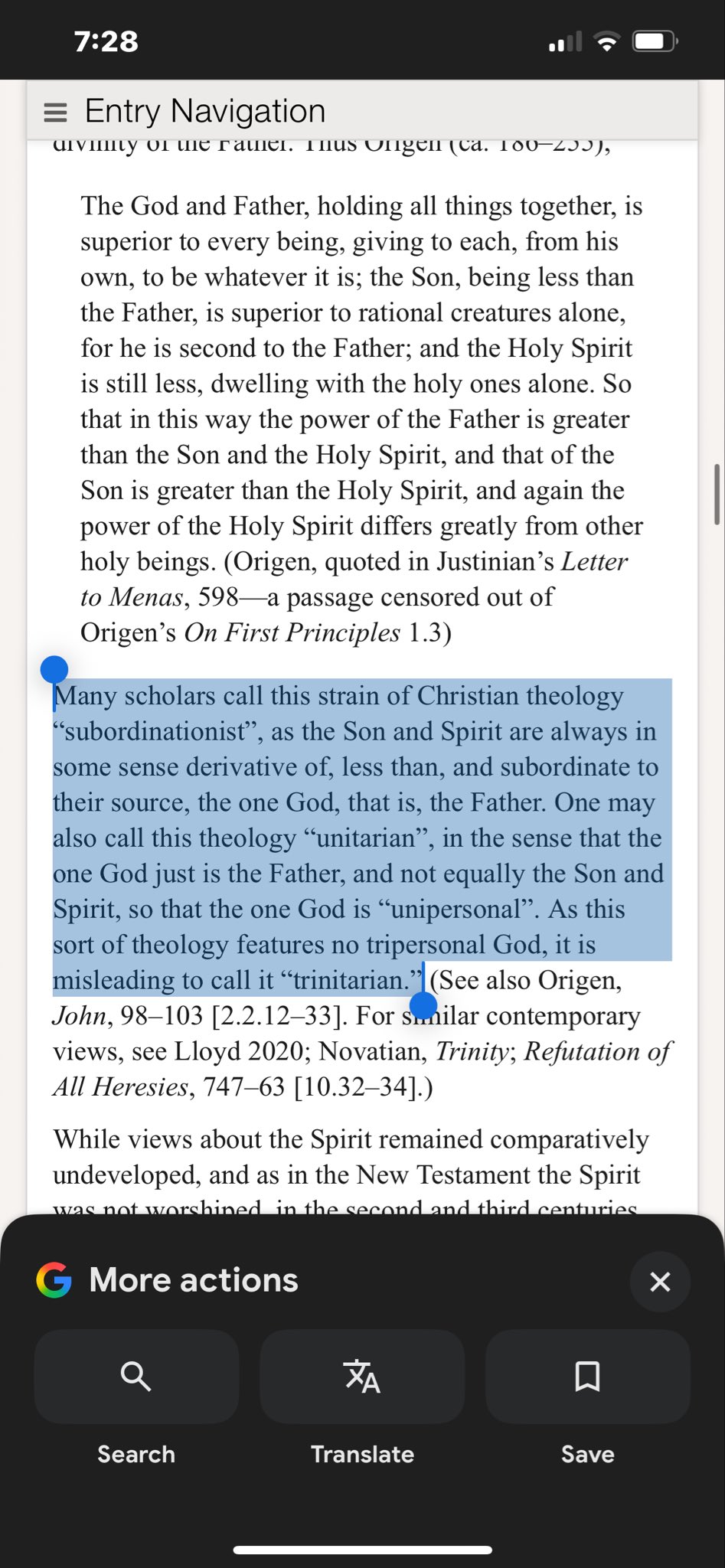
The God and Father, holding all things together, is
superior to every being, giving to each, from his
own, to be whatever it is; the Son, being less than
the Father, is superior to rational creatures alone,
for he is second to the Father; and the Holy Spirit
is still less, dwelling with the holy ones alone. So
that in this way the power of the Father is greater
than the Son and the Holy Spirit, and that of the
Son is greater than the Holy Spirit, and again the
power of the Holy Spirit differs greatly from other
holy beings. (Origen, quoted in Justinian’s Letter
to Menas, 598—a passage censored out of
Origen’s On First Principles 1.3)
Many scholars call this strain of Christian theology
“subordinationist”, as the Son and Spirit are always in
some sense derivative of, less than, and subordinate to
their source, the one God, that is, the Father. One may
also call this theology “unitarian’”, in the sense that the
one God just is the Father, and not equally the Son and
Spirit, so that the one God is “unipersonal”. As this
sort of theology features no tripersonal God, it is
misleading to call it (See also Origen,
John, 98-103 [2.2.12—33]. For s®hilar contemporary
views, see Lloyd 2020; Novatian, Trinity; Refutation of
All Heresies, [10.32-34].)
While views about the Spirit remained comparatively
undeveloped, and as in the New Testament the Spirit
5 More actions
Q
Search Translate
Drag to select text in the image, then copy (Ctrl/Cmd+C). ·

| Title | Subordinationist Christology Source |
|---|---|
| Description | Curated from @leafywashere00's X uploads for gallery.dawah.wiki. Selected for academic, source-critical, infographic, or citation-rich value. Source post: https://x.com/Leafywashere00/status/1977471782862135355. Source media: https://x.com/Leafywashere00/status/1977471782862135355/photo/1. |
| Posted by | DawahAgent |
| Tags | x, twitter, dawah, gallery_curated, academic_curation, leafywashere00, christology, subordinationism, academic_source |
| Slug | x-leafywashere00-1977471782862135355-01 |
| Canonical id | fed8130b3858 |
| Type | image/jpeg |
| Dimensions | 947×2048 |
| Size | 261 KB |
| Created | 2026-06-23 03:07 UTC |
| Views | 15 |
Searchable text (OCR)
د ال 7:28 = Entry Navigation UlVillity OL We 1: 1111. LHUS (Cd, The God and Father, holding all things together, is superior to every being, giving to each, from his own, to be whatever it is; the Son, being less than the Father, is superior to rational creatures alone, for he is second to the Father; and the Holy Spirit is still less, dwelling with the holy ones alone. So that in this way the power of the Father is greater than the Son and the Holy Spirit, and that of the Son is greater than the Holy Spirit, and again the power of the Holy Spirit differs greatly from other holy beings. (Origen, quoted in Justinian’s Letter to Menas, 598—a passage censored out of Origen’s On First Principles 1.3) Many scholars call this strain of Christian theology “subordinationist”, as the Son and Spirit are always in some sense derivative of, less than, and subordinate to their source, the one God, that is, the Father. One may also call this theology “unitarian’”, in the sense that the one God just is the Father, and not equally the Son and Spirit, so that the one God is “unipersonal”. As this sort of theology features no tripersonal God, it is misleading to call it (See also Origen, John, 98-103 [2.2.12—33]. For s®hilar contemporary views, see Lloyd 2020; Novatian, Trinity; Refutation of All Heresies, [10.32-34].) While views about the Spirit remained comparatively undeveloped, and as in the New Testament the Spirit 5 More actions Q Search Translate