
Radak on Psalms 2:12
RG. Finch, London, 1919
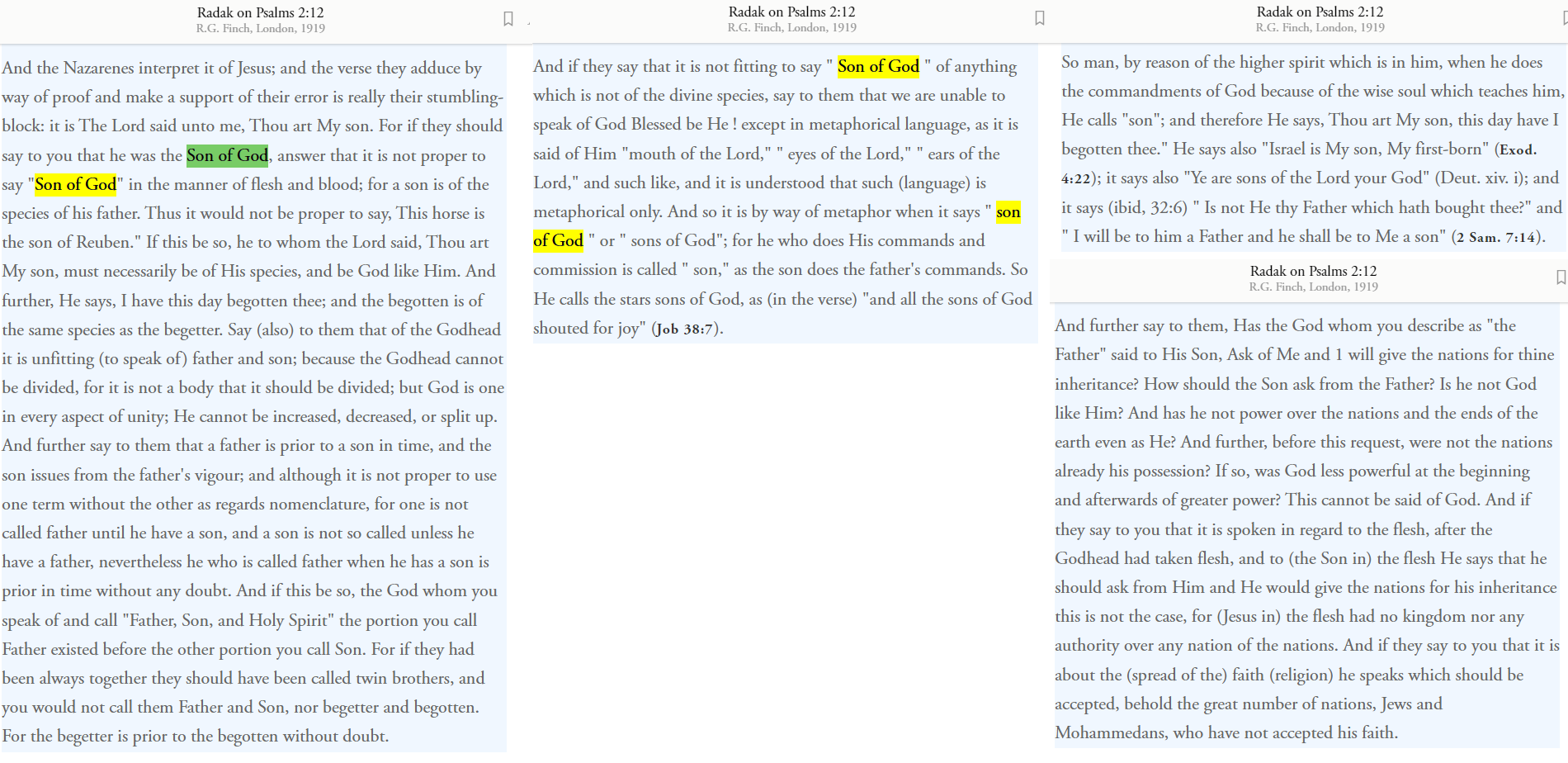
And the Nazarenes interpret it of Jesus; and the verse they adduce by
way of proof and make a support of their error is really their stumbling-
block: it is The Lord said unto me, Thou art My son. For if they should
say to you that he was the Son of God, answer that it is not proper to
say "Son of God" in the manner of flesh and blood; for a son is of the
species of his father. Thus it would not be proper to say, This horse is
the son of Reuben.” If this be so, he to whom the Lord said, Thou art
My son, must necessarily be of His species, and be God like Him. And
further, He says, I have this day begotten thee; and the begotten is of
the same species as the begetter. Say (also) to them that of the Godhead
it is unfitting (to speak of) father and son; because the Godhead cannot
be divided, for it is not a body that it should be divided; but God is one
in every aspect of unity; He cannot be increased, decreased, or split up.
And further say to them that a father is prior to a son in time, and the
son issues from the father's vigour; and although it is not proper to use
one term without the other as regards nomenclature, for one is not
called father until he have a son, and a son is not so called unless he
have a father, nevertheless he who is called father when he has a son is
prior in time without any doubt. And if this be so, the God whom you
speak of and call "Father, Son, and Holy Spirit" the portion you call
Father existed before the other portion you call Son. For if they had
been always together they should have been called twin brothers, and
you would not call them Father and Son, nor begetter and begotten.
For the begetter is prior to the begotten without doubt.
Radak on Psalms 2:12
RG. Finch, London, 1919
And if they say that it is not fitting to say " Son of God " of anything
which is not of the divine species, say to them that we are unable to
speak of God Blessed be He ! except in metaphorical language, as it is
said of Him "mouth of the Lord," " eyes of the Lord,” " ears of the
Lord,” and such like, and it is understood that such (language) is
metaphorical only. And so it is by way of metaphor when it says " son
" or " sons of God"; for he who does His commands and
commission is called " son," as the son does the father's commands. So
He calls the stars sons of God, as (in the verse) "and all the sons of God
shouted for joy" (Job 38:7).
Radak on Psalms 2:12 I
RG. Finch, London, 1919
So man, by reason of the higher spirit which is in him, when he does
the commandments of God because of the wise soul which teaches him,
He calls "son"; and therefore He says, Thou art My son, this day have I
begotten thee.” He says also "Israel is My son, My first-born” (Exod.
4:22); it says also "Ye are sons of the Lord your God" (Deut. xiv. i); and
it says (ibid, 32:6) " Is not He thy Father which hath bought thee?” and
" [will be to him a Father and he shall be to Me a son” (2 Sam. 7:14).
Radak on Psalms 2:12 8
RG. Finch, London, 1919
And further say to them, Has the God whom you describe as "the
Father" said to His Son, Ask of Me and 1 will give the nations for thine
inheritance? How should the Son ask from the Father? Is he not God
like Him? And has he not power over the nations and the ends of the
earth even as He? And further, before this request, were not the nations
already his possession? If so, was God less powerful at the beginning
and afterwards of greater power? This cannot be said of God. And if
they say to you that it is spoken in regard to the flesh, after the
Godhead had taken flesh, and to (the Son in) the flesh He says that he
should ask from Him and He would give the nations for his inheritance
this is not the case, for (Jesus in) the flesh had no kingdom nor any
authority over any nation of the nations. And if they say to you that it is
about the (spread of the) faith (religion) he speaks which should be
accepted, behold the great number of nations, Jews and
Mohammedans, who have not accepted his faith.
Drag to select text in the image, then copy (Ctrl/Cmd+C). ·

| Title | Jews on sons of God |
|---|---|
| Description | |
| Posted by | theIslampill |
| Tags | dawah, jews, judaism, son of god, sons of god |
| Slug | — (none yet) |
| Canonical id | fa56ba5c4468 |
| Type | image/png |
| Dimensions | 1900×924 |
| Size | 256 KB |
| Created | 2026-06-10 08:12 UTC |
| Views | 20 |
Searchable text (OCR)
Radak on Psalms 2:12 RG. Finch, London, 1919 And the Nazarenes interpret it of Jesus; and the verse they adduce by way of proof and make a support of their error is really their stumbling- block: it is The Lord said unto me, Thou art My son. For if they should say to you that he was the Son of God, answer that it is not proper to say "Son of God" in the manner of flesh and blood; for a son is of the species of his father. Thus it would not be proper to say, This horse is the son of Reuben.” If this be so, he to whom the Lord said, Thou art My son, must necessarily be of His species, and be God like Him. And further, He says, I have this day begotten thee; and the begotten is of the same species as the begetter. Say (also) to them that of the Godhead it is unfitting (to speak of) father and son; because the Godhead cannot be divided, for it is not a body that it should be divided; but God is one in every aspect of unity; He cannot be increased, decreased, or split up. And further say to them that a father is prior to a son in time, and the son issues from the father's vigour; and although it is not proper to use one term without the other as regards nomenclature, for one is not called father until he have a son, and a son is not so called unless he have a father, nevertheless he who is called father when he has a son is prior in time without any doubt. And if this be so, the God whom you speak of and call "Father, Son, and Holy Spirit" the portion you call Father existed before the other portion you call Son. For if they had been always together they should have been called twin brothers, and you would not call them Father and Son, nor begetter and begotten. For the begetter is prior to the begotten without doubt. Radak on Psalms 2:12 RG. Finch, London, 1919 And if they say that it is not fitting to say " Son of God " of anything which is not of the divine species, say to them that we are unable to speak of God Blessed be He ! except in metaphorical language, as it is said of Him "mouth of the Lord," " eyes of the Lord,” " ears of the Lord,” and such like, and it is understood that such (language) is metaphorical only. And so it is by way of metaphor when it says " son " or " sons of God"; for he who does His commands and commission is called " son," as the son does the father's commands. So He calls the stars sons of God, as (in the verse) "and all the sons of God shouted for joy" (Job 38:7). Radak on Psalms 2:12 I RG. Finch, London, 1919 So man, by reason of the higher spirit which is in him, when he does the commandments of God because of the wise soul which teaches him, He calls "son"; and therefore He says, Thou art My son, this day have I begotten thee.” He says also "Israel is My son, My first-born” (Exod. 4:22); it says also "Ye are sons of the Lord your God" (Deut. xiv. i); and it says (ibid, 32:6) " Is not He thy Father which hath bought thee?” and " [will be to him a Father and he shall be to Me a son” (2 Sam. 7:14). Radak on Psalms 2:12 8 RG. Finch, London, 1919 And further say to them, Has the God whom you describe as "the Father" said to His Son, Ask of Me and 1 will give the nations for thine inheritance? How should the Son ask from the Father? Is he not God like Him? And has he not power over the nations and the ends of the earth even as He? And further, before this request, were not the nations already his possession? If so, was God less powerful at the beginning and afterwards of greater power? This cannot be said of God. And if they say to you that it is spoken in regard to the flesh, after the Godhead had taken flesh, and to (the Son in) the flesh He says that he should ask from Him and He would give the nations for his inheritance this is not the case, for (Jesus in) the flesh had no kingdom nor any authority over any nation of the nations. And if they say to you that it is about the (spread of the) faith (religion) he speaks which should be accepted, behold the great number of nations, Jews and Mohammedans, who have not accepted his faith.