
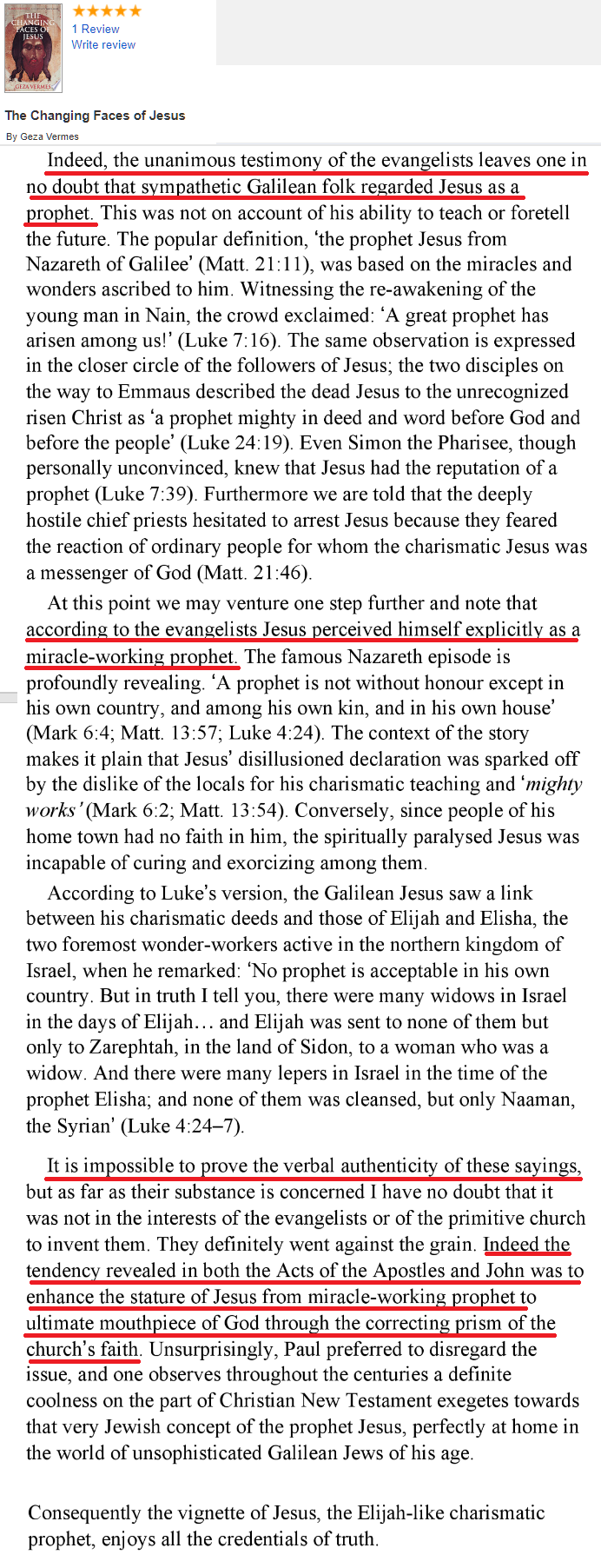
١ |‘ 1 Review Write review ‘The Changing Faces of Jesus Geza Indeed, the unanimous testimony of the evangelists leaves one in no doubt that sympathetic Galilean folk regarded Jesus as a prophet. This was not on account of his ability to teach or foretell the future. The popular definition, ‘the prophet Jesus from Nazareth of Galilee’ (Matt. 21:11), was based on the miracles and wonders ascribed to him. Witnessing the re-awakening of the young man in Nain, the crowd exclaimed: ‘A great prophet has arisen among us!’ (Luke 7:16). The same observation is expressed in the closer circle of the followers of Jesus; the two disciples on the way to Emmaus described the dead Jesus to the unrecognized risen Christ as ‘a prophet mighty in deed and word before God and before the people’ (Luke 24:19). Even Simon the Pharisee, though personally unconvinced, knew that Jesus had the reputation of a prophet (Luke 7:39). Furthermore we are told that the deeply hostile chief priests hesitated to arrest Jesus because they feared the reaction of ordinary people for whom the charismatic Jesus was a messenger of God (Matt. 21:46). At this point we may venture one step further and note that according to the evangelists Jesus perceived himself explicitly as a miracle-working prophet. The famous Nazareth episode is profoundly revealing. ‘A prophet is not without honour except in his own country, and among his own kin, and in his own house’ (Mark 6:4; Matt. 13:57; Luke 4:24). The context of the story makes it plain that Jesus’ disillusioned declaration was sparked off by the dislike of the locals for his charismatic teaching and ‘mighty works’ (Mark 6:2; Matt. 13:54). Conversely, since people of his home town had no faith in him, the spiritually paralysed Jesus was incapable of curing and exorcizing among them According to Luke’s version, the Galilean Jesus saw a link between his charismatic deeds and those of Elijah and Elisha, the two foremost wonder-workers active in the northern kingdom of Israel, when he remarked: ‘No prophet is acceptable in his own country. But in truth I tell you, there were many widows in Israel in the days of Elijah... and Elijah was sent to none of them but only to Zarephtah, in the land of Sidon, to a woman who was a widow. And there were many lepers in Israel in the time of the prophet Elisha; and none of them was cleansed, but only Naaman, the Syrian’ (Luke 4:24-7). It is impossible to prove the verbal authenticity of these sayings, but as far as their substance is concerned I have no doubt that it was not in the interests of the evangelists or of the primitive church to invent them. They definitely went against the grain. Indeed the tendency revealed in both the Acts of the Apostles and John was to enhance the stature of Jesus from miracle-working prophet to ultimate mouthpiece of God through the correcting prism of the church’s faith. Unsurprisingly, Paul preferred to disregard the issue, and one observes throughout the centuries a definite coolness on the part of Christian New Testament exegetes towards that very Jewish concept of the prophet Jesus, perfectly at home in the world of unsophisticated Galilean Jews of his age. Consequently the vignette of Jesus, the Elijah-like charismatic prophet, enjoys all the credentials of truth.
Drag to select text in the image, then copy (Ctrl/Cmd+C). ·

| Title | Regarded as a Prophet |
|---|---|
| Description | |
| Posted by | theIslampill |
| Tags | dawah, new testament, christianity |
| Slug | — (none yet) |
| Canonical id | ef77e97c662e |
| Type | image/png |
| Dimensions | 692×1804 |
| Size | 489 KB |
| Created | 2026-06-10 09:39 UTC |
| Views | 130 |
Searchable text (OCR)
١ |‘ 1 Review Write review ‘The Changing Faces of Jesus Geza Indeed, the unanimous testimony of the evangelists leaves one in no doubt that sympathetic Galilean folk regarded Jesus as a prophet. This was not on account of his ability to teach or foretell the future. The popular definition, ‘the prophet Jesus from Nazareth of Galilee’ (Matt. 21:11), was based on the miracles and wonders ascribed to him. Witnessing the re-awakening of the young man in Nain, the crowd exclaimed: ‘A great prophet has arisen among us!’ (Luke 7:16). The same observation is expressed in the closer circle of the followers of Jesus; the two disciples on the way to Emmaus described the dead Jesus to the unrecognized risen Christ as ‘a prophet mighty in deed and word before God and before the people’ (Luke 24:19). Even Simon the Pharisee, though personally unconvinced, knew that Jesus had the reputation of a prophet (Luke 7:39). Furthermore we are told that the deeply hostile chief priests hesitated to arrest Jesus because they feared the reaction of ordinary people for whom the charismatic Jesus was a messenger of God (Matt. 21:46). At this point we may venture one step further and note that according to the evangelists Jesus perceived himself explicitly as a miracle-working prophet. The famous Nazareth episode is profoundly revealing. ‘A prophet is not without honour except in his own country, and among his own kin, and in his own house’ (Mark 6:4; Matt. 13:57; Luke 4:24). The context of the story makes it plain that Jesus’ disillusioned declaration was sparked off by the dislike of the locals for his charismatic teaching and ‘mighty works’ (Mark 6:2; Matt. 13:54). Conversely, since people of his home town had no faith in him, the spiritually paralysed Jesus was incapable of curing and exorcizing among them According to Luke’s version, the Galilean Jesus saw a link between his charismatic deeds and those of Elijah and Elisha, the two foremost wonder-workers active in the northern kingdom of Israel, when he remarked: ‘No prophet is acceptable in his own country. But in truth I tell you, there were many widows in Israel in the days of Elijah... and Elijah was sent to none of them but only to Zarephtah, in the land of Sidon, to a woman who was a widow. And there were many lepers in Israel in the time of the prophet Elisha; and none of them was cleansed, but only Naaman, the Syrian’ (Luke 4:24-7). It is impossible to prove the verbal authenticity of these sayings, but as far as their substance is concerned I have no doubt that it was not in the interests of the evangelists or of the primitive church to invent them. They definitely went against the grain. Indeed the tendency revealed in both the Acts of the Apostles and John was to enhance the stature of Jesus from miracle-working prophet to ultimate mouthpiece of God through the correcting prism of the church’s faith. Unsurprisingly, Paul preferred to disregard the issue, and one observes throughout the centuries a definite coolness on the part of Christian New Testament exegetes towards that very Jewish concept of the prophet Jesus, perfectly at home in the world of unsophisticated Galilean Jews of his age. Consequently the vignette of Jesus, the Elijah-like charismatic prophet, enjoys all the credentials of truth.