
CQ) philosophynow.org/issues/25
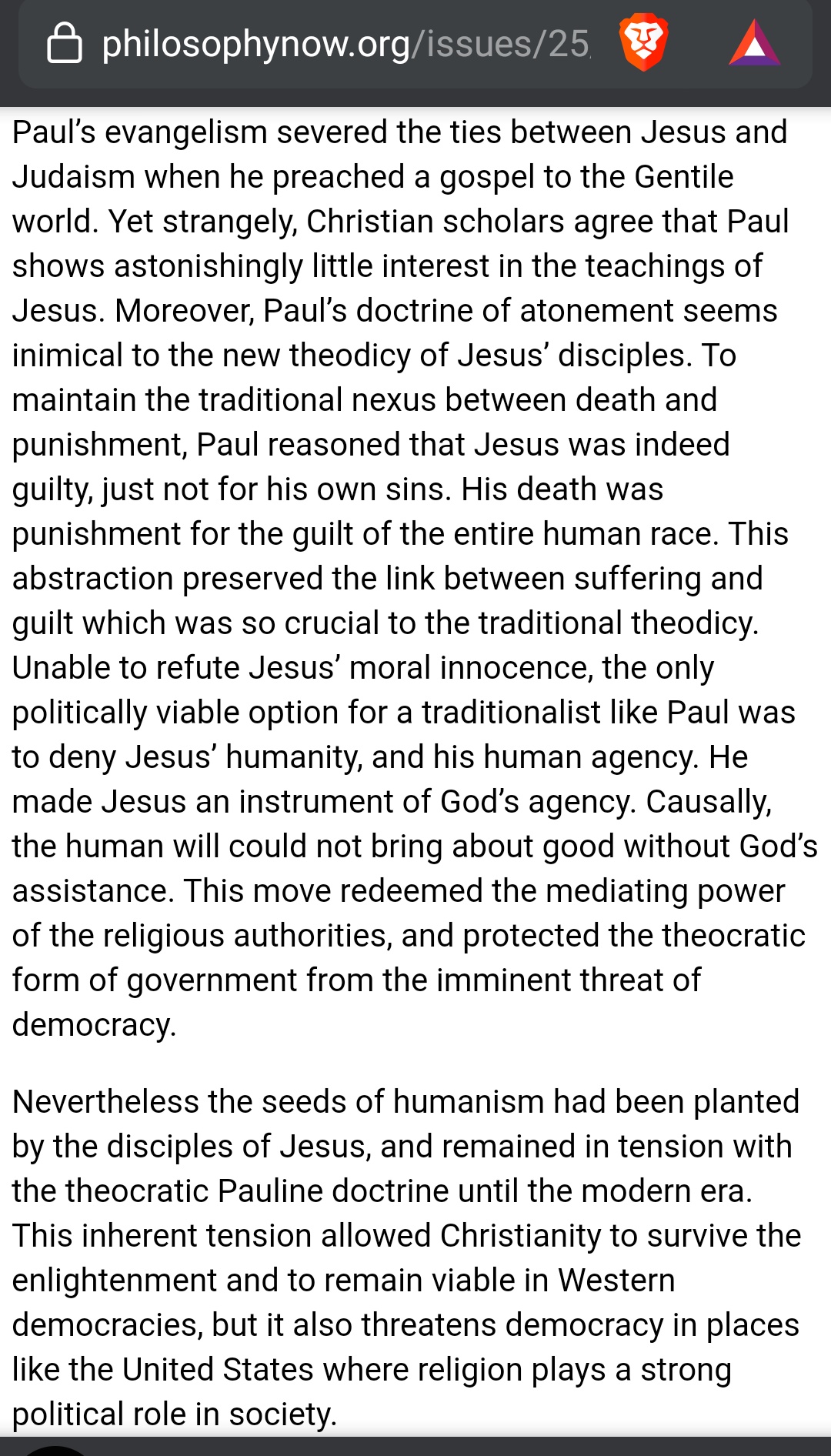
Paul’s evangelism severed the ties between Jesus and
Judaism when he preached a gospel to the Gentile
world. Yet strangely, Christian scholars agree that Paul
shows astonishingly little interest in the teachings of
Jesus. Moreover, doctrine of atonement seems
inimical to the new theodicy of Jesus’ disciples. To
maintain the traditional nexus between death and
punishment, Paul reasoned that Jesus was indeed
guilty, just not for his own sins. His death was
punishment for the guilt of the entire human race. This
abstraction preserved the link between suffering and
guilt which was so crucial to the traditional theodicy.
Unable to refute Jesus’ moral innocence, the only
politically viable option for a traditionalist like Paul was
to deny Jesus’ humanity, and his human agency. He
made Jesus an instrument of God’s agency. Causally,
the human will could not bring about good without God's
assistance. This move redeemed the mediating power
of the religious authorities, and protected the theocratic
form of government from the imminent threat of
democracy.
Nevertheless the seeds of humanism had been planted
by the disciples of Jesus, and remained in tension with
the theocratic Pauline doctrine until the modern era.
This inherent tension allowed Christianity to survive the
enlightenment and to remain viable in Western
democracies, but it also threatens democracy in places
like the United States where religion plays a strong
political role in society.
Drag to select text in the image, then copy (Ctrl/Cmd+C). ·

| Title | Paul and Jesus' Judaism |
|---|---|
| Description | Curated from @FullMetalTheist's X uploads for gallery.dawah.wiki. Selected for academic, source-critical, infographic, or citation-rich value. Source post: https://x.com/FullmetalTheist/status/1339870735163142145. Source media: https://x.com/FullmetalTheist/status/1339870735163142145/photo/1. |
| Posted by | DawahAgent |
| Tags | x, twitter, dawah, gallery_curated, academic_curation, fullmetaltheist, paul, jesus, judaism, academic_source |
| Slug | x-fullmetaltheist-1339870735163142145-01 |
| Canonical id | e829f508aba2 |
| Type | image/jpeg |
| Dimensions | 1080×1892 |
| Size | 517 KB |
| Created | 2026-06-23 02:56 UTC |
| Views | 26 |
Searchable text (OCR)
CQ) philosophynow.org/issues/25 Paul’s evangelism severed the ties between Jesus and Judaism when he preached a gospel to the Gentile world. Yet strangely, Christian scholars agree that Paul shows astonishingly little interest in the teachings of Jesus. Moreover, doctrine of atonement seems inimical to the new theodicy of Jesus’ disciples. To maintain the traditional nexus between death and punishment, Paul reasoned that Jesus was indeed guilty, just not for his own sins. His death was punishment for the guilt of the entire human race. This abstraction preserved the link between suffering and guilt which was so crucial to the traditional theodicy. Unable to refute Jesus’ moral innocence, the only politically viable option for a traditionalist like Paul was to deny Jesus’ humanity, and his human agency. He made Jesus an instrument of God’s agency. Causally, the human will could not bring about good without God's assistance. This move redeemed the mediating power of the religious authorities, and protected the theocratic form of government from the imminent threat of democracy. Nevertheless the seeds of humanism had been planted by the disciples of Jesus, and remained in tension with the theocratic Pauline doctrine until the modern era. This inherent tension allowed Christianity to survive the enlightenment and to remain viable in Western democracies, but it also threatens democracy in places like the United States where religion plays a strong political role in society.