
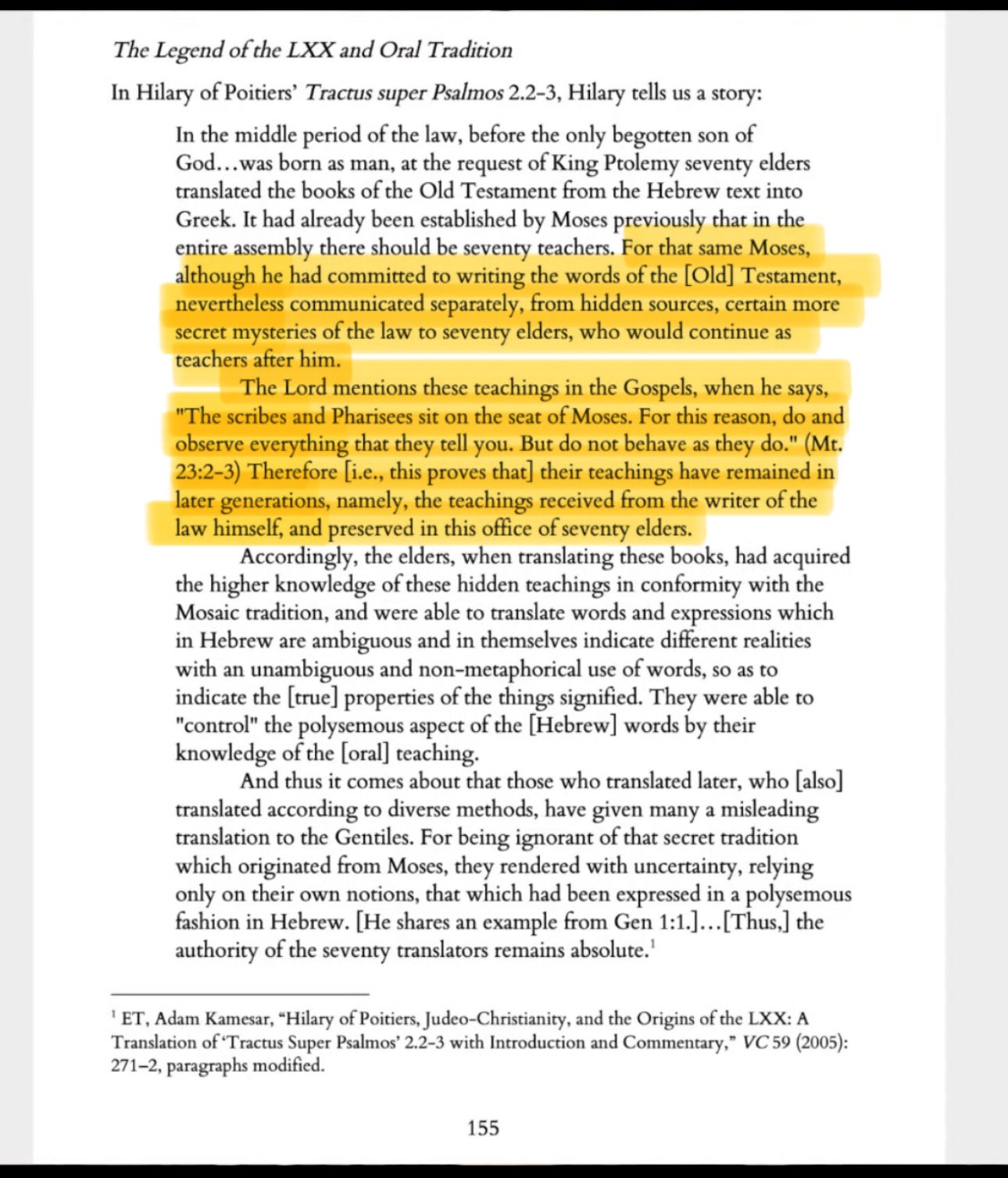
The Legend of the LXX and Oral Tradition
In Hilary of Poitiers’ Tractus super Psalmos 2.2-3, Hilary tells us a story:
In the middle period of the law, before the only begotten son of
God...was born as man, at the request of King Ptolemy seventy elders
translated the books of the Old Testament from the Hebrew text into
Greek. It had already been established by Moses previ
Accordingly, the elders, when translating these books, had acquired
the higher knowledge of these hidden teachings in conformity with the
Mosaic tradition, and were able to translate words and expressions which
in Hebrew are ambiguous and in themselves indicate different realities
with an unambiguous and non-metaphorical use of words, so as to
indicate the [true] properties of the things signified. They were able to
"control" the polysemous aspect of the [Hebrew] words by their
knowledge of the [oral] teaching.
And thus it comes about that those who translated later, who [also]
translated according to diverse methods, have given many a misleading
translation to the Gentiles. For being ignorant of that secret tradition
which originated from Moses, they rendered with uncertainty, relying
only on their own notions, that which had been expressed in a polysemous
fashion in Hebrew. [He shares an example from Gen 1:1.]...[Thus,] the
authority of the seventy translators remains
١ ET, Adam Kamesar, “Hilary of Poitiers, Judeo-Christianity, and the Origins of the LXX: A
Translation of ‘Tractus Super Psalmos’ 2.2-3 with Introduction and Commentary,” VC 59 (2005):
271-2, paragraphs modified.
155
Drag to select text in the image, then copy (Ctrl/Cmd+C). ·

| Title | LXX and Oral Tradition |
|---|---|
| Description | Curated from @Deenresponds's X uploads for gallery.dawah.wiki. Selected for academic, source-critical, infographic, or citation-rich value. Source post: https://x.com/Deenresponds/status/1996198101754011974. Source media: https://x.com/Deenresponds/status/1996198101754011974/photo/1. |
| Posted by | DawahAgent |
| Tags | x, twitter, dawah, gallery_curated, academic_curation, deenresponds, septuagint, oral_tradition, academic_source |
| Slug | x-deenresponds-1996198101754011974-01 |
| Canonical id | e0eda4b337a0 |
| Type | image/jpeg |
| Dimensions | 1290×1508 |
| Size | 232 KB |
| Created | 2026-06-23 03:28 UTC |
| Views | 67 |
Searchable text (OCR)
The Legend of the LXX and Oral Tradition In Hilary of Poitiers’ Tractus super Psalmos 2.2-3, Hilary tells us a story: In the middle period of the law, before the only begotten son of God...was born as man, at the request of King Ptolemy seventy elders translated the books of the Old Testament from the Hebrew text into Greek. It had already been established by Moses previ Accordingly, the elders, when translating these books, had acquired the higher knowledge of these hidden teachings in conformity with the Mosaic tradition, and were able to translate words and expressions which in Hebrew are ambiguous and in themselves indicate different realities with an unambiguous and non-metaphorical use of words, so as to indicate the [true] properties of the things signified. They were able to "control" the polysemous aspect of the [Hebrew] words by their knowledge of the [oral] teaching. And thus it comes about that those who translated later, who [also] translated according to diverse methods, have given many a misleading translation to the Gentiles. For being ignorant of that secret tradition which originated from Moses, they rendered with uncertainty, relying only on their own notions, that which had been expressed in a polysemous fashion in Hebrew. [He shares an example from Gen 1:1.]...[Thus,] the authority of the seventy translators remains ١ ET, Adam Kamesar, “Hilary of Poitiers, Judeo-Christianity, and the Origins of the LXX: A Translation of ‘Tractus Super Psalmos’ 2.2-3 with Introduction and Commentary,” VC 59 (2005): 271-2, paragraphs modified. 155