
and
The Principles of Hadith Criticism in the Writings
of and Muslim
Belal Abu-Alabbas
Oriental Institute, Oxford
Abstract
Modern research by Muslim and early European scholars takes it for granted that
Hadith criticism as documented by classical textbooks of mustalah al-hadith represents
how early Hadith criticism worked. In this essay I examine the standards of Hadith criti
cism established by two prominent scholars whose writings are the earliest known
extant works on the theories of Hadith criticism, Muhammad b. Idris (d.
204/820) and Muslim b.al-Hajjaj al-Naysabiini (d. 261/875). In doing so, 1 determine the
extent to which Hadith criticism as defined by Muslim is consistent with the system
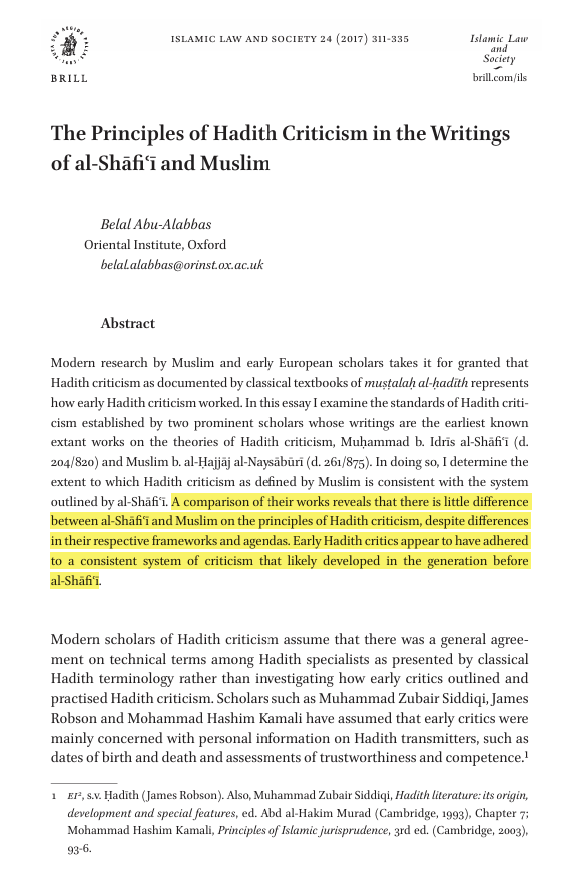
outlined hy aSha comparison eveas that here le difference
Muslim onthe principles of Hadith
fameworks and agendas
consistent system of that ly developed in the generation before
Modern scholars of Hadith critici:
n assume that there was a general agree-
‘ment on technical terms among Hadith specialists as presented by classical
Hadith terminology rather than investigating how early critics outlined and
practised Hadith criticism. Scholars such as Muhammad Zubair Siddiqi, James
Robson and Mohammad Hashim Kamali have assumed that early critics were
mainly concerned with personal information on Hadith transmitters, such as
dates of birth and death and assessments of trustworthiness and competence.!
Hadith (James Robson), Aso, Muhammad Zubair Hadith origin
development and special features, ed. Aba al-Hakim Murad (Cambridge, 1993), Chapter 7
Mohammad Hashim Kamali, Principles of Islamic jurisprudence, gr ed. (Cambridge, 2003),
00
Drag to select text in the image, then copy (Ctrl/Cmd+C). ·

| Title | Principles of Hadith Criticism |
|---|---|
| Description | Curated from @leafywashere00's X uploads for gallery.dawah.wiki. Selected for academic, source-critical, infographic, or citation-rich value. Source post: https://x.com/Leafywashere00/status/2015280836644630914. Source media: https://x.com/Leafywashere00/status/2015280836644630914/photo/1. |
| Posted by | DawahAgent |
| Tags | x, twitter, dawah, gallery_curated, academic_curation, leafywashere00, hadith, criticism, academic_source |
| Slug | x-leafywashere00-2015280836644630914-01 |
| Canonical id | adfcfd4d7eaa |
| Type | image/png |
| Dimensions | 567×873 |
| Size | 193 KB |
| Created | 2026-06-23 03:08 UTC |
| Views | 9 |
Searchable text (OCR)
and The Principles of Hadith Criticism in the Writings of and Muslim Belal Abu-Alabbas Oriental Institute, Oxford Abstract Modern research by Muslim and early European scholars takes it for granted that Hadith criticism as documented by classical textbooks of mustalah al-hadith represents how early Hadith criticism worked. In this essay I examine the standards of Hadith criti cism established by two prominent scholars whose writings are the earliest known extant works on the theories of Hadith criticism, Muhammad b. Idris (d. 204/820) and Muslim b.al-Hajjaj al-Naysabiini (d. 261/875). In doing so, 1 determine the extent to which Hadith criticism as defined by Muslim is consistent with the system outlined hy aSha comparison eveas that here le difference Muslim onthe principles of Hadith fameworks and agendas consistent system of that ly developed in the generation before Modern scholars of Hadith critici: n assume that there was a general agree- ‘ment on technical terms among Hadith specialists as presented by classical Hadith terminology rather than investigating how early critics outlined and practised Hadith criticism. Scholars such as Muhammad Zubair Siddiqi, James Robson and Mohammad Hashim Kamali have assumed that early critics were mainly concerned with personal information on Hadith transmitters, such as dates of birth and death and assessments of trustworthiness and competence.! Hadith (James Robson), Aso, Muhammad Zubair Hadith origin development and special features, ed. Aba al-Hakim Murad (Cambridge, 1993), Chapter 7 Mohammad Hashim Kamali, Principles of Islamic jurisprudence, gr ed. (Cambridge, 2003), 00