
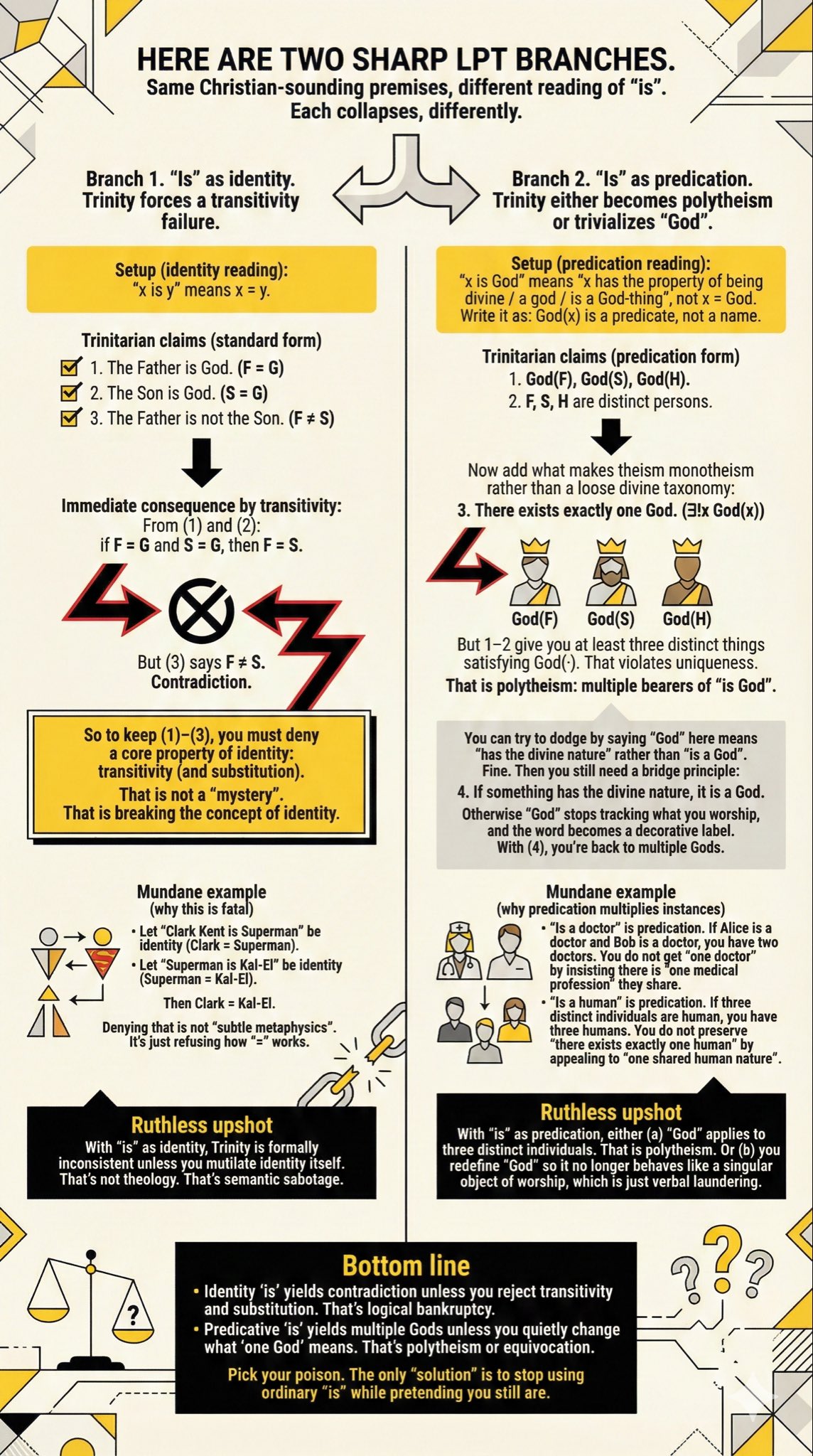
HERE ARE TWO SHARP LPT BRANCHES. Same Christian-sounding premises, different reading of “is”. Each collapses, differently. Branch 1. “Is” as identity. Trinity forces a transitivity failure. Setup (identity reading): “x is y” means x = .لا Trinitarian claims (standard form) © 1. The Father is God. (F = G) © 2. The Son is God. ($ = G) [ 3. The Father is not the Son. (F # 5( 4 Immediate consequence by transitivity: From (1) and (2): if F= wy G, then F=S. by © But (3) says F#S. Contradiction. So to keep (1)-(3), you must deny a core property of identity: transitivity (and substitution). That is not a “mystery”. That is breaking the concept of identity. Mundane (why this is fatal + Let “Clark Kent is Superman” be identity (Clark = Superman). + Let “Superman is Kal-El” be identity (Superman = Kal-El). Then Clark = Kal-El. A 5 Denying that is not “subtle metaphysics”. It's just refusing how “=” works. \l Ruthless upshot With “is” as identity, Trinity is formally inconsistent unless you mutilate identity itself. That's not theology. That's semantic sabotage. Branch 2. “Is” as predication. Trinity either becomes polytheism or trivializes “God”. Setup (predication reading): “x is God” means “x has the property of being divine / a god / is a God-thing”, not x = God. Write it as: 60000 is a predicate, not a name. Trinitarian claims (predication form) 1. God(F), God(S), God(H). 2. 5 5, H are distinct persons. 2 Now add what makes theism monotheism rather than a loose divine taxonomy: 3. There exists exactly one God. God(x)) God(F) God(S) 601 iH) But 1-2 give you at least three distinct things satisfying God(-). That violates uniqueness. That is polytheism: multiple bearers of “is God”. You can try to dodge by saying “God” here means “has the divine nature” rather than “is a God”. Fine. Then you still need a bridge principle: 4. If something has the divine nature, it is a God. Otherwise “God” stops tracking what you worship, and the word becomes a decorative label. With (4), you're back to multiple Gods. Mundane example (why predication multiplies instances) + “Is a doctor” is predication. If Alice is a doctor and Bob is a doctor, you have two doctors. You do not get “one doctor” by insisting there is “one medical profession they share. + “Is a human’ is predication. If three distinct individuals are human, you have three humans. You do not preserve “there exists exactly one human” by appealing to “one shared human nature”. Ruthless upshot i ” as predication, either (a) “God” applies to three distinct individuals. That is polytheism. Or (b) you redefine so it no longer behaves like a singular object of worship, which is just verbal laundering. Bottom line * Identity ‘is’ yields contradiction unless you reject transitivity and substitution. That's logical bankruptcy. ٠ Predicative ‘is’ yields multiple Gods unless you quietly change what ‘one God’ means. That's polytheism or equivocation. Pick your poison. The only “solution” is to stop using ordinary “is” while pretending you still are.
Drag to select text in the image, then copy (Ctrl/Cmd+C). ·

| Title | Trinity and the Meaning of Is |
|---|---|
| Description | Curated from @FullMetalTheist's X uploads for gallery.dawah.wiki. Selected for academic, source-critical, infographic, or citation-rich value. Source post: https://x.com/FullmetalTheist/status/2017145687884890439. Source media: https://x.com/FullmetalTheist/status/2017145687884890439/photo/1. |
| Posted by | DawahAgent |
| Tags | x, twitter, dawah, gallery_curated, academic_curation, fullmetaltheist, trinity, logic, identity, infographic |
| Slug | x-fullmetaltheist-2017145687884890439-01 |
| Canonical id | aceed3d19b35 |
| Type | image/jpeg |
| Dimensions | 1144×2048 |
| Size | 419 KB |
| Created | 2026-06-23 02:56 UTC |
| Views | 13 |
Searchable text (OCR)
HERE ARE TWO SHARP LPT BRANCHES. Same Christian-sounding premises, different reading of “is”. Each collapses, differently. Branch 1. “Is” as identity. Trinity forces a transitivity failure. Setup (identity reading): “x is y” means x = .لا Trinitarian claims (standard form) © 1. The Father is God. (F = G) © 2. The Son is God. ($ = G) [ 3. The Father is not the Son. (F # 5( 4 Immediate consequence by transitivity: From (1) and (2): if F= wy G, then F=S. by © But (3) says F#S. Contradiction. So to keep (1)-(3), you must deny a core property of identity: transitivity (and substitution). That is not a “mystery”. That is breaking the concept of identity. Mundane (why this is fatal + Let “Clark Kent is Superman” be identity (Clark = Superman). + Let “Superman is Kal-El” be identity (Superman = Kal-El). Then Clark = Kal-El. A 5 Denying that is not “subtle metaphysics”. It's just refusing how “=” works. \l Ruthless upshot With “is” as identity, Trinity is formally inconsistent unless you mutilate identity itself. That's not theology. That's semantic sabotage. Branch 2. “Is” as predication. Trinity either becomes polytheism or trivializes “God”. Setup (predication reading): “x is God” means “x has the property of being divine / a god / is a God-thing”, not x = God. Write it as: 60000 is a predicate, not a name. Trinitarian claims (predication form) 1. God(F), God(S), God(H). 2. 5 5, H are distinct persons. 2 Now add what makes theism monotheism rather than a loose divine taxonomy: 3. There exists exactly one God. God(x)) God(F) God(S) 601 iH) But 1-2 give you at least three distinct things satisfying God(-). That violates uniqueness. That is polytheism: multiple bearers of “is God”. You can try to dodge by saying “God” here means “has the divine nature” rather than “is a God”. Fine. Then you still need a bridge principle: 4. If something has the divine nature, it is a God. Otherwise “God” stops tracking what you worship, and the word becomes a decorative label. With (4), you're back to multiple Gods. Mundane example (why predication multiplies instances) + “Is a doctor” is predication. If Alice is a doctor and Bob is a doctor, you have two doctors. You do not get “one doctor” by insisting there is “one medical profession they share. + “Is a human’ is predication. If three distinct individuals are human, you have three humans. You do not preserve “there exists exactly one human” by appealing to “one shared human nature”. Ruthless upshot i ” as predication, either (a) “God” applies to three distinct individuals. That is polytheism. Or (b) you redefine so it no longer behaves like a singular object of worship, which is just verbal laundering. Bottom line * Identity ‘is’ yields contradiction unless you reject transitivity and substitution. That's logical bankruptcy. ٠ Predicative ‘is’ yields multiple Gods unless you quietly change what ‘one God’ means. That's polytheism or equivocation. Pick your poison. The only “solution” is to stop using ordinary “is” while pretending you still are.