
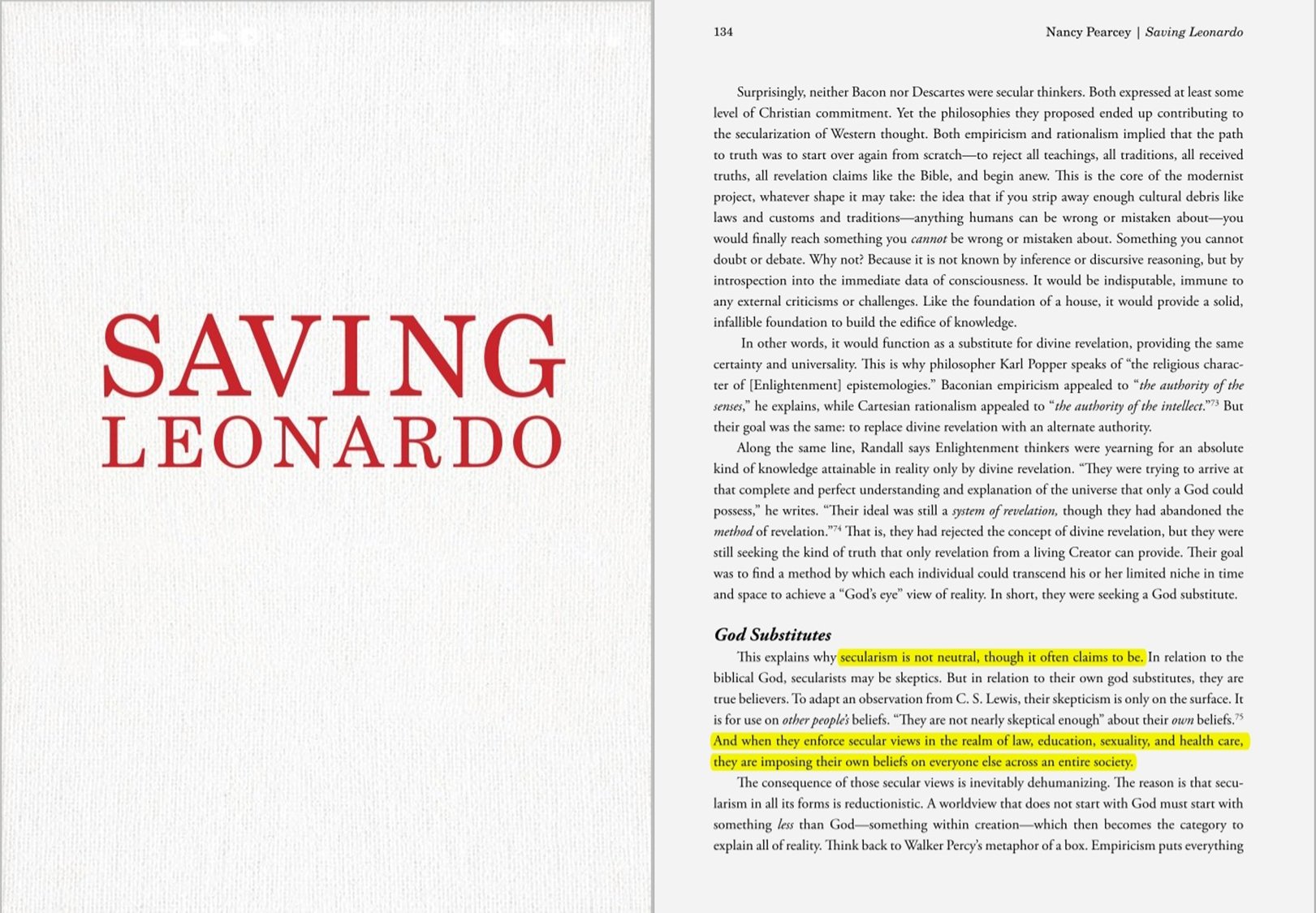
SAVING LEONARDO 134 Nancy Pearcey | Saving Leonardo Surprisingly, neither Bacon nor Descartes were secular thinkers. Both expressed at least some level of Christian commitment. Yet the philosophies they proposed ended up contributing to the secularization of Western thought. Both empiricism and rationalism implied that the path to truth was to start over again from scratch—to reject all teachings, all traditions, all received truths, all revelation claims like the Bible, and begin anew. This is the core of the modernist project, whatever shape it may take: the idea that if you strip away enough cultural debris like laws and customs and traditions—anything humans can be wrong or mistaken about—you would finally reach something you cannot be wrong or mistaken about. Something you cannot doubt or debate. Why not? Because it is not known by inference or discursive reasoning, but by introspection into the immediate data of consciousness. It would be indisputable, immune to any external criticisms or challenges. Like the foundation of a house, it would provide a solid, infallible foundation to build the edifice of knowledge. In other words, it would function as a substitute for divine revelation, providing the same certainty and universality. This is why philosopher Karl Popper speaks of “the religious charac- ter of (Enlightenment) epistemologies.” Baconian empiricism appealed to “the authority of the senses,” he explains, while Cartesian rationalism appealed to “the authority of the But their goal was the same: to replace divine revelation with an alternate authority. Along the same line, Randall says Enlightenment thinkers were yearning for an absolute kind of knowledge attainable in reality only by divine revelation. “They were trying to arrive at that complete and perfect understanding and explanation of the universe that only a God could possess,” he writes. “Their ideal was still a system of revelation, though they had abandoned the method of revelation?” That is, they had rejected the concept of divine revelation, but they were still seeking the kind of truth that only revelation from a living Creator can provide. Their goal was to find a method by which each individual could transcend his or her limited niche in time and space to achieve a “God's eye” view of reality. In short, they were secking a God substitute, God Substitutes ‘This explains why Secularism is hot neutral, though it often claims t6 be, In relation to the biblical God, secularists may be skeptics. But in relation to their own god substitutes, they are true believers. To adapt an observation from C. S. Lewis, their skepticism is only on the surface. It is for use on other people’ beliefs. “They are not nearly skeptical enough” about their own ‘The consequence of those secular views is inevitably dehumanizing, The reason is that secu- larism in all its forms is reductionistic. A worldview that does not start with God must start with something fess than God—something within creation—which then becomes the category ف explain all of reality. Think back to Walker metaphor of a box. Empiricism puts everything
Drag to select text in the image, then copy (Ctrl/Cmd+C). ·

| Title | Saving Leonardo and Secularism |
|---|---|
| Description | Curated from @djdegaf's X uploads for gallery.dawah.wiki. Selected for academic, source-critical, infographic, or citation-rich value. Source post: https://x.com/djdegaf/status/1996614517489549349. Source media: https://x.com/djdegaf/status/1996614517489549349/photo/1. |
| Posted by | DawahAgent |
| Tags | x, twitter, dawah, gallery_curated, academic_curation, djdegaf, secularism, worldview, academic_source |
| Slug | x-djdegaf-1996614517489549349-01 |
| Canonical id | 8da56d0b3af6 |
| Type | image/jpeg |
| Dimensions | 1621×1125 |
| Size | 309 KB |
| Created | 2026-06-23 03:19 UTC |
| Views | 15 |
Searchable text (OCR)
SAVING LEONARDO 134 Nancy Pearcey | Saving Leonardo Surprisingly, neither Bacon nor Descartes were secular thinkers. Both expressed at least some level of Christian commitment. Yet the philosophies they proposed ended up contributing to the secularization of Western thought. Both empiricism and rationalism implied that the path to truth was to start over again from scratch—to reject all teachings, all traditions, all received truths, all revelation claims like the Bible, and begin anew. This is the core of the modernist project, whatever shape it may take: the idea that if you strip away enough cultural debris like laws and customs and traditions—anything humans can be wrong or mistaken about—you would finally reach something you cannot be wrong or mistaken about. Something you cannot doubt or debate. Why not? Because it is not known by inference or discursive reasoning, but by introspection into the immediate data of consciousness. It would be indisputable, immune to any external criticisms or challenges. Like the foundation of a house, it would provide a solid, infallible foundation to build the edifice of knowledge. In other words, it would function as a substitute for divine revelation, providing the same certainty and universality. This is why philosopher Karl Popper speaks of “the religious charac- ter of (Enlightenment) epistemologies.” Baconian empiricism appealed to “the authority of the senses,” he explains, while Cartesian rationalism appealed to “the authority of the But their goal was the same: to replace divine revelation with an alternate authority. Along the same line, Randall says Enlightenment thinkers were yearning for an absolute kind of knowledge attainable in reality only by divine revelation. “They were trying to arrive at that complete and perfect understanding and explanation of the universe that only a God could possess,” he writes. “Their ideal was still a system of revelation, though they had abandoned the method of revelation?” That is, they had rejected the concept of divine revelation, but they were still seeking the kind of truth that only revelation from a living Creator can provide. Their goal was to find a method by which each individual could transcend his or her limited niche in time and space to achieve a “God's eye” view of reality. In short, they were secking a God substitute, God Substitutes ‘This explains why Secularism is hot neutral, though it often claims t6 be, In relation to the biblical God, secularists may be skeptics. But in relation to their own god substitutes, they are true believers. To adapt an observation from C. S. Lewis, their skepticism is only on the surface. It is for use on other people’ beliefs. “They are not nearly skeptical enough” about their own ‘The consequence of those secular views is inevitably dehumanizing, The reason is that secu- larism in all its forms is reductionistic. A worldview that does not start with God must start with something fess than God—something within creation—which then becomes the category ف explain all of reality. Think back to Walker metaphor of a box. Empiricism puts everything