
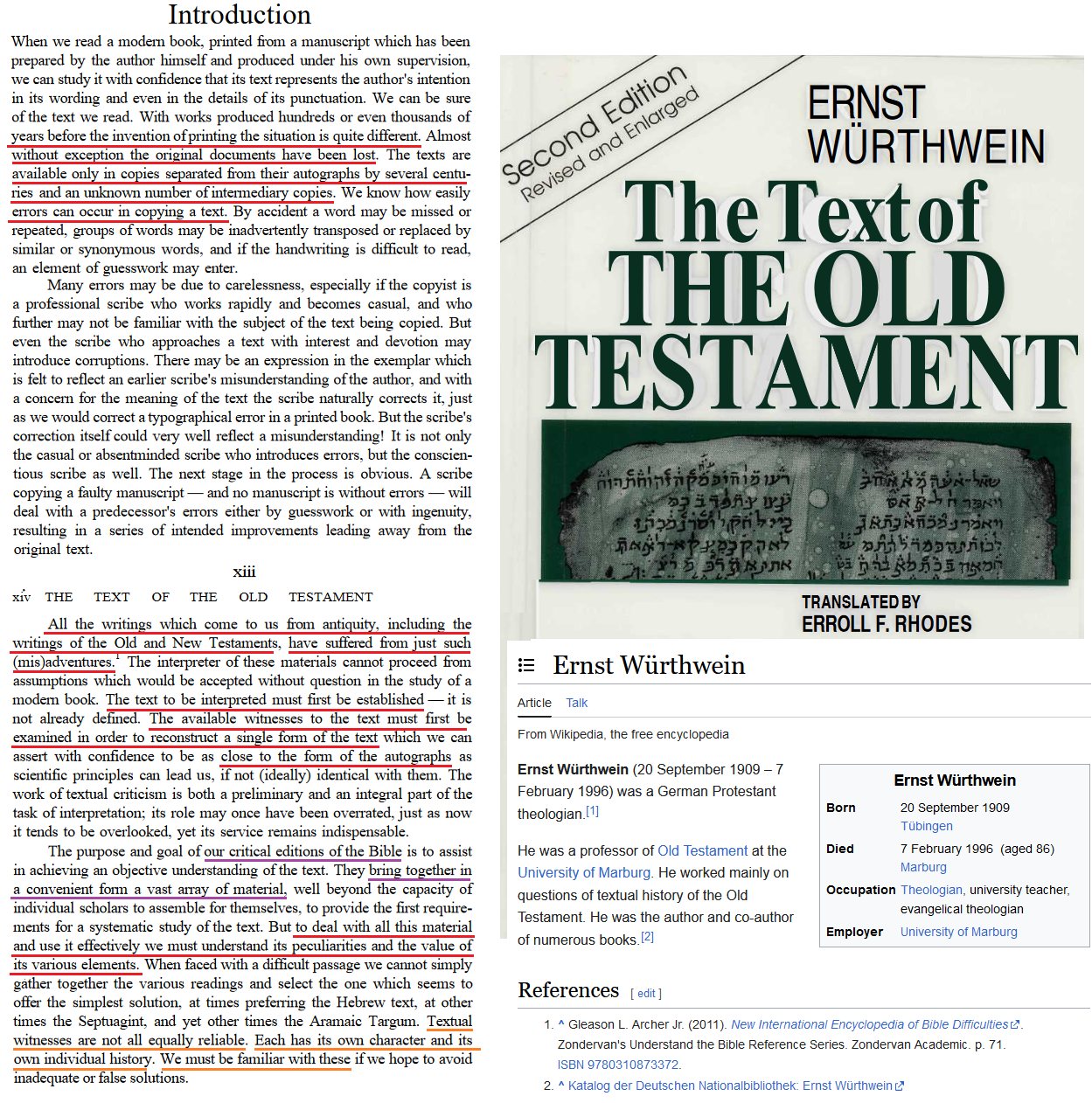
Introduction When we read a modem book, printed from a manuscript which has been prepared by the author himself and produced under his own supervision, we can study it with confidence that its text represents the author's intention in its wording and even in the details of its punctuation. We can be sure of the text we read. With works produced hundreds or even thousands of years before the invention of printing the situation is quite different. Almost the original documents have been lost. The texts are available only in copies separated from their autographs by several centu- ries_and an unknown number of intermediary copies. We know how easily errors can occur in copying a text. By accident a word may be missed or Tepeated, groups of words may be inadvertently transposed or replaced by similar or synonymous words, and if the handwriting is difficult to read, an element of guesswork may enter. Many errors may be due to carelessness, especially if the copyist is a professional scribe who works rapidly and becomes casual, and who further may not be familiar with the subject of the text being copied. But even the scribe who approaches a text with interest and devotion may introduce corruptions. There may be an expression in the exemplar which is felt to reflect an earlier scribe's misunderstanding of the author, and with aconcem for the meaning of the text the scribe naturally corrects it, just as we would correct a typographical error in a printed book. But the scribe's correction itself could very well reflect a misunderstanding! It is not only the casual or absentminded scribe who introduces errors, but the conscien- tious scribe as well. The next stage in the process is obvious. A scribe copying a faulty manuscript — and no manuscript is without errors — will deal with a predecessor's errors either by guesswork or with ingenuity, resulting in a series of intended improvements leading away from the original text. xiv THE TEXT OF THE OLD TESTAMENT All which including the writings of the Old and New Testaments, have suffered from just such (mis)adventures.” The interpreter of these materials cannot proceed from assumptions which would be accepted without question in the study of a modem book. The text to be interpreted must first be established — it is not already defined. The available witnesses to the text must first be examined in order to single form of the text which we can assert with confidence to be as close to the form of the autographs as scientific principles can lead us, if not (ideally) identical with them. The work of textual criticism is both a preliminary and an integral part of the task of interpretation; its role may once have been overrated, just as now it tends to be overlooked, yet its service remains indispensable. The purpose and goal of our critical editions of the Bible is to assist in achieving an objective understanding of the text. They bring together in a convenient form a vast array of material, well beyond the capacity of individual scholars to assemble for themselves, to provide the first require- ments for a systematic study of the text. But to deal with all this material and use it effectively we must understand its peculiarities and the value of its various elements. When faced with a difficult passage we cannot simply gather together the various readings and select the one which seems to offer the simplest solution, at times preferring the Hebrew text, at other times the Septuagint, and yet other times the Aramaic Targum. Textual not all equally reliable. Each has its own character and its own individual history. We must be familiar with these if we hope to avoid inadequate orfalse 0000000 TRANSLATED BY ERROLL F. RHODES Ernst Wiirthwein Article Talk From Wikipedia, the free encyclopedia Ernst Wiirthwein (20 September 1909 - 7 Ernst Wirthwein February 1996) was a German Protestant Born 20 September 1909 Tubingen He was a professor of Old Testament at the Died 7 February 1996 (aged 86) University of Marburg. He worked mainly on Marburg questions of textual history of the Old Occupation Theologian, university teacher, Testament. He was the author and co-author of numerous Employer University of Marburg References ] 1. * Gleason L. Archer Jr. (2011). New International Encyclopedia of Bible Difficulties قا Zondervan's Understand the Bible Reference Series. Zondervan Academic. p. 71 ISBN 9780310873372 2. + Katalog der Deutschen Nationalbibliothek: Ernst اق
Drag to select text in the image, then copy (Ctrl/Cmd+C). ·

| Title | Textual Criticism |
|---|---|
| Description | |
| Posted by | theIslampill |
| Tags | dawah, textual criticism |
| Slug | — (none yet) |
| Canonical id | 85ed2c9cca3a |
| Type | image/jpeg |
| Dimensions | 1249×1262 |
| Size | 501 KB |
| Created | 2026-06-10 08:15 UTC |
| Views | 15 |
Searchable text (OCR)
Introduction When we read a modem book, printed from a manuscript which has been prepared by the author himself and produced under his own supervision, we can study it with confidence that its text represents the author's intention in its wording and even in the details of its punctuation. We can be sure of the text we read. With works produced hundreds or even thousands of years before the invention of printing the situation is quite different. Almost the original documents have been lost. The texts are available only in copies separated from their autographs by several centu- ries_and an unknown number of intermediary copies. We know how easily errors can occur in copying a text. By accident a word may be missed or Tepeated, groups of words may be inadvertently transposed or replaced by similar or synonymous words, and if the handwriting is difficult to read, an element of guesswork may enter. Many errors may be due to carelessness, especially if the copyist is a professional scribe who works rapidly and becomes casual, and who further may not be familiar with the subject of the text being copied. But even the scribe who approaches a text with interest and devotion may introduce corruptions. There may be an expression in the exemplar which is felt to reflect an earlier scribe's misunderstanding of the author, and with aconcem for the meaning of the text the scribe naturally corrects it, just as we would correct a typographical error in a printed book. But the scribe's correction itself could very well reflect a misunderstanding! It is not only the casual or absentminded scribe who introduces errors, but the conscien- tious scribe as well. The next stage in the process is obvious. A scribe copying a faulty manuscript — and no manuscript is without errors — will deal with a predecessor's errors either by guesswork or with ingenuity, resulting in a series of intended improvements leading away from the original text. xiv THE TEXT OF THE OLD TESTAMENT All which including the writings of the Old and New Testaments, have suffered from just such (mis)adventures.” The interpreter of these materials cannot proceed from assumptions which would be accepted without question in the study of a modem book. The text to be interpreted must first be established — it is not already defined. The available witnesses to the text must first be examined in order to single form of the text which we can assert with confidence to be as close to the form of the autographs as scientific principles can lead us, if not (ideally) identical with them. The work of textual criticism is both a preliminary and an integral part of the task of interpretation; its role may once have been overrated, just as now it tends to be overlooked, yet its service remains indispensable. The purpose and goal of our critical editions of the Bible is to assist in achieving an objective understanding of the text. They bring together in a convenient form a vast array of material, well beyond the capacity of individual scholars to assemble for themselves, to provide the first require- ments for a systematic study of the text. But to deal with all this material and use it effectively we must understand its peculiarities and the value of its various elements. When faced with a difficult passage we cannot simply gather together the various readings and select the one which seems to offer the simplest solution, at times preferring the Hebrew text, at other times the Septuagint, and yet other times the Aramaic Targum. Textual not all equally reliable. Each has its own character and its own individual history. We must be familiar with these if we hope to avoid inadequate orfalse 0000000 TRANSLATED BY ERROLL F. RHODES Ernst Wiirthwein Article Talk From Wikipedia, the free encyclopedia Ernst Wiirthwein (20 September 1909 - 7 Ernst Wirthwein February 1996) was a German Protestant Born 20 September 1909 Tubingen He was a professor of Old Testament at the Died 7 February 1996 (aged 86) University of Marburg. He worked mainly on Marburg questions of textual history of the Old Occupation Theologian, university teacher, Testament. He was the author and co-author of numerous Employer University of Marburg References ] 1. * Gleason L. Archer Jr. (2011). New International Encyclopedia of Bible Difficulties قا Zondervan's Understand the Bible Reference Series. Zondervan Academic. p. 71 ISBN 9780310873372 2. + Katalog der Deutschen Nationalbibliothek: Ernst اق