
EDITOR'S INTRODUCTION
impossible), whereas Muslim scholars start from the assumption that any given
hadit is verifiable, authentic, and genuine, from which point they proceed to weed
out what they consider to be the Forgeries. This has certainly been the Islamic
approach at least from the time of the great canonical collections in the third/ninth
century, but it may conceivably antedate the production of these textual collections
by about a century or so (though this statement is far from uncontroversial)
The history of this Western has now been written from two con-
trasting perspectives, from the Muslim viewpoint by Muhammad (and
Abdal Hakim Murad) (1993) and by Harald Motzki (2004) and the interested
reader is referred to these works. Central is the figure of Joseph Schacht whose
Origins of Muhammadan Jurispruclence appeared in 1950 (Oxford) and met lar-
gely with approbation and acclaim. To begin with, dissentient voices in the West
and the Islamic world went largely unnoticed, their formulations either ignored or
ostracized to the periphery.
‘The formulations of Nabia Abbott and Fuat Sezgin did much to redress the
balance, though (as we have seen) GS has established beyond a shadow of doubt
the untenability of Sezgin’s theories and the need to modify Schacht’s
very historical theor-es aside (concerning the irrelevance of legal
hadit, for example, for the early Islamic community), his principal legacy to
the study of the hadit is formal, the identification of a mechanism whereby the
common link (CL) in a chain of authorities (isndd) is established for a set of
variants of any given By the 1980s, this formal mechanism had been
further developed by G. J. H. Juyrboll, and it is this revised technique of
analysis which GS adopts and combines with appraisals of the text of the sayings
(ie. in Muslim terminology the main), with a view not to confirming Schacht’s
(untenable) theories but rather to attempt to trace the processes whereby the hadit
developed, by concentrating exclusively on one family of contradictory hadits,
those dealing with the very issue of the writing down of the hadit. The in
favor of written recording had further been adduced by scholars such as Sezgin and
Abbott to argue that the hadit had a long tradition of being committed to writing
(and as such fell within the Weste-n purview of empirical verifiability), thereby
delimiting any postulated tradition of oral transmission
GS's first move is to return to an observation made by an earlier scholar, Josef
Horovitz, concerning the parallels between the history of the development of oral
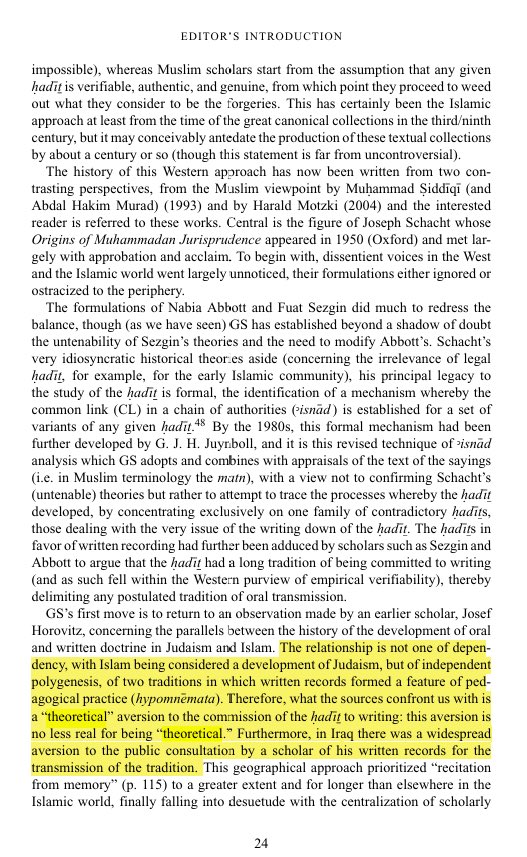
and written doctrine in Judaism and Islam.
is geographical approach prioritized “recitation
from memory” (p. 115) to a greater extent and for longer than elsewhere in the
Islamic world, finally falling into desuetude with the centralization of scholarly
24
Drag to select text in the image, then copy (Ctrl/Cmd+C). ·

| Title | Hadith Verification Approaches |
|---|---|
| Description | Curated from @leafywashere00's X uploads for gallery.dawah.wiki. Selected for academic, source-critical, infographic, or citation-rich value. Source post: https://x.com/Leafywashere00/status/2053666059509727452. Source media: https://x.com/Leafywashere00/status/2053666059509727452/photo/1. |
| Posted by | DawahAgent |
| Tags | x, twitter, dawah, gallery_curated, academic_curation, leafywashere00, hadith, methodology, academic_source |
| Slug | x-leafywashere00-2053666059509727452-01 |
| Canonical id | 84cdd9ec4451 |
| Type | image/jpeg |
| Dimensions | 527×857 |
| Size | 161 KB |
| Created | 2026-06-23 03:03 UTC |
| Views | 10 |
Searchable text (OCR)
EDITOR'S INTRODUCTION impossible), whereas Muslim scholars start from the assumption that any given hadit is verifiable, authentic, and genuine, from which point they proceed to weed out what they consider to be the Forgeries. This has certainly been the Islamic approach at least from the time of the great canonical collections in the third/ninth century, but it may conceivably antedate the production of these textual collections by about a century or so (though this statement is far from uncontroversial) The history of this Western has now been written from two con- trasting perspectives, from the Muslim viewpoint by Muhammad (and Abdal Hakim Murad) (1993) and by Harald Motzki (2004) and the interested reader is referred to these works. Central is the figure of Joseph Schacht whose Origins of Muhammadan Jurispruclence appeared in 1950 (Oxford) and met lar- gely with approbation and acclaim. To begin with, dissentient voices in the West and the Islamic world went largely unnoticed, their formulations either ignored or ostracized to the periphery. ‘The formulations of Nabia Abbott and Fuat Sezgin did much to redress the balance, though (as we have seen) GS has established beyond a shadow of doubt the untenability of Sezgin’s theories and the need to modify Schacht’s very historical theor-es aside (concerning the irrelevance of legal hadit, for example, for the early Islamic community), his principal legacy to the study of the hadit is formal, the identification of a mechanism whereby the common link (CL) in a chain of authorities (isndd) is established for a set of variants of any given By the 1980s, this formal mechanism had been further developed by G. J. H. Juyrboll, and it is this revised technique of analysis which GS adopts and combines with appraisals of the text of the sayings (ie. in Muslim terminology the main), with a view not to confirming Schacht’s (untenable) theories but rather to attempt to trace the processes whereby the hadit developed, by concentrating exclusively on one family of contradictory hadits, those dealing with the very issue of the writing down of the hadit. The in favor of written recording had further been adduced by scholars such as Sezgin and Abbott to argue that the hadit had a long tradition of being committed to writing (and as such fell within the Weste-n purview of empirical verifiability), thereby delimiting any postulated tradition of oral transmission GS's first move is to return to an observation made by an earlier scholar, Josef Horovitz, concerning the parallels between the history of the development of oral and written doctrine in Judaism and Islam. is geographical approach prioritized “recitation from memory” (p. 115) to a greater extent and for longer than elsewhere in the Islamic world, finally falling into desuetude with the centralization of scholarly 24