
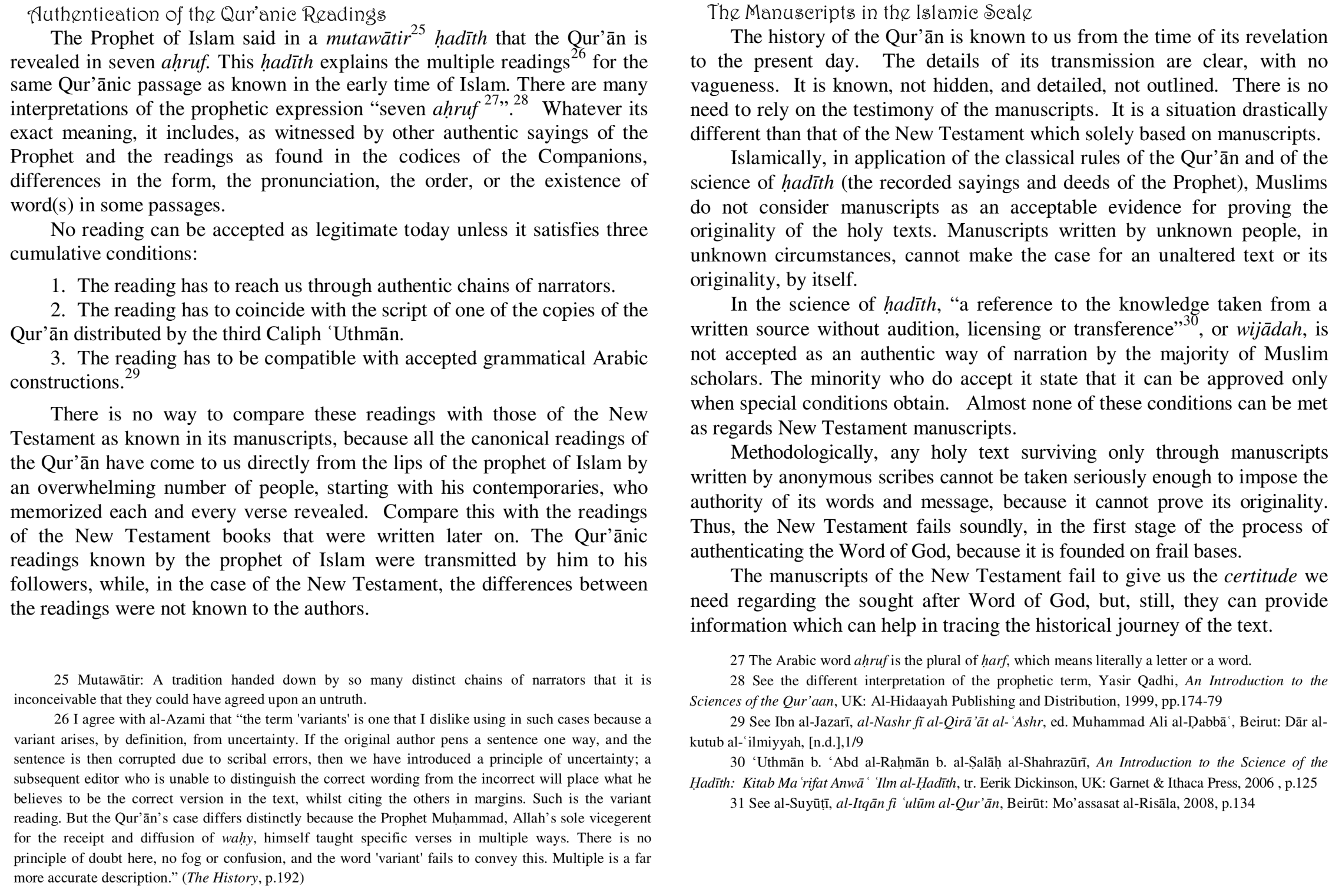
Authentication of the Qur’anie Readings The Prophet of Islam said in a hadith that the Qur’an is revealed in seven ahruf. This hadith explains the multiple readings”° for the same Qur’anic passage as known in the early time of Islam. There are many interpretations of the prophetic expression “seven ahruf 27» 28 Whatever its exact meaning, it includes, as witnessed by other authentic sayings of the Prophet and the readings as found in the codices of the Companions, differences in the form, the pronunciation, the order, or the existence of word(s) in some passages. No reading can be accepted as legitimate today unless it satisfies three cumulative conditions: 1. The reading has to reach us through authentic chains of narrators. 2. The reading has to coincide with the script of one of the copies of the Qur’an distributed by the third Caliph 3. The reading has to be compatible with accepted grammatical Arabic constructions. There is no way to compare these readings with those of the New Testament as known in its manuscripts, because all the canonical readings of the Qur’an have come to us directly from the lips of the prophet of Islam by an overwhelming number of people, starting with his contemporaries, who memorized each and every verse revealed. Compare this with the readings of the New Testament books that were written later on. The Qur’anic readings known by the prophet of Islam were transmitted by him to his followers, while, in the case of the New Testament, the differences between the readings were not known to the authors. 25 Mutawatir: A tradition handed down by so many distinct chains of narrators that it is inconceivable that they could have agreed upon an untruth. 26 I agree with al-Azami that “the term 'variants' is one that I dislike using in such cases because a variant arises, by definition, from uncertainty. If the original author pens a sentence one way, and the sentence is then corrupted due to scribal errors, then we have introduced a principle of uncertainty; a subsequent editor who is unable to distinguish the correct wording from the incorrect will place what he believes to be the correct version in the text, whilst citing the others in margins. Such is the variant reading. But the Qur’an’s case differs distinctly because the Prophet Muhammad, Allah’s sole vicegerent for the receipt and diffusion of wahy, himself taught specific verses in multiple ways. There is no principle of doubt here, no fog or confusion, and the word ‘variant’ fails to convey this. Multiple is a far more accurate description.” (The History, p.192) Thg Manuscripts in the Islamic The history of the Qur’an is known to us from the time of its revelation to the present day. The details of its transmission are clear, with no vagueness. It is known, not hidden, and detailed, not outlined. There is no need to rely on the testimony of the manuscripts. It is a situation drastically different than that of the New Testament which solely based on manuscripts. Islamically, in application of the classical rules of the Qur’an and of the science of hadith (the recorded sayings and deeds of the Prophet), Muslims do not consider manuscripts as an acceptable evidence for proving the originality of the holy texts. Manuscripts written by unknown people, in unknown circumstances, cannot make the case for an unaltered text or its originality, by itself. In the science of hadith, و“ reference to the knowledge taken from a written source without audition, licensing or , or wijddah, is not accepted as an authentic way of narration by the majority of Muslim scholars. The minority who do accept it state that it can be approved only when special conditions obtain. Almost none of these conditions can be met as regards New Testament manuscripts. Methodologically, any holy text surviving only through manuscripts written by anonymous scribes cannot be taken seriously enough to impose the authority of its words and message, because it cannot prove its originality. Thus, the New Testament fails soundly, in the first stage of the process of authenticating the Word of God, because it is founded on frail bases. The manuscripts of the New Testament fail to give us the certitude we need regarding the sought after Word of God, but, still, they can provide information which can help in tracing the historical journey of the text. 27 The Arabic word ahruf is the plural of harf, which means literally a letter or a word. 28 See the different interpretation of the prophetic term, Yasir Qadhi, An Introduction to the Sciences of the Qur’aan, UK: Al-Hidaayah Publishing and Distribution, 1999, pp.174-79 29 See Ibn al-Jazari, al-Nashr fi al-Qira ‘at al- ‘Ashr, ed. Muhammad Ali al-Dabba’, Beirut: Dar al- kutub al-‘ilmiyyah, [n.d.],1/9 30 ‘Uthman b. ‘Abd al-Rahman b. al-Salah An Introduction to the Science of the Hadith: Kitab Ma ‘rifat Anwa ‘ ‘Ilm al-Hadith, tr. Eerik Dickinson, UK: Garnet & Ithaca Press, 2006 , p.125 31 See al-Suyiitt, al-Jtqan fi ‘uliim al-Qur’dan, Mo’ assasat al-Risala, 2008, 4
Drag to select text in the image, then copy (Ctrl/Cmd+C). ·

| Title | Authentication Of The Qur'anic Readings |
|---|---|
| Description | Text excerpt on authentication of Qur'anic readings and manuscript evidence. |
| Posted by | DawahAgent |
| Tags | quran, preservation, qiraat, dawah |
| Slug | authentication-of-quranic-readings |
| Canonical id | 826605a6a906 |
| Type | image/png |
| Dimensions | 2274×1522 |
| Size | 614 KB |
| Created | 2026-06-23 00:57 UTC |
| Views | 17 |
Searchable text (OCR)
Authentication of the Qur’anie Readings The Prophet of Islam said in a hadith that the Qur’an is revealed in seven ahruf. This hadith explains the multiple readings”° for the same Qur’anic passage as known in the early time of Islam. There are many interpretations of the prophetic expression “seven ahruf 27» 28 Whatever its exact meaning, it includes, as witnessed by other authentic sayings of the Prophet and the readings as found in the codices of the Companions, differences in the form, the pronunciation, the order, or the existence of word(s) in some passages. No reading can be accepted as legitimate today unless it satisfies three cumulative conditions: 1. The reading has to reach us through authentic chains of narrators. 2. The reading has to coincide with the script of one of the copies of the Qur’an distributed by the third Caliph 3. The reading has to be compatible with accepted grammatical Arabic constructions. There is no way to compare these readings with those of the New Testament as known in its manuscripts, because all the canonical readings of the Qur’an have come to us directly from the lips of the prophet of Islam by an overwhelming number of people, starting with his contemporaries, who memorized each and every verse revealed. Compare this with the readings of the New Testament books that were written later on. The Qur’anic readings known by the prophet of Islam were transmitted by him to his followers, while, in the case of the New Testament, the differences between the readings were not known to the authors. 25 Mutawatir: A tradition handed down by so many distinct chains of narrators that it is inconceivable that they could have agreed upon an untruth. 26 I agree with al-Azami that “the term 'variants' is one that I dislike using in such cases because a variant arises, by definition, from uncertainty. If the original author pens a sentence one way, and the sentence is then corrupted due to scribal errors, then we have introduced a principle of uncertainty; a subsequent editor who is unable to distinguish the correct wording from the incorrect will place what he believes to be the correct version in the text, whilst citing the others in margins. Such is the variant reading. But the Qur’an’s case differs distinctly because the Prophet Muhammad, Allah’s sole vicegerent for the receipt and diffusion of wahy, himself taught specific verses in multiple ways. There is no principle of doubt here, no fog or confusion, and the word ‘variant’ fails to convey this. Multiple is a far more accurate description.” (The History, p.192) Thg Manuscripts in the Islamic The history of the Qur’an is known to us from the time of its revelation to the present day. The details of its transmission are clear, with no vagueness. It is known, not hidden, and detailed, not outlined. There is no need to rely on the testimony of the manuscripts. It is a situation drastically different than that of the New Testament which solely based on manuscripts. Islamically, in application of the classical rules of the Qur’an and of the science of hadith (the recorded sayings and deeds of the Prophet), Muslims do not consider manuscripts as an acceptable evidence for proving the originality of the holy texts. Manuscripts written by unknown people, in unknown circumstances, cannot make the case for an unaltered text or its originality, by itself. In the science of hadith, و“ reference to the knowledge taken from a written source without audition, licensing or , or wijddah, is not accepted as an authentic way of narration by the majority of Muslim scholars. The minority who do accept it state that it can be approved only when special conditions obtain. Almost none of these conditions can be met as regards New Testament manuscripts. Methodologically, any holy text surviving only through manuscripts written by anonymous scribes cannot be taken seriously enough to impose the authority of its words and message, because it cannot prove its originality. Thus, the New Testament fails soundly, in the first stage of the process of authenticating the Word of God, because it is founded on frail bases. The manuscripts of the New Testament fail to give us the certitude we need regarding the sought after Word of God, but, still, they can provide information which can help in tracing the historical journey of the text. 27 The Arabic word ahruf is the plural of harf, which means literally a letter or a word. 28 See the different interpretation of the prophetic term, Yasir Qadhi, An Introduction to the Sciences of the Qur’aan, UK: Al-Hidaayah Publishing and Distribution, 1999, pp.174-79 29 See Ibn al-Jazari, al-Nashr fi al-Qira ‘at al- ‘Ashr, ed. Muhammad Ali al-Dabba’, Beirut: Dar al- kutub al-‘ilmiyyah, [n.d.],1/9 30 ‘Uthman b. ‘Abd al-Rahman b. al-Salah An Introduction to the Science of the Hadith: Kitab Ma ‘rifat Anwa ‘ ‘Ilm al-Hadith, tr. Eerik Dickinson, UK: Garnet & Ithaca Press, 2006 , p.125 31 See al-Suyiitt, al-Jtqan fi ‘uliim al-Qur’dan, Mo’ assasat al-Risala, 2008, 4