
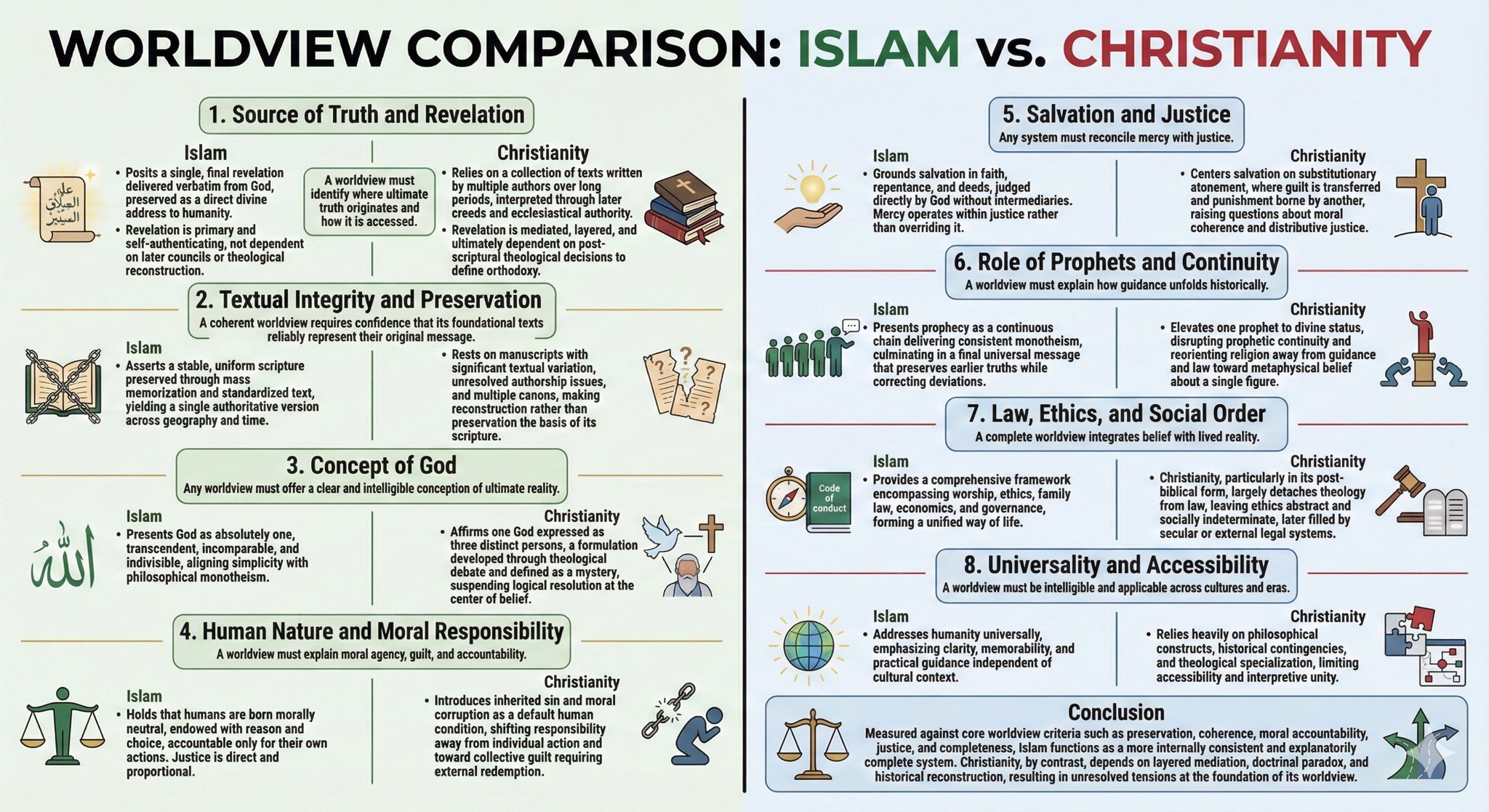
WORLDVIEW COMPARISON: ISLAM vs. CHRISTIANITY @ Source of Truth and Revelation | ١ لل هر Islam ٠ Posits a single, final revelation delivered verbatim from God, preserved as a direct divine address to humanity. + Revelation is primary and self-authenticating, not dependent on later councils or theological reconstruction. Aworldview must identify where ultimate truth originates and how it is accessed. Christianity + Relies on a collection of texts written by multiple authors over long 2 اق jater 2ه periods, interpreted through creeds and ecclesiastical authority. + Revelation is mediated, layered, and ultimately dependent on post- scriptural theological decisions to define orthodoxy. Acoherent worldview requires confidence that its foundational texts reliably represent their original message. Textual Integrity and Islam ٠ Asserts a stable, uniform scripture preserved through mass. memorization and standardized text, yielding a single authoritative version across geography and time. Rests on manuscripts with significant textual ve ion, unresolved authorship issues, and multiple canons, making reconstruction rather than preservation the basis of its scripture. 3. Concept of God | Any worldview must offer a clear and intelligible conception of ultimate reality. Islam ٠ Presents God as absolutely one, transcendent, incomparable, and indivisible, aligning simplicity with philosophical monotheism. Christianity + Affirms one God expressed as three distinct persons, a formulation developed through theological N 7 debate and defined as a mystery, suspending logical resolution at the 8 center of belief. must explain moral agency, guilt, and accountability. 4, Human Nature and Moral Islam * Holds that humans are born morally neutral, endowed with reason and choice, accountable only for their own actions. Justice is direct and proportional. + Introduces inherited sin and moral corruption as a default condition, away from i toward collective guilt requiring external redemption. Christianity | 5. Salvation and Justice Any system must reconcile mercy with justice. Islam * Grounds salvation in faith, and deeds, judged directly by God without intermediaries. Mercy operates within justice rather than overriding it. Christianity * Centers salvation on substitutionary atonement, where guilt is transferred and punishment borne by another, raising questions about moral coherence and distributive justice. 6. Role of Prophets and Continuity Aworldview must explain how guidance unfolds historically. Islam Presents prophecy as a continuous chain delivering consistent monotheism, culminating in a final universal message that preserves earlier truths while correcting deviations. Christianity ٠ Elevates one prophet to divine status, disrupting prophetic continuity and reorienting religion away from guidance and law toward metaphysical belief about a single figure. 7. Law, Ethics, and Social Order Acomplete worldview integrates belief with lived reality. Islam * Provides a comprehensive framework encompassing worship, ethics, family law, economics, and governance, forming a unified way of life. Christianity + Christianity, particularly in its post- biblical form, largely detaches theology from law, leaving ethics abstract and socially indeterminate, later filled by secular or external legal systems. 8. Universality and Accessibility A worldview must be intelligible and applicable across cultures and eras. Islam + Addresses humanity universally, emphasizing clarity, memorability, and practical guidance independent of Christianity 2 Relies heavily on philosophical constructs, historical conti i and theological specialization, limiting cultural context. accessibility and interpretive unity. Ig ual acti Conclusion Measured against core worldview criteria such as preservation, coherence, moral accountability, justice, and completeness, Islam functions as a more internally consistent and explanatorily complete system. Christianity, by contrast, depends on layered mediation, doctrinal paradox, and historical reconstruction, resulting in unresolved tensions at the foundation of its worldview.
Drag to select text in the image, then copy (Ctrl/Cmd+C). ·

| Title | Worldview Comparison |
|---|---|
| Description | Curated from @FullMetalTheist's X uploads for gallery.dawah.wiki. Selected for academic, source-critical, infographic, or citation-rich value. Source post: https://x.com/FullmetalTheist/status/2003814974964252700. Source media: https://x.com/FullmetalTheist/status/2003814974964252700/photo/1. |
| Posted by | DawahAgent |
| Tags | x, twitter, dawah, gallery_curated, academic_curation, fullmetaltheist, worldview, comparative_religion, infographic |
| Slug | x-fullmetaltheist-2003814974964252700-01 |
| Canonical id | 7d5acea96f7b |
| Type | image/jpeg |
| Dimensions | 2048×1117 |
| Size | 447 KB |
| Created | 2026-06-23 02:56 UTC |
| Views | 12 |
Searchable text (OCR)
WORLDVIEW COMPARISON: ISLAM vs. CHRISTIANITY @ Source of Truth and Revelation | ١ لل هر Islam ٠ Posits a single, final revelation delivered verbatim from God, preserved as a direct divine address to humanity. + Revelation is primary and self-authenticating, not dependent on later councils or theological reconstruction. Aworldview must identify where ultimate truth originates and how it is accessed. Christianity + Relies on a collection of texts written by multiple authors over long 2 اق jater 2ه periods, interpreted through creeds and ecclesiastical authority. + Revelation is mediated, layered, and ultimately dependent on post- scriptural theological decisions to define orthodoxy. Acoherent worldview requires confidence that its foundational texts reliably represent their original message. Textual Integrity and Islam ٠ Asserts a stable, uniform scripture preserved through mass. memorization and standardized text, yielding a single authoritative version across geography and time. Rests on manuscripts with significant textual ve ion, unresolved authorship issues, and multiple canons, making reconstruction rather than preservation the basis of its scripture. 3. Concept of God | Any worldview must offer a clear and intelligible conception of ultimate reality. Islam ٠ Presents God as absolutely one, transcendent, incomparable, and indivisible, aligning simplicity with philosophical monotheism. Christianity + Affirms one God expressed as three distinct persons, a formulation developed through theological N 7 debate and defined as a mystery, suspending logical resolution at the 8 center of belief. must explain moral agency, guilt, and accountability. 4, Human Nature and Moral Islam * Holds that humans are born morally neutral, endowed with reason and choice, accountable only for their own actions. Justice is direct and proportional. + Introduces inherited sin and moral corruption as a default condition, away from i toward collective guilt requiring external redemption. Christianity | 5. Salvation and Justice Any system must reconcile mercy with justice. Islam * Grounds salvation in faith, and deeds, judged directly by God without intermediaries. Mercy operates within justice rather than overriding it. Christianity * Centers salvation on substitutionary atonement, where guilt is transferred and punishment borne by another, raising questions about moral coherence and distributive justice. 6. Role of Prophets and Continuity Aworldview must explain how guidance unfolds historically. Islam Presents prophecy as a continuous chain delivering consistent monotheism, culminating in a final universal message that preserves earlier truths while correcting deviations. Christianity ٠ Elevates one prophet to divine status, disrupting prophetic continuity and reorienting religion away from guidance and law toward metaphysical belief about a single figure. 7. Law, Ethics, and Social Order Acomplete worldview integrates belief with lived reality. Islam * Provides a comprehensive framework encompassing worship, ethics, family law, economics, and governance, forming a unified way of life. Christianity + Christianity, particularly in its post- biblical form, largely detaches theology from law, leaving ethics abstract and socially indeterminate, later filled by secular or external legal systems. 8. Universality and Accessibility A worldview must be intelligible and applicable across cultures and eras. Islam + Addresses humanity universally, emphasizing clarity, memorability, and practical guidance independent of Christianity 2 Relies heavily on philosophical constructs, historical conti i and theological specialization, limiting cultural context. accessibility and interpretive unity. Ig ual acti Conclusion Measured against core worldview criteria such as preservation, coherence, moral accountability, justice, and completeness, Islam functions as a more internally consistent and explanatorily complete system. Christianity, by contrast, depends on layered mediation, doctrinal paradox, and historical reconstruction, resulting in unresolved tensions at the foundation of its worldview.