
Eusebuis quotes:
(1) “Go ye, and make disciples of all the nations, teaching them to observe all things, whatsoever | have commanded you.” What could He mean but the
teaching and discipline of the new covenant? Since, then, | have proved my facts, let us proceed to investigate together the character of the new
covenant, and the new song and the new law that were foretold. [3]
(2) Such was the message to all nations given by the word of the new covenant by the teaching of Christ. And the Christ of God bade His disciples teach
them to all nations, saying: “Go ye into all the world, and make disciples of all the nations . teaching them to observe whatsoever | have commanded
you.” [4]
(3) With one word and voice He said to His disciples: “Go, and make disciples of all the nations in My Name, teaching them to observe all things
whatsoever | have commanded you,” [[Matt. xxviii. 19.]] [5]
(4) | am irresistibly forced to retrace my steps, and search for their cause, and to confess that they could only have succeeded in their daring venture, by
a power more divine, and more strong than man’s, and by the co-operation of Him Who said to them: “Make disciples of all the nations in my Name.” [6]
(5) Whereas He, who conceived nothing human or mortal, see (136) how truly He speaks with the voice of God, saying in these very words to those
disciples of His, the poorest of the poor: “Go forth, and make disciples of all the nations.” [[Matt.xxviii. 19.]] “But how,” the disciples might reasonably
have answered the Master, “can we do it? How, pray, can we preach to Romans? How can we argue with Egyptians? We are men bred up to use the
Syrian tongue only, what language shall we speak to Greeks? How shall we persuade Persians, Armenians, Chaldrearis, Scythians, Indians, and other (b)
barbarous nations to give up their ancestral gods, and worship the Creator of all? What sufficiency of speech have we to trust to in attempting such
work as this? And what hope of success can we have if we dare to proclaim laws directly opposed to the laws about their own gods that have been
established for ages among all nations? By what power shall we ever survive our daring attempt?”
But while the disciples of Jesus were most likely either saying thus, or thinking thus, the Master solved their difficulties, by the addition of one phrase,
saying they should (c) triumph “In MY NAME.” For He did not bid them simply and indefinitely make disciples of all nations, but with the necessary
addition of ” In my Name.” And the power of His Name being so great, that the apostle says: “God has given him a name which is above every name, that
in the name of Jesus every knee should bow, of things in heaven, and things in earth, and things under the earth,” [[Phil. |] He shewed the virtue of
the power in His Name concealed (d) from the crowd when He said to His disciples: “Go, and make disciples of all nations in my Name.” He also most
accurately forecasts the future when He says: “For this gospel must first be preached to all the world, for a witness to all nations.” [[Matt.xxiv.14.]]
These words were said in a corner of the earth then, and only those present heard it. How, | ask, did they credit them, unless from other divine works
that He had done they had experienced the truth in His words? Not one of them disobeyed His command: but in obedience to (137) His Will according to
their orders they began to make disciples of every race of men, going from their own country to all races, and in a short time it was possible to see His
words realized. [7]
(6) And He says to them, “The kingdom of God shall be taken away from you, and shall be given to a nation bearing the fruits of it.” And He bids His own
disciples after their rejection, “Go ye and make disciples of all nations in my name.’ (7) Hence, of course, our Lord and Saviour, Jesus the Son of God,
said to His disciples after His Resurrection: “{6a} Go and make disciples of all the nations,” and added: “Teaching them to observe all things, whatsoever
| have commanded you” [8]
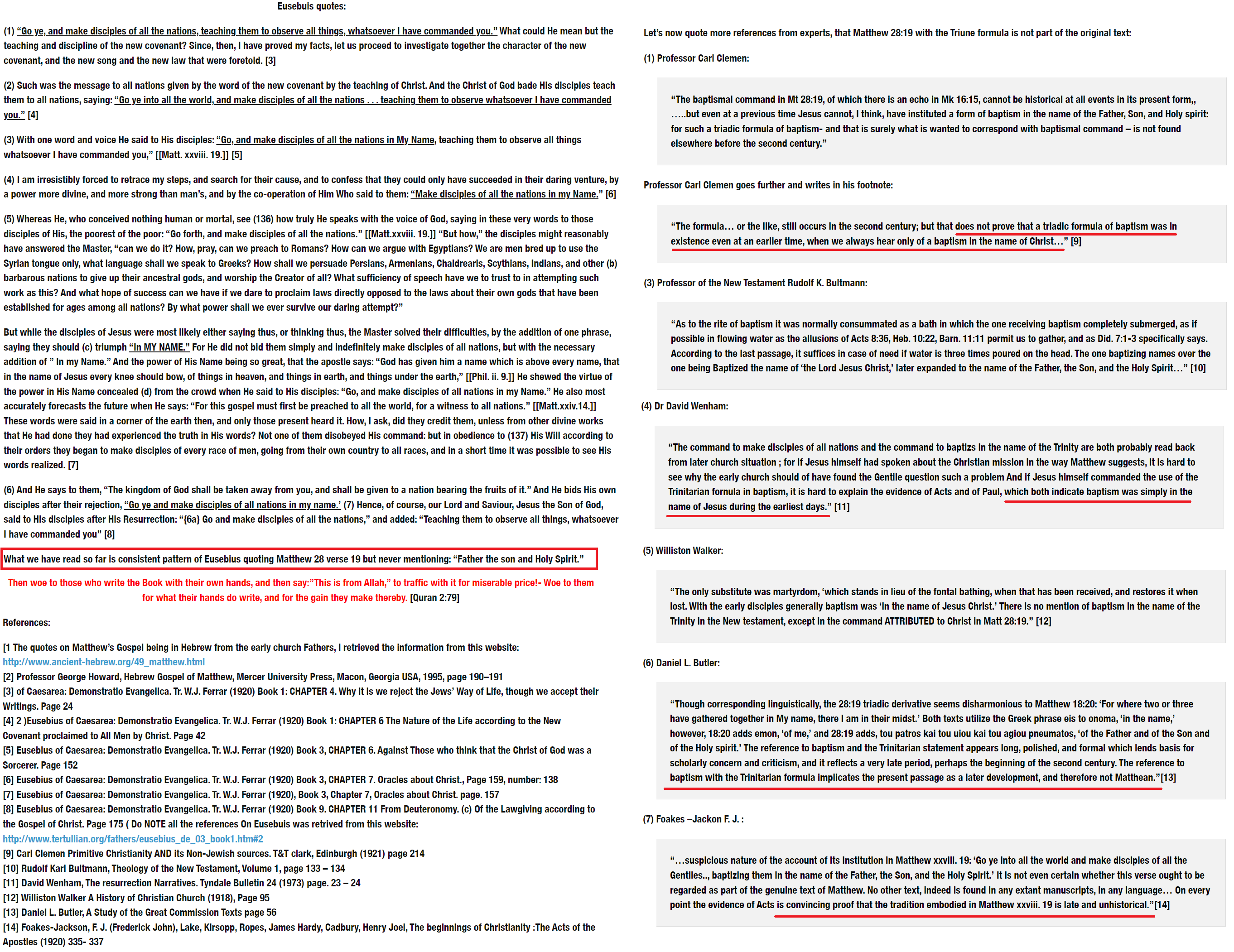
What we have read so far is consistent pattern of Eusebius quoting Matthew 28 verse 19 but never mentioning: “Father the son and Holy S|
Then woe to those who write the Book with their own hands, and then say:” This is from Allah,” to traffic with it for miserable price!- Woe to them
for what their hands do write, and for the gain they make thereby. [Quran 2:79]
References:
[1 The quotes on Matthew’s Gospel being in Hebrew from the early church Fathers, | retrieved the information from this website:
[2] Professor George Howard, Hebrew Gospel of Matthew, Mercer University Press, Macon, Georgia USA, 1995, page 190-191
[3] of Caesarea: Demonstratio Evangelica. Tr. W.J. Ferrar (1920) Book 1: CHAPTER 4. Why it is we reject the Jews’ Way of Life, though we accept their
Writings. Page 24
[4] 2 )Eusebius of Caesarea: Demonstratio Evangelica. Tr. W.J. Ferrar (1920) Book 1: CHAPTER 6 The Nature of the Life according to the New
Covenant proclaimed to All Men by Christ. Page 42
[5] Eusebius of Caesarea: Demonstratio Evangelica. Tr. W.J. Ferrar (1920) Book 3, CHAPTER 6. Against Those who think that the Christ of God was a
Sorcerer. Page 152
[6] Eusebius of Caesarea: Demonstratio Evangelica. Tr. W.J. Ferrar (1920) Book 3, CHAPTER 7. Oracles about Christ., Page 159, number: 138
[7] Eusebius of Caesarea: Demonstratio Evangelica. Tr. W.J. Ferrar (1920), Book 3, Chapter 7, Oracles about Christ. page. 157
[8] Eusebius of Caesarea: Demonstratio Evangelica. Tr. W.J. Ferrar (1920) Book 9. CHAPTER 11 From Deuteronomy. (c) Of the Lawgiving according to
the Gospel of Christ. Page 175 ( Do NOTE all the references On Eusebuis was retrived from this website:
[9] Carl Clemen Primitive Christianity AND its Non-Jewish sources. T&T clark, Edinburgh (1921) page 214
[10] Rudolf Karl Bultmann, Theology of the New Testament, Volume 1, page 133 - 4
[11] David Wenham, The resurrection Narratives. Tyndale Bulletin 24 (1973) page. 23 - 24
[12] Williston Walker A History of Christian Church (1918), Page 5
[13] Daniel L. Butler, A Study of the Great Commission Texts page 56
[14] Foakes-Jackson, F. J. (Frederick John), Lake, Kirsopp, Ropes, James Hardy, Cadbury, Henry Joel, The beginnings of Christianity :The Acts of the
Apostles (1920) 335- 337
Let’s now quote more references from experts, that Matthew 28:19 with the Triune formula is not part of the original text:
(1) Professor Carl Clemen:
“The baptismal command in Mt 28:19, of which there is an echo in Mk 16:15, cannot be historical at all events in its present form,,
..-.-but even at a previous time Jesus cannot, | think, have instituted a form of baptism in the name of the Father, Son, and Holy spirit:
for such a triadic formula of baptism- and that is surely what is wanted to correspond with baptismal command - is not found
elsewhere before the second century.”
Professor Carl Clemen goes further and writes in his footnote:
“The formula... or the like, still occurs in the second century; but that does not prove that a triadic formula of baptism was in
existence even at an earlier time, when we always hear only of a baptism in the name of Christ...” [9]
(3) Professor of the New Testament Rudolf K. Bultmann:
“As to the rite of baptism it was normally consummated as a bath in which the one receiving baptism completely submerged, as if
possible in flowing water as the allusions of Acts 8:36, Heb. 10:22, Barn. 11:11 permit us to gather, and as Did. 7:1-3 specifically says.
According to the last passage, it suffices in case of need if water is three times poured on the head. The one baptizing names over the
one being Baptized the name of ‘the Lord Jesus Christ,’ later expanded to the name of the Father, the Son, and the Holy Spirit...” [10]
(4) Dr David Wenham:
“The command to make disciples of all nations and the command to baptizs in the name of the Trinity are both probably read back
from later church situation ; for if Jesus himself had spoken about the Christian mission in the way Matthew suggests, it is hard to
see why the early church should of have found the Gentile question such a problem And if Jesus himself commanded the use of the
Trinitarian fornula in baptism, it is hard to explain the evidence of Acts and of Paul, which both indicate baptism was simply in the
name of Jesus during the earliest days.” [11]
(5) Williston Walker:
“The only substitute was martyrdom, ‘which stands in lieu of the fontal bathing, when that has been received, and restores it when
lost. With the early disciples generally baptism was ‘in the name of Jesus Christ.’ There is no mention of baptism in the name of the
Trinity in the New testament, except in the command ATTRIBUTED to Christ in Matt 28:19.” [12]
(6) Daniel L. Butler:
“Though corresponding linguistically, the 28:19 triadic derivative seems disharmonious to Matthew 18:20: ‘For where two or three
have gathered together in My name, there | am in their midst.’ Both texts utilize the Greek phrase eis to onoma, ‘in the name,’
however, 18:20 adds emon, ‘of me,’ and 28:19 adds, tou patros kai tou uiou kai tou agiou pneumatos, ‘of the Father and of the Son and
of the Holy spirit.’ The reference to baptism and the Trinitarian statement appears long, polished, and formal which lends basis for
scholarly concern and criticism, and it reflects a very late period, perhaps the beginning of the second century. The reference to
baptism with the Trinitarian formula implicates the present passage as a later development, and therefore not Matthean.”[13]
(7) Foakes —Jackon F. J. :
“ .. Suspicious nature of the account of its institution in Matthew xxviii. 19: ‘Go ye into all the world and make disciples of all the
Gentiles.., baptizing them in the name of the Father, the Son, and the Holy Spirit.’ It is not even certain whether this verse ought to be
regarded as part of the genuine text of Matthew. No other text, indeed is found in any extant manuscripts, in any language... On every
point the evidence of Acts is convincing proof that the tradition embodied in Matthew xxviii. 19 is late and unhistorical.”[14]
Drag to select text in the image, then copy (Ctrl/Cmd+C). ·

| Title | Matthew 28:19 and the Trinity |
|---|---|
| Description | |
| Posted by | theIslampill |
| Tags | dawah, new testament, trinity |
| Slug | — (none yet) |
| Canonical id | 704d85ad3c00 |
| Type | image/png |
| Dimensions | 2724×2102 |
| Size | 655 KB |
| Created | 2026-06-10 08:32 UTC |
| Views | 15 |
Searchable text (OCR)
Eusebuis quotes:
(1) “Go ye, and make disciples of all the nations, teaching them to observe all things, whatsoever | have commanded you.” What could He mean but the
teaching and discipline of the new covenant? Since, then, | have proved my facts, let us proceed to investigate together the character of the new
covenant, and the new song and the new law that were foretold. [3]
(2) Such was the message to all nations given by the word of the new covenant by the teaching of Christ. And the Christ of God bade His disciples teach
them to all nations, saying: “Go ye into all the world, and make disciples of all the nations . teaching them to observe whatsoever | have commanded
you.” [4]
(3) With one word and voice He said to His disciples: “Go, and make disciples of all the nations in My Name, teaching them to observe all things
whatsoever | have commanded you,” [[Matt. xxviii. 19.]] [5]
(4) | am irresistibly forced to retrace my steps, and search for their cause, and to confess that they could only have succeeded in their daring venture, by
a power more divine, and more strong than man’s, and by the co-operation of Him Who said to them: “Make disciples of all the nations in my Name.” [6]
(5) Whereas He, who conceived nothing human or mortal, see (136) how truly He speaks with the voice of God, saying in these very words to those
disciples of His, the poorest of the poor: “Go forth, and make disciples of all the nations.” [[Matt.xxviii. 19.]] “But how,” the disciples might reasonably
have answered the Master, “can we do it? How, pray, can we preach to Romans? How can we argue with Egyptians? We are men bred up to use the
Syrian tongue only, what language shall we speak to Greeks? How shall we persuade Persians, Armenians, Chaldrearis, Scythians, Indians, and other (b)
barbarous nations to give up their ancestral gods, and worship the Creator of all? What sufficiency of speech have we to trust to in attempting such
work as this? And what hope of success can we have if we dare to proclaim laws directly opposed to the laws about their own gods that have been
established for ages among all nations? By what power shall we ever survive our daring attempt?”
But while the disciples of Jesus were most likely either saying thus, or thinking thus, the Master solved their difficulties, by the addition of one phrase,
saying they should (c) triumph “In MY NAME.” For He did not bid them simply and indefinitely make disciples of all nations, but with the necessary
addition of ” In my Name.” And the power of His Name being so great, that the apostle says: “God has given him a name which is above every name, that
in the name of Jesus every knee should bow, of things in heaven, and things in earth, and things under the earth,” [[Phil. |] He shewed the virtue of
the power in His Name concealed (d) from the crowd when He said to His disciples: “Go, and make disciples of all nations in my Name.” He also most
accurately forecasts the future when He says: “For this gospel must first be preached to all the world, for a witness to all nations.” [[Matt.xxiv.14.]]
These words were said in a corner of the earth then, and only those present heard it. How, | ask, did they credit them, unless from other divine works
that He had done they had experienced the truth in His words? Not one of them disobeyed His command: but in obedience to (137) His Will according to
their orders they began to make disciples of every race of men, going from their own country to all races, and in a short time it was possible to see His
words realized. [7]
(6) And He says to them, “The kingdom of God shall be taken away from you, and shall be given to a nation bearing the fruits of it.” And He bids His own
disciples after their rejection, “Go ye and make disciples of all nations in my name.’ (7) Hence, of course, our Lord and Saviour, Jesus the Son of God,
said to His disciples after His Resurrection: “{6a} Go and make disciples of all the nations,” and added: “Teaching them to observe all things, whatsoever
| have commanded you” [8]
What we have read so far is consistent pattern of Eusebius quoting Matthew 28 verse 19 but never mentioning: “Father the son and Holy S|
Then woe to those who write the Book with their own hands, and then say:” This is from Allah,” to traffic with it for miserable price!- Woe to them
for what their hands do write, and for the gain they make thereby. [Quran 2:79]
References:
[1 The quotes on Matthew’s Gospel being in Hebrew from the early church Fathers, | retrieved the information from this website:
[2] Professor George Howard, Hebrew Gospel of Matthew, Mercer University Press, Macon, Georgia USA, 1995, page 190-191
[3] of Caesarea: Demonstratio Evangelica. Tr. W.J. Ferrar (1920) Book 1: CHAPTER 4. Why it is we reject the Jews’ Way of Life, though we accept their
Writings. Page 24
[4] 2 )Eusebius of Caesarea: Demonstratio Evangelica. Tr. W.J. Ferrar (1920) Book 1: CHAPTER 6 The Nature of the Life according to the New
Covenant proclaimed to All Men by Christ. Page 42
[5] Eusebius of Caesarea: Demonstratio Evangelica. Tr. W.J. Ferrar (1920) Book 3, CHAPTER 6. Against Those who think that the Christ of God was a
Sorcerer. Page 152
[6] Eusebius of Caesarea: Demonstratio Evangelica. Tr. W.J. Ferrar (1920) Book 3, CHAPTER 7. Oracles about Christ., Page 159, number: 138
[7] Eusebius of Caesarea: Demonstratio Evangelica. Tr. W.J. Ferrar (1920), Book 3, Chapter 7, Oracles about Christ. page. 157
[8] Eusebius of Caesarea: Demonstratio Evangelica. Tr. W.J. Ferrar (1920) Book 9. CHAPTER 11 From Deuteronomy. (c) Of the Lawgiving according to
the Gospel of Christ. Page 175 ( Do NOTE all the references On Eusebuis was retrived from this website:
[9] Carl Clemen Primitive Christianity AND its Non-Jewish sources. T&T clark, Edinburgh (1921) page 214
[10] Rudolf Karl Bultmann, Theology of the New Testament, Volume 1, page 133 - 4
[11] David Wenham, The resurrection Narratives. Tyndale Bulletin 24 (1973) page. 23 - 24
[12] Williston Walker A History of Christian Church (1918), Page 5
[13] Daniel L. Butler, A Study of the Great Commission Texts page 56
[14] Foakes-Jackson, F. J. (Frederick John), Lake, Kirsopp, Ropes, James Hardy, Cadbury, Henry Joel, The beginnings of Christianity :The Acts of the
Apostles (1920) 335- 337
Let’s now quote more references from experts, that Matthew 28:19 with the Triune formula is not part of the original text:
(1) Professor Carl Clemen:
“The baptismal command in Mt 28:19, of which there is an echo in Mk 16:15, cannot be historical at all events in its present form,,
..-.-but even at a previous time Jesus cannot, | think, have instituted a form of baptism in the name of the Father, Son, and Holy spirit:
for such a triadic formula of baptism- and that is surely what is wanted to correspond with baptismal command - is not found
elsewhere before the second century.”
Professor Carl Clemen goes further and writes in his footnote:
“The formula... or the like, still occurs in the second century; but that does not prove that a triadic formula of baptism was in
existence even at an earlier time, when we always hear only of a baptism in the name of Christ...” [9]
(3) Professor of the New Testament Rudolf K. Bultmann:
“As to the rite of baptism it was normally consummated as a bath in which the one receiving baptism completely submerged, as if
possible in flowing water as the allusions of Acts 8:36, Heb. 10:22, Barn. 11:11 permit us to gather, and as Did. 7:1-3 specifically says.
According to the last passage, it suffices in case of need if water is three times poured on the head. The one baptizing names over the
one being Baptized the name of ‘the Lord Jesus Christ,’ later expanded to the name of the Father, the Son, and the Holy Spirit...” [10]
(4) Dr David Wenham:
“The command to make disciples of all nations and the command to baptizs in the name of the Trinity are both probably read back
from later church situation ; for if Jesus himself had spoken about the Christian mission in the way Matthew suggests, it is hard to
see why the early church should of have found the Gentile question such a problem And if Jesus himself commanded the use of the
Trinitarian fornula in baptism, it is hard to explain the evidence of Acts and of Paul, which both indicate baptism was simply in the
name of Jesus during the earliest days.” [11]
(5) Williston Walker:
“The only substitute was martyrdom, ‘which stands in lieu of the fontal bathing, when that has been received, and restores it when
lost. With the early disciples generally baptism was ‘in the name of Jesus Christ.’ There is no mention of baptism in the name of the
Trinity in the New testament, except in the command ATTRIBUTED to Christ in Matt 28:19.” [12]
(6) Daniel L. Butler:
“Though corresponding linguistically, the 28:19 triadic derivative seems disharmonious to Matthew 18:20: ‘For where two or three
have gathered together in My name, there | am in their midst.’ Both texts utilize the Greek phrase eis to onoma, ‘in the name,’
however, 18:20 adds emon, ‘of me,’ and 28:19 adds, tou patros kai tou uiou kai tou agiou pneumatos, ‘of the Father and of the Son and
of the Holy spirit.’ The reference to baptism and the Trinitarian statement appears long, polished, and formal which lends basis for
scholarly concern and criticism, and it reflects a very late period, perhaps the beginning of the second century. The reference to
baptism with the Trinitarian formula implicates the present passage as a later development, and therefore not Matthean.”[13]
(7) Foakes —Jackon F. J. :
“ .. Suspicious nature of the account of its institution in Matthew xxviii. 19: ‘Go ye into all the world and make disciples of all the
Gentiles.., baptizing them in the name of the Father, the Son, and the Holy Spirit.’ It is not even certain whether this verse ought to be
regarded as part of the genuine text of Matthew. No other text, indeed is found in any extant manuscripts, in any language... On every
point the evidence of Acts is convincing proof that the tradition embodied in Matthew xxviii. 19 is late and unhistorical.”[14]