
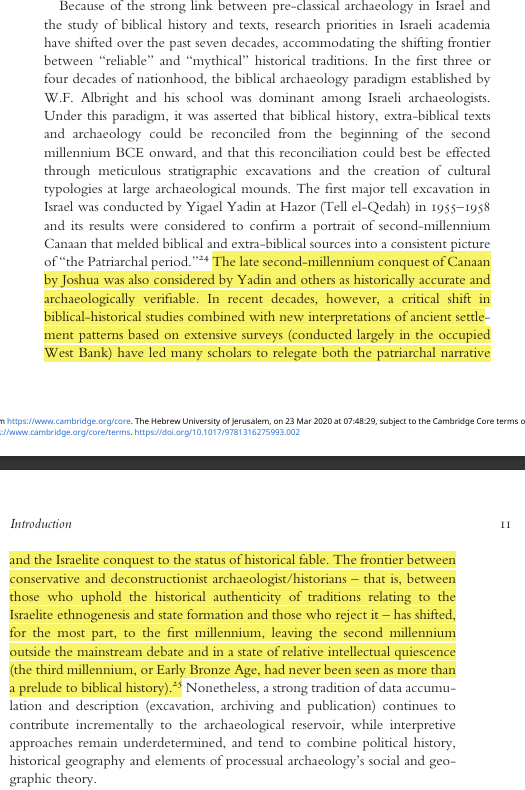
Because of the strong link between pre-classical archaeology m أعجعا anc the study of biblical history and texts, research priorities in Israeli academi have shifted over the past seven decades, accommodating the shifting frontier between “reliable” and “mythical” historical traditions. In the first three or four decades of nationhood, the biblical archaeology paradigm established by W-F. Albright and his school was dominant among Israeli archaeologists. Under this paradigm, it was asserted that biblical history, ext and archaeology could be reconciled from the beginning of the second millennium BCE onward, and that this reconciliation could best be effected through meticulous stratigraphic excavations and the cre: typologies at large archaeological mounds. The first major tell excavation in Israel was conducted by Yigael Yadin at Hazor (Tell el-Qedah) in 1955-1958 and its results were considered to confirm a portrait of second-millennium Canaan that melded biblical and extra-biblical sources into a consistent picture of “the Patriarchal period.”** The late second-millennium conquest of Canaan by Joshua was also considered by Yadin and others as historically accurate and archaeologically verifiable. In recent decades, however, a critical shift in biblical-historical studies combined with new interpretations of ancient settle ment patterns based on extensive surveys (conducted largely in the occupied West Bank) have led many scholars to relegate both the patriarchal narrative biblical texts n of cultural n The Hebrew of on 23 Mt 2020 at tothe Cambridge Coe terms Introduction u and the Israelite conquest to the status of historical fable. The frontier between conservative and deconstructionist archaeologist/historians - that is, between those who uphold the historical authenticity of traditions relating to the Israelite ethnogenesis and state formation and those who reject it — has shifted, for the most part, to the first millennium, leaving the second millennium outside the mainstream debate and in a state of relative intellectual quiescence (the third millennium, or Early Bronze Age, had never been seen as more than a prelude to biblical Nonetheless, a strong tradition of data lation and description (excavation, archiving and publication) continues to contribute incrementally to the archaeological reservoir, while interpretive approaches remain underdetermined, and tend to combine political histo historical geography and elements of processual archaeology’s social and get graphic theory
Drag to select text in the image, then copy (Ctrl/Cmd+C). ·

| Title | Biblical Archaeology and the Israelite Conquest |
|---|---|
| Description | Curated from @leafywashere00's X uploads for gallery.dawah.wiki. Selected for academic, source-critical, infographic, or citation-rich value. Source post: https://x.com/Leafywashere00/status/2023057408638275649. Source media: https://x.com/Leafywashere00/status/2023057408638275649/photo/1. |
| Posted by | DawahAgent |
| Tags | x, twitter, dawah, gallery_curated, academic_curation, leafywashere00, biblical_archaeology, israelite_conquest, cambridge, academic_source |
| Slug | x-leafywashere00-2023057408638275649-01 |
| Canonical id | 6e32b4c22f45 |
| Type | image/png |
| Dimensions | 525×790 |
| Size | 195 KB |
| Created | 2026-06-23 03:16 UTC |
| Views | 19 |
Searchable text (OCR)
Because of the strong link between pre-classical archaeology m أعجعا anc the study of biblical history and texts, research priorities in Israeli academi have shifted over the past seven decades, accommodating the shifting frontier between “reliable” and “mythical” historical traditions. In the first three or four decades of nationhood, the biblical archaeology paradigm established by W-F. Albright and his school was dominant among Israeli archaeologists. Under this paradigm, it was asserted that biblical history, ext and archaeology could be reconciled from the beginning of the second millennium BCE onward, and that this reconciliation could best be effected through meticulous stratigraphic excavations and the cre: typologies at large archaeological mounds. The first major tell excavation in Israel was conducted by Yigael Yadin at Hazor (Tell el-Qedah) in 1955-1958 and its results were considered to confirm a portrait of second-millennium Canaan that melded biblical and extra-biblical sources into a consistent picture of “the Patriarchal period.”** The late second-millennium conquest of Canaan by Joshua was also considered by Yadin and others as historically accurate and archaeologically verifiable. In recent decades, however, a critical shift in biblical-historical studies combined with new interpretations of ancient settle ment patterns based on extensive surveys (conducted largely in the occupied West Bank) have led many scholars to relegate both the patriarchal narrative biblical texts n of cultural n The Hebrew of on 23 Mt 2020 at tothe Cambridge Coe terms Introduction u and the Israelite conquest to the status of historical fable. The frontier between conservative and deconstructionist archaeologist/historians - that is, between those who uphold the historical authenticity of traditions relating to the Israelite ethnogenesis and state formation and those who reject it — has shifted, for the most part, to the first millennium, leaving the second millennium outside the mainstream debate and in a state of relative intellectual quiescence (the third millennium, or Early Bronze Age, had never been seen as more than a prelude to biblical Nonetheless, a strong tradition of data lation and description (excavation, archiving and publication) continues to contribute incrementally to the archaeological reservoir, while interpretive approaches remain underdetermined, and tend to combine political histo historical geography and elements of processual archaeology’s social and get graphic theory