
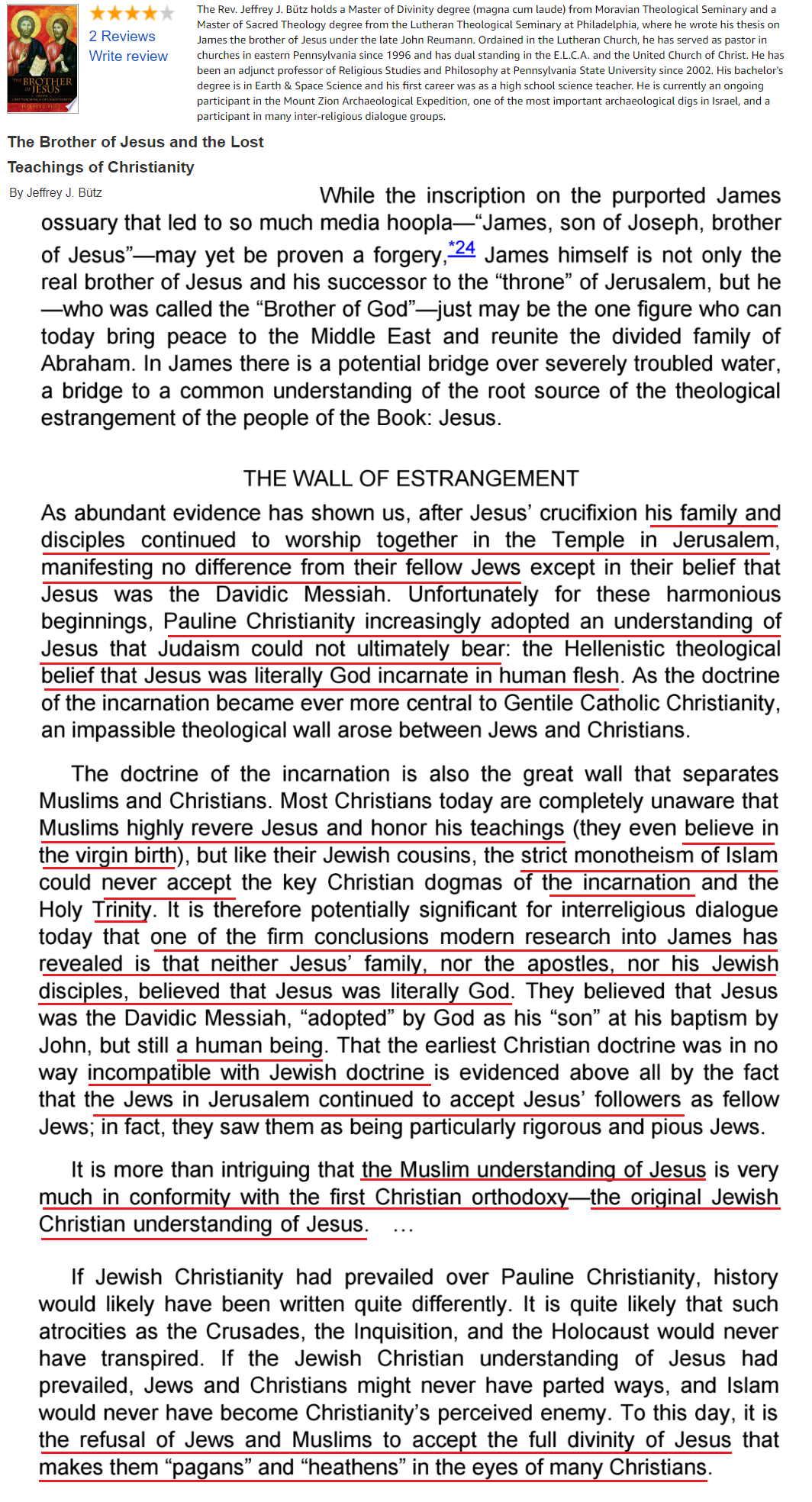
The Rev. Jeffrey J. Biitz holds a Master of Divinity degree (magna cum laude) from Moravian Theological Seminary and a جار جار جاو ١ Master of Sacred Theology degree from the Lutheran Theological Seminary at Philadelphia, where he wrote his thesis on 2 Reviews James the brother of Jesus under the late John Reumann. Ordained in the Lutheran Church, he has served as pastor in Write review churches in eastern Pennsylvania since 1996 and has dual standing in the E.L.C.A. and the United Church of Christ. He has been an adjunct professor of Religious Studies and Philosophy at Pennsylvania State University since 2002. His bachelor's degree is in Earth & Space Science and his first career was as a high school science teacher. He is currently an ongoing participant in the Mount Zion Archaeological Expedition, one of the most important archaeological digs in Israel, and a participant in many inter-religious dialogue groups. The Brother of Jesus and the Lost Teachings of Christianity By Jeffrey J. Butz While the inscription on the purported James ossuary that led to so much media hoopla—“James, son of Joseph, brother of Jesus’—may yet be proven a James himself is not only the real brother of Jesus and his successor to the “throne” of Jerusalem, but he —who was called the “Brother of God’—just may be the one figure who can today bring peace to the Middle East and reunite the divided family of Abraham. In James there is a potential bridge over severely troubled water, a bridge to a common understanding of the root source of the theological estrangement of the people of the Book: Jesus. THE WALL OF ESTRANGEMENT As abundant evidence has shown us, after Jesus’ crucifixion his family and disciples continued to worship together in the Temple in Jerusalem, manifesting no difference from their fellow Jews except in their belief that Jesus was the Davidic Messiah. Unfortunately for these harmonious beginnings, Pauline Christianity increasingly adopted an understanding of Jesus that Judaism could not ultimately bear: the Hellenistic theological belief that Jesus was literally God incarnate in human flesh. As the doctrine of the incarnation became ever more central to Gentile Catholic Christianity, an impassible theological wall arose between Jews and Christians. The doctrine of the incarnation is also the great wall that separates Muslims and Christians. Most Christians today are completely unaware that Muslims highly revere Jesus and honor his teachings (they even believe in the virgin birth), but like their Jewish cousins, the strict monotheism of Islam could never accept the key Christian dogmas of the incarnation and the Holy Trinity. It is therefore potentially significant for interreligious dialogue today that one of the firm conclusions modern research into James has revealed is that neither Jesus’ family, nor the apostles, nor his Jewish disciples, believed that Jesus was literally God. They believed that Jesus was the Davidic Messiah, “adopted” by God as his “son” at his baptism by John, but still a human being. That the earliest Christian doctrine was in no way incompatible with Jewish doctrine is evidenced above all by the fact that the Jews in Jerusalem continued to accept Jesus’ followers as fellow Jews; in fact, they saw them as being particularly rigorous and pious Jews. It is more than intriguing that the Muslim understanding of Jesus is very much in conformity with the first original Jewish Christian understanding of Jesus. If Jewish Christianity had prevailed over Pauline Christianity, history would likely have been written quite differently. It is quite likely that such atrocities as the Crusades, the Inquisition, and the Holocaust would never have transpired. If the Jewish Christian understanding of Jesus had prevailed, Jews and Christians might never have parted ways, and Islam would never have become Christianity’s perceived enemy. To this day, it is the refusal of Jews and Muslims to accept the full divinity of Jesus that makes them “pagans” and “heathens” in the eyes of many Christians.
Drag to select text in the image, then copy (Ctrl/Cmd+C). ·

| Title | First Followers |
|---|---|
| Description | |
| Posted by | theIslampill |
| Tags | dawah, new testament, christianity, disciples |
| Slug | — (none yet) |
| Canonical id | 632586bb10da |
| Type | image/png |
| Dimensions | 1064×1968 |
| Size | 871 KB |
| Created | 2026-06-10 08:56 UTC |
| Views | 19 |
Searchable text (OCR)
The Rev. Jeffrey J. Biitz holds a Master of Divinity degree (magna cum laude) from Moravian Theological Seminary and a جار جار جاو ١ Master of Sacred Theology degree from the Lutheran Theological Seminary at Philadelphia, where he wrote his thesis on 2 Reviews James the brother of Jesus under the late John Reumann. Ordained in the Lutheran Church, he has served as pastor in Write review churches in eastern Pennsylvania since 1996 and has dual standing in the E.L.C.A. and the United Church of Christ. He has been an adjunct professor of Religious Studies and Philosophy at Pennsylvania State University since 2002. His bachelor's degree is in Earth & Space Science and his first career was as a high school science teacher. He is currently an ongoing participant in the Mount Zion Archaeological Expedition, one of the most important archaeological digs in Israel, and a participant in many inter-religious dialogue groups. The Brother of Jesus and the Lost Teachings of Christianity By Jeffrey J. Butz While the inscription on the purported James ossuary that led to so much media hoopla—“James, son of Joseph, brother of Jesus’—may yet be proven a James himself is not only the real brother of Jesus and his successor to the “throne” of Jerusalem, but he —who was called the “Brother of God’—just may be the one figure who can today bring peace to the Middle East and reunite the divided family of Abraham. In James there is a potential bridge over severely troubled water, a bridge to a common understanding of the root source of the theological estrangement of the people of the Book: Jesus. THE WALL OF ESTRANGEMENT As abundant evidence has shown us, after Jesus’ crucifixion his family and disciples continued to worship together in the Temple in Jerusalem, manifesting no difference from their fellow Jews except in their belief that Jesus was the Davidic Messiah. Unfortunately for these harmonious beginnings, Pauline Christianity increasingly adopted an understanding of Jesus that Judaism could not ultimately bear: the Hellenistic theological belief that Jesus was literally God incarnate in human flesh. As the doctrine of the incarnation became ever more central to Gentile Catholic Christianity, an impassible theological wall arose between Jews and Christians. The doctrine of the incarnation is also the great wall that separates Muslims and Christians. Most Christians today are completely unaware that Muslims highly revere Jesus and honor his teachings (they even believe in the virgin birth), but like their Jewish cousins, the strict monotheism of Islam could never accept the key Christian dogmas of the incarnation and the Holy Trinity. It is therefore potentially significant for interreligious dialogue today that one of the firm conclusions modern research into James has revealed is that neither Jesus’ family, nor the apostles, nor his Jewish disciples, believed that Jesus was literally God. They believed that Jesus was the Davidic Messiah, “adopted” by God as his “son” at his baptism by John, but still a human being. That the earliest Christian doctrine was in no way incompatible with Jewish doctrine is evidenced above all by the fact that the Jews in Jerusalem continued to accept Jesus’ followers as fellow Jews; in fact, they saw them as being particularly rigorous and pious Jews. It is more than intriguing that the Muslim understanding of Jesus is very much in conformity with the first original Jewish Christian understanding of Jesus. If Jewish Christianity had prevailed over Pauline Christianity, history would likely have been written quite differently. It is quite likely that such atrocities as the Crusades, the Inquisition, and the Holocaust would never have transpired. If the Jewish Christian understanding of Jesus had prevailed, Jews and Christians might never have parted ways, and Islam would never have become Christianity’s perceived enemy. To this day, it is the refusal of Jews and Muslims to accept the full divinity of Jesus that makes them “pagans” and “heathens” in the eyes of many Christians.