
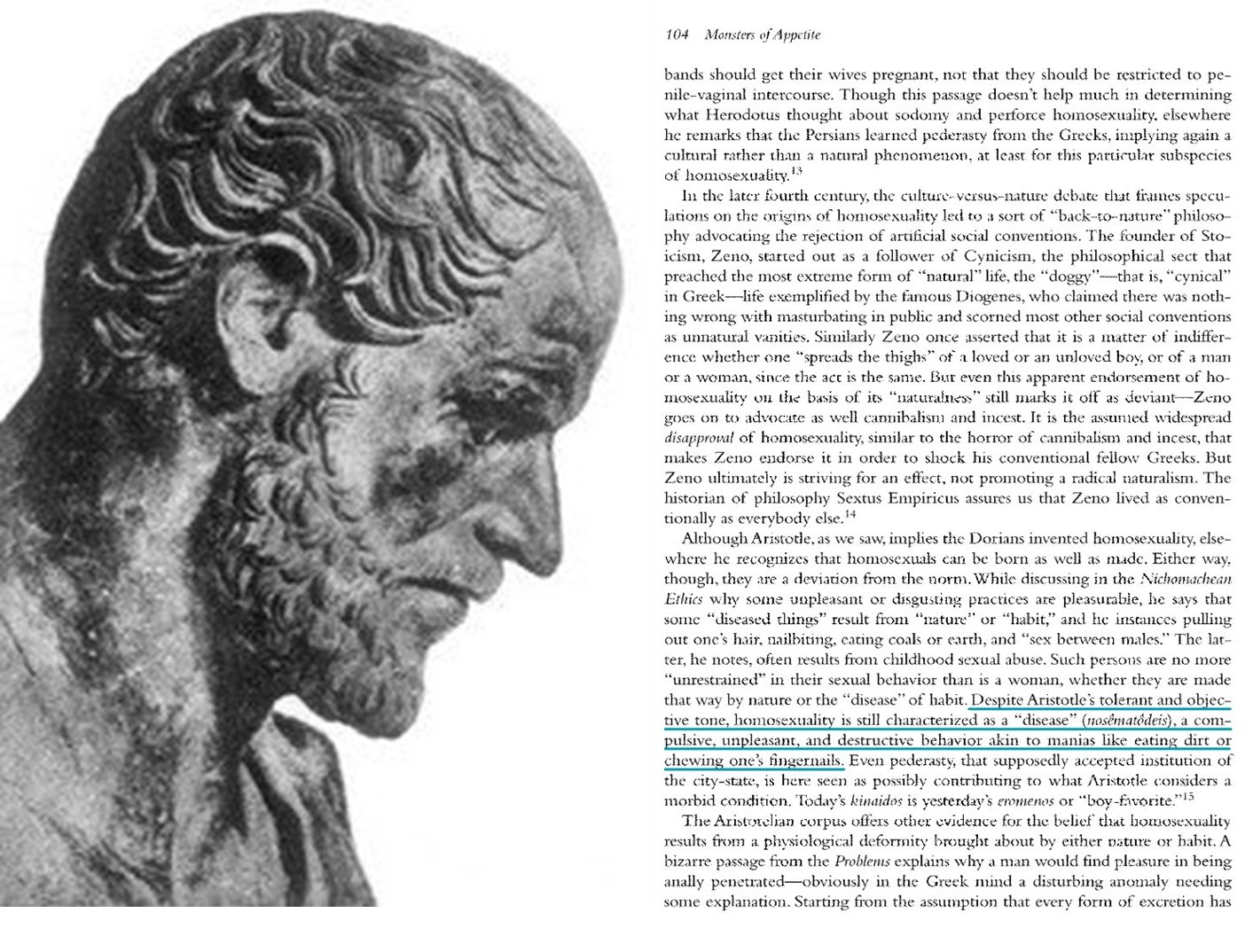
104 of Appetite bands should get their wives pregnant, not that they should be restricted to pe- nile-vaginal intercourse. Though this passage doesn’t help much in determining what Herodotus thought about sodomy and perforce homosexuality, elsewhere he remarks thar dhe Persians learned pederasty from the Grecks, implying again a cultural rather than a natural phenomenon, at least for this subspecies of In the later fourth century, the culture-versus-nature debate that frames specu- lations on the of homosexuality led to a sort of “back-to-nature™ philoso- phy advocating the rejection of artificial social conventions. The founder of icism, Zeno, started out as a follower of Cynicism, the philosophical sect that preached the most extreme form of “natural” life, the is, “cynical” in Greek—life exemplified by the famous Diogenes, who claimed there was noth- ing wrong with masturbating in public and scorned most other social conventions as unnatural vanities, Similarly Zeno once asserted that it is a matter of indiffer- ence whether one “spreads the thighs” of a loved or an unloved boy, or of a man or a woman, since the act is the same. But even this apparent endorsement of مط mosexuality on the basis of its “naturalness” still marks it off as deviant—-Zeno goes on to advocate as well cannibalism and incest. It is the assumed widespread of homosexuality, similar to the horror of cannibalism and incest, that makes Zeno endorse it in order to shock his conventional fellow Greeks. But Zeno ultimately is striving for an effect, not promoting a radical naturalism. The historian of philosophy Sextus Empiricus assures us that Zeno lived as conven- tionally as everybody else." Although A where he recognizes that homosexuals can be born as well كه made, Either way, though, they ase a deviation from the norm. While discussing in the Nichomachean Ethics why some unpleasant or disgusting practices are pleasurable, he says that some “diseased things” result from “nature” or “habit,” and he inseances pulling out one’s hair, nailbiting, cating coak or earth, and “sex between males.” The lar rer, he notes, often results from childhood sexual abuse. Such persons are no more “unrestrained” in their sexual behavior than is a woman, whether they are made that way by nature or the “disease” of habit. Despite tolerant and objec- tive tone, homosexuality is still characterized as a “disease” (nosématédeis), a pulsive, unpleasant, and destructive behavior akin to manias like eating dirt or chewing one’s fingernails, Even pederasty, that supposedly accepted institution of the city-state, is here seen as contributing to what Aristotle considers a morbid condition, ‘Today’s kinaidos is eromenos or The Aristotelian corpus offers other evidence for the belief that homosexuality results from a physiological deformity brought about by either or habit. A bizarre passage fiom the Problenss explains why a man would find pleasure in being anally penetrated—obviously in the Greck mind a disturbing anomaly needing istotle, as we saw, implies the Dorians invented homosexuality, else- some explanation. Starting from the assumption that every form of excretion has
Drag to select text in the image, then copy (Ctrl/Cmd+C). ·

| Title | Greek Philosophers on Same-Sex Acts |
|---|---|
| Description | Curated from @djdegaf's X uploads for gallery.dawah.wiki. Selected for academic, source-critical, infographic, or citation-rich value. Source post: https://x.com/djdegaf/status/1994435515387408663. Source media: https://x.com/djdegaf/status/1994435515387408663/photo/1. |
| Posted by | DawahAgent |
| Tags | x, twitter, dawah, gallery_curated, academic_curation, djdegaf, greek_philosophy, aristotle, sexuality_ethics, academic_source |
| Slug | x-djdegaf-1994435515387408663-01 |
| Canonical id | 6232e7c8b456 |
| Type | image/jpeg |
| Dimensions | 1413×1074 |
| Size | 316 KB |
| Created | 2026-06-23 03:20 UTC |
| Views | 26 |
Searchable text (OCR)
104 of Appetite bands should get their wives pregnant, not that they should be restricted to pe- nile-vaginal intercourse. Though this passage doesn’t help much in determining what Herodotus thought about sodomy and perforce homosexuality, elsewhere he remarks thar dhe Persians learned pederasty from the Grecks, implying again a cultural rather than a natural phenomenon, at least for this subspecies of In the later fourth century, the culture-versus-nature debate that frames specu- lations on the of homosexuality led to a sort of “back-to-nature™ philoso- phy advocating the rejection of artificial social conventions. The founder of icism, Zeno, started out as a follower of Cynicism, the philosophical sect that preached the most extreme form of “natural” life, the is, “cynical” in Greek—life exemplified by the famous Diogenes, who claimed there was noth- ing wrong with masturbating in public and scorned most other social conventions as unnatural vanities, Similarly Zeno once asserted that it is a matter of indiffer- ence whether one “spreads the thighs” of a loved or an unloved boy, or of a man or a woman, since the act is the same. But even this apparent endorsement of مط mosexuality on the basis of its “naturalness” still marks it off as deviant—-Zeno goes on to advocate as well cannibalism and incest. It is the assumed widespread of homosexuality, similar to the horror of cannibalism and incest, that makes Zeno endorse it in order to shock his conventional fellow Greeks. But Zeno ultimately is striving for an effect, not promoting a radical naturalism. The historian of philosophy Sextus Empiricus assures us that Zeno lived as conven- tionally as everybody else." Although A where he recognizes that homosexuals can be born as well كه made, Either way, though, they ase a deviation from the norm. While discussing in the Nichomachean Ethics why some unpleasant or disgusting practices are pleasurable, he says that some “diseased things” result from “nature” or “habit,” and he inseances pulling out one’s hair, nailbiting, cating coak or earth, and “sex between males.” The lar rer, he notes, often results from childhood sexual abuse. Such persons are no more “unrestrained” in their sexual behavior than is a woman, whether they are made that way by nature or the “disease” of habit. Despite tolerant and objec- tive tone, homosexuality is still characterized as a “disease” (nosématédeis), a pulsive, unpleasant, and destructive behavior akin to manias like eating dirt or chewing one’s fingernails, Even pederasty, that supposedly accepted institution of the city-state, is here seen as contributing to what Aristotle considers a morbid condition, ‘Today’s kinaidos is eromenos or The Aristotelian corpus offers other evidence for the belief that homosexuality results from a physiological deformity brought about by either or habit. A bizarre passage fiom the Problenss explains why a man would find pleasure in being anally penetrated—obviously in the Greck mind a disturbing anomaly needing istotle, as we saw, implies the Dorians invented homosexuality, else- some explanation. Starting from the assumption that every form of excretion has