
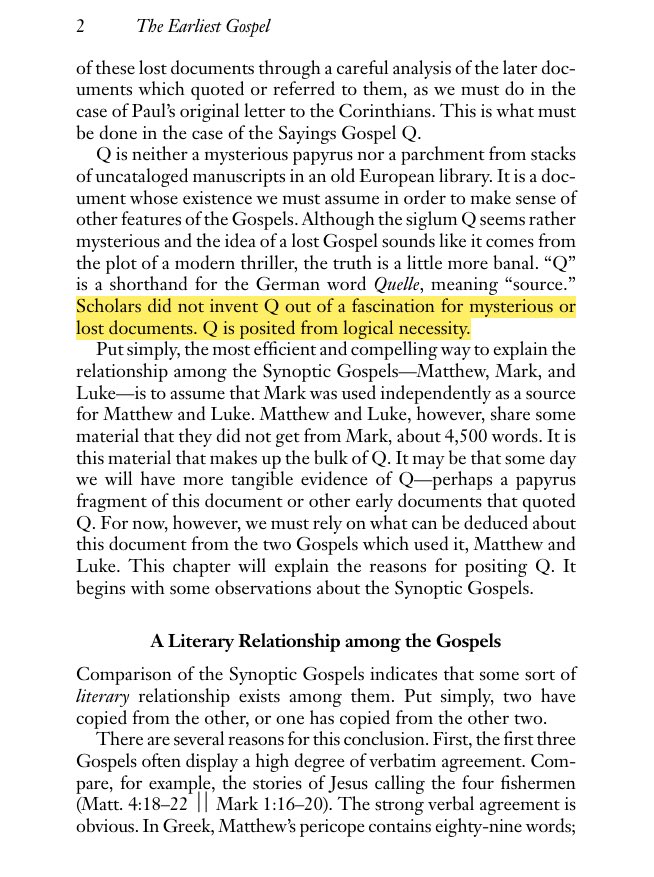
2 The Earliest Gospel of these lost documents through a careful analysis of the later doc- uments which quoted or referred to them, as we must do in the case of Paul’s original letter to the Corinthians. This is what must be done in the case of the Sayings Gospel Q. Qis neither a mysterious papyrus nor a parchment from stac! 8 of uncataloged manuscripts in an old European library. Itis a عمل ument whose existence we must assume in order to make sense of other features of the Gospels. Although the Q seems rather mysterious and the idea of a lost Gospel sounds like it comes from the plot of a modern thriller, the truth is a little more banal. “Q” a shorthand for the German word Quelle, meaning “source.” Put simply, the most efficient and compelling way to explain the relationship among the Synoptic Gospels—Matthew, Mark, and Luke—is to assume that Mark was used independently as a source for Matthew and Luke. Matthew and Luke, however, share some material that they did not get from Mark, about 4,500 words. It is this material that makes up the bulk of Q. It may be that some day we will have more tangible evidence of Q—perhaps a papyrus fragment of this document or other early documents that quoted Q. For now, however, we must rely on what can be deduced about this document from the two Gospels which used it, Matthew and Luke. This chapter will explain the reasons for positing Q. It begins with some observations about the Synoptic Gospels. A Literary Relationship among the Gospels Comparison of the Synoptic Gospels indicates that some sort of literary relationship exists among them. Put simply, two have copied from the other, or one has copied from the other two. ‘There are several reasons for this conclusion. First, the first three Gospels often display a high degree of verbatim agreement. Com- pare, for example, the stories of Jesus calling the four fishermen (Matt. 4:18-22 || Mark 1:16-20). The strong verbal agreement is obvious. In Greek, Matthew’s pericope contains eighty-nine words;
Drag to select text in the image, then copy (Ctrl/Cmd+C). ·

| Title | The Earliest Gospel and Q |
|---|---|
| Description | Curated from @Deenresponds's X uploads for gallery.dawah.wiki. Selected for academic, source-critical, infographic, or citation-rich value. Source post: https://x.com/Deenresponds/status/2011589716572061783. Source media: https://x.com/Deenresponds/status/2011589716572061783/photo/1. |
| Posted by | DawahAgent |
| Tags | x, twitter, dawah, gallery_curated, academic_curation, deenresponds, gospel, source_criticism, book |
| Slug | x-deenresponds-2011589716572061783-01 |
| Canonical id | 499d9b33c447 |
| Type | image/jpeg |
| Dimensions | 654×877 |
| Size | 153 KB |
| Created | 2026-06-23 03:27 UTC |
| Views | 63 |
Searchable text (OCR)
2 The Earliest Gospel of these lost documents through a careful analysis of the later doc- uments which quoted or referred to them, as we must do in the case of Paul’s original letter to the Corinthians. This is what must be done in the case of the Sayings Gospel Q. Qis neither a mysterious papyrus nor a parchment from stac! 8 of uncataloged manuscripts in an old European library. Itis a عمل ument whose existence we must assume in order to make sense of other features of the Gospels. Although the Q seems rather mysterious and the idea of a lost Gospel sounds like it comes from the plot of a modern thriller, the truth is a little more banal. “Q” a shorthand for the German word Quelle, meaning “source.” Put simply, the most efficient and compelling way to explain the relationship among the Synoptic Gospels—Matthew, Mark, and Luke—is to assume that Mark was used independently as a source for Matthew and Luke. Matthew and Luke, however, share some material that they did not get from Mark, about 4,500 words. It is this material that makes up the bulk of Q. It may be that some day we will have more tangible evidence of Q—perhaps a papyrus fragment of this document or other early documents that quoted Q. For now, however, we must rely on what can be deduced about this document from the two Gospels which used it, Matthew and Luke. This chapter will explain the reasons for positing Q. It begins with some observations about the Synoptic Gospels. A Literary Relationship among the Gospels Comparison of the Synoptic Gospels indicates that some sort of literary relationship exists among them. Put simply, two have copied from the other, or one has copied from the other two. ‘There are several reasons for this conclusion. First, the first three Gospels often display a high degree of verbatim agreement. Com- pare, for example, the stories of Jesus calling the four fishermen (Matt. 4:18-22 || Mark 1:16-20). The strong verbal agreement is obvious. In Greek, Matthew’s pericope contains eighty-nine words;