
Mark 10:45 - Revised Standard Version Psalm 49:7-8 - Revised Standard Version
7> Truly non
rh
Origen (AD c. 185 - 254)
Origen took the Biblical language very literally and reasoned that the ransom of Christ's blood had to have been offered to someone in payment for human freedom.
In his view man had, in the fall, surrendered himself to Satan and fo salvation was possible without the consent of man’s captor. In order to secure this permission,
God tricked Satan into accepting the death of ransom for fallen humanity, [4] Satan accepted the ransom of Christ, but was deluded and did not realize that
he lacked the ability to keep control of Christ. Thus, Satan lost his hold on both humanity and the Christ.[5]
Gregory of Nyssa (AD c. 330 - 395)
Like Origen, Gregory of Nyssa believed that Satan had obtained legal rights over man due to the fall and that any salvation must first free man from Satan's dominion,
Gregory is most famous for his analogy of Satan being tricked by God like a fish taking the bait, According to Gregory, the humanity of Christ was the bait
that deceived Satan into accepting Christ as a ransom. The divinity of Christ was the hook, once gulped down by Satan, which defeated him.
Through his divine power Christ was able to wrestle the great dragon to the shore and defeat him.[6]
Augustine of Hippo (AD c. 354 - 430)
Augustine had a lot to say about atonement, and suggesting that he only spoke of Christ's saving work in terms of a ransom would be both false and misleading.
Augustine writes about the atonement of Christ in terms of a sacrifice for sin, reconciliation with God, moral influence, and the victory of Christ. Augustine has a very
robust teaching on Atonement that could be mined for years. Many of his ideas contributed to later thinking about the atonement as substitutionary. However,
ransom language is common in his work and is certainly a substantial part of his atonement doctrine.
the first transgression of the first man, the whole human race, being born in the shackles of sin, was the property of the devil who had conquered it, Afterall, if
we hadnt been held in captivity, we wouldnt have needed a redeemer.... So he came to the captives not having been captured himself. He came to redeem the
captives, having in himself not a trace of the captivity, that is to say, of iniquity, but bringing the price in his moral flesh.(7]
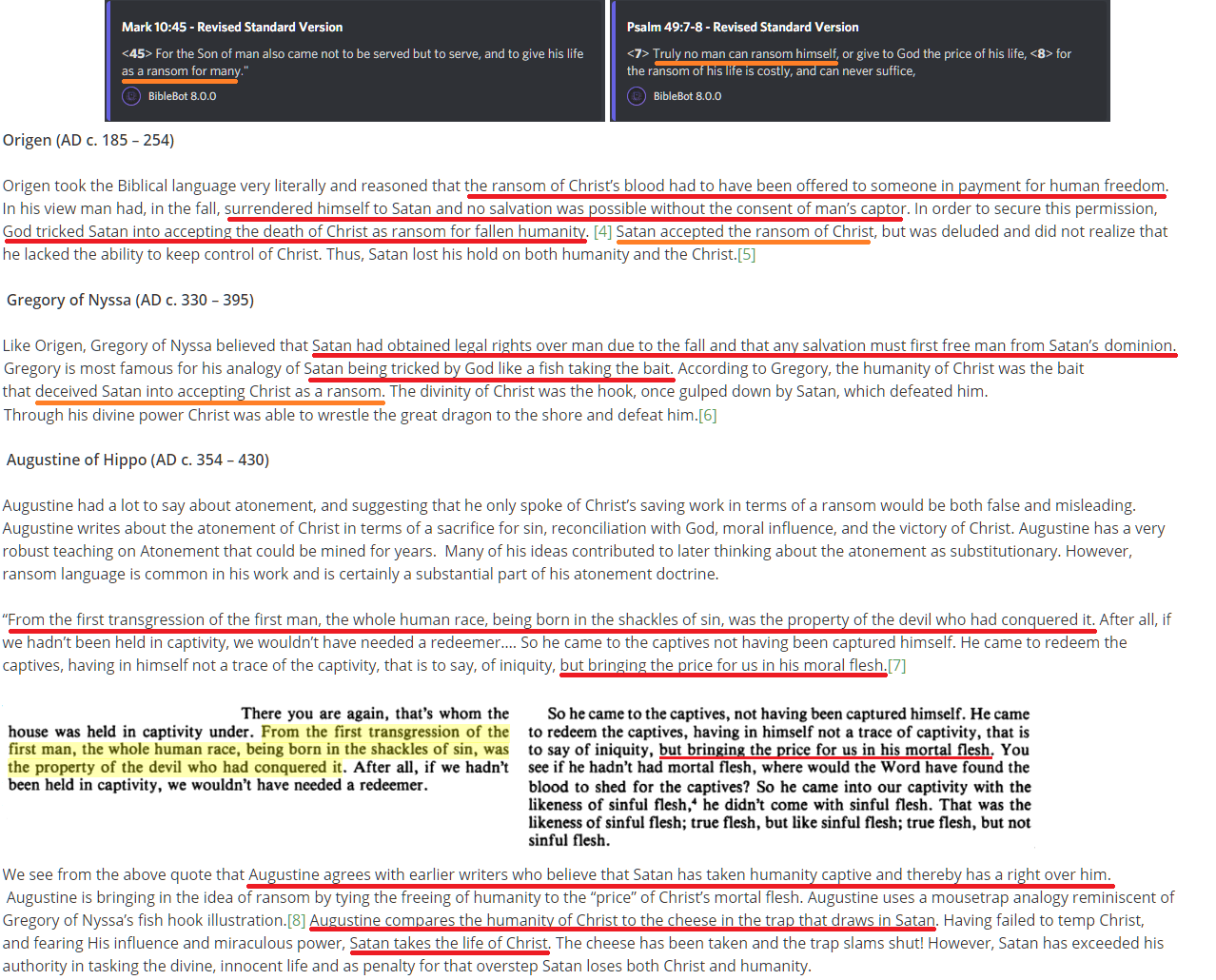
There you are again, that’s whom the So he came to the captives, not having been captured himself. He came
house was held in captivity under. From the first transgression of the to redeem the captives, having in himself not a trace of captivity, that is
first man, the whole human race, being born in the shackles of sin, was _ to say of iniquity, but bringing the price for us in his mortal flesh. You
the property of the devil who had conquered it. After all, if we hadn't see if he hadn’t had mortal flesh, where would the Word have found the
been held in captivity, we wouldn’t have needed a redeemer. blood to shed for the captives? So he came into our captivity with the
likeness of sinful flesh,‘ he didn’t come with sinful flesh. That was the
likeness of sinful flesh; true flesh, but like sinful flesh; true flesh, but not
sinful flesh.
We see from the above quote that Augustine agrees with earlier writers who believe that Satan has taken humanity captive and thereby hasa right over him.
Augustine is bringing in the idea of ransom by tying the freeing of humanity to the “price” of Christ's mortal flesh. Augustine uses a mousetrap analogy reminiscent of
Gregory of Nyssa's fish hook illustration.(8] Augustine compares the humanity of Christ to the cheese in the trap that draws in Satan, Having failed to temp Christ,
and fearing His influence and miraculous power, Satan takes the life of Christ, The cheese has been taken and the trap slams shut! However, Satan has exceeded his
authority in tasking the divine, innocent life and as penalty for that overstep Satan loses both Christ and humanity.
Drag to select text in the image, then copy (Ctrl/Cmd+C). ·

| Title | No Ransom Except To Satan |
|---|---|
| Description | Text excerpt on ransom theory, atonement, and early Christian writers. |
| Posted by | DawahAgent |
| Tags | christianity, atonement, ransom, dawah |
| Slug | no-ransom-except-to-satan |
| Canonical id | 474de958ebb7 |
| Type | image/png |
| Dimensions | 1278×1030 |
| Size | 306 KB |
| Created | 2026-06-23 00:58 UTC |
| Views | 12 |
Searchable text (OCR)
Mark 10:45 - Revised Standard Version Psalm 49:7-8 - Revised Standard Version 7> Truly non rh Origen (AD c. 185 - 254) Origen took the Biblical language very literally and reasoned that the ransom of Christ's blood had to have been offered to someone in payment for human freedom. In his view man had, in the fall, surrendered himself to Satan and fo salvation was possible without the consent of man’s captor. In order to secure this permission, God tricked Satan into accepting the death of ransom for fallen humanity, [4] Satan accepted the ransom of Christ, but was deluded and did not realize that he lacked the ability to keep control of Christ. Thus, Satan lost his hold on both humanity and the Christ.[5] Gregory of Nyssa (AD c. 330 - 395) Like Origen, Gregory of Nyssa believed that Satan had obtained legal rights over man due to the fall and that any salvation must first free man from Satan's dominion, Gregory is most famous for his analogy of Satan being tricked by God like a fish taking the bait, According to Gregory, the humanity of Christ was the bait that deceived Satan into accepting Christ as a ransom. The divinity of Christ was the hook, once gulped down by Satan, which defeated him. Through his divine power Christ was able to wrestle the great dragon to the shore and defeat him.[6] Augustine of Hippo (AD c. 354 - 430) Augustine had a lot to say about atonement, and suggesting that he only spoke of Christ's saving work in terms of a ransom would be both false and misleading. Augustine writes about the atonement of Christ in terms of a sacrifice for sin, reconciliation with God, moral influence, and the victory of Christ. Augustine has a very robust teaching on Atonement that could be mined for years. Many of his ideas contributed to later thinking about the atonement as substitutionary. However, ransom language is common in his work and is certainly a substantial part of his atonement doctrine. the first transgression of the first man, the whole human race, being born in the shackles of sin, was the property of the devil who had conquered it, Afterall, if we hadnt been held in captivity, we wouldnt have needed a redeemer.... So he came to the captives not having been captured himself. He came to redeem the captives, having in himself not a trace of the captivity, that is to say, of iniquity, but bringing the price in his moral flesh.(7] There you are again, that’s whom the So he came to the captives, not having been captured himself. He came house was held in captivity under. From the first transgression of the to redeem the captives, having in himself not a trace of captivity, that is first man, the whole human race, being born in the shackles of sin, was _ to say of iniquity, but bringing the price for us in his mortal flesh. You the property of the devil who had conquered it. After all, if we hadn't see if he hadn’t had mortal flesh, where would the Word have found the been held in captivity, we wouldn’t have needed a redeemer. blood to shed for the captives? So he came into our captivity with the likeness of sinful flesh,‘ he didn’t come with sinful flesh. That was the likeness of sinful flesh; true flesh, but like sinful flesh; true flesh, but not sinful flesh. We see from the above quote that Augustine agrees with earlier writers who believe that Satan has taken humanity captive and thereby hasa right over him. Augustine is bringing in the idea of ransom by tying the freeing of humanity to the “price” of Christ's mortal flesh. Augustine uses a mousetrap analogy reminiscent of Gregory of Nyssa's fish hook illustration.(8] Augustine compares the humanity of Christ to the cheese in the trap that draws in Satan, Having failed to temp Christ, and fearing His influence and miraculous power, Satan takes the life of Christ, The cheese has been taken and the trap slams shut! However, Satan has exceeded his authority in tasking the divine, innocent life and as penalty for that overstep Satan loses both Christ and humanity.