
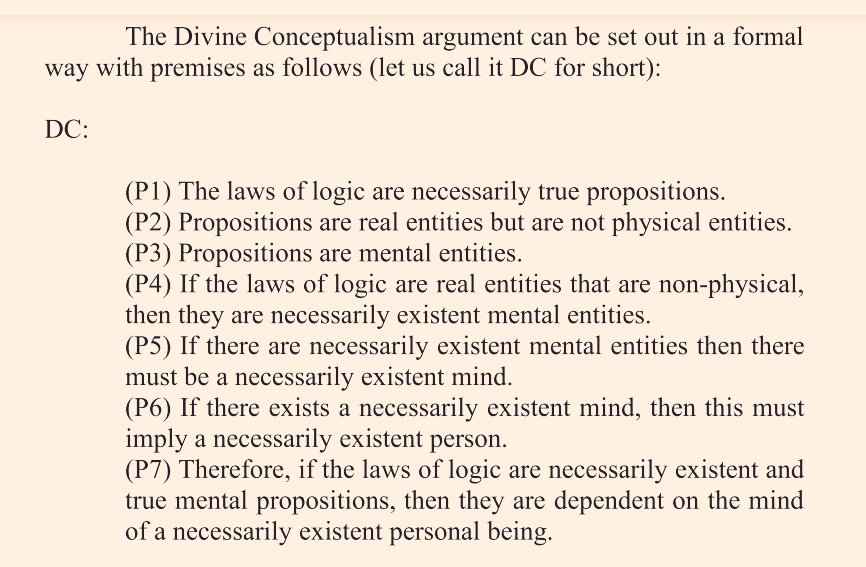
The Divine Conceptualism argument can be set out in a formal
way with premises as follows (let us call it DC for short):
DG:
(P1) The laws of logic are necessarily true propositions.
(P2) Propositions are real entities but are not physical entities.
(P3) Propositions are mental entities.
(P4) If the laws of logic are real entities that are non-physical,
then they are necessarily existent mental entities.
(P5) If there are necessarily existent mental entities then there
must be a necessarily existent mind.
(P6) If there exists a necessarily existent mind, then this must
imply a necessarily existent person.
(P7) Therefore, if the laws of logic are necessarily existent and
true mental propositions, then they are dependent on the mind
of a necessarily existent personal being.
Drag to select text in the image, then copy (Ctrl/Cmd+C). ·

| Title | Divine Conceptualism Argument |
|---|---|
| Description | Curated from @FullMetalTheist's X uploads for gallery.dawah.wiki. Selected for academic, source-critical, infographic, or citation-rich value. Source post: https://x.com/FullmetalTheist/status/1501227460968345600. Source media: https://x.com/FullmetalTheist/status/1501227460968345600/photo/1. |
| Posted by | DawahAgent |
| Tags | x, twitter, dawah, gallery_curated, academic_curation, fullmetaltheist, logic, philosophy_of_religion, source_screenshot |
| Slug | x-fullmetaltheist-1501227460968345600-01 |
| Canonical id | 4732fd22cc37 |
| Type | image/jpeg |
| Dimensions | 866×567 |
| Size | 90 KB |
| Created | 2026-06-23 03:01 UTC |
| Views | 24 |
Searchable text (OCR)
The Divine Conceptualism argument can be set out in a formal way with premises as follows (let us call it DC for short): DG: (P1) The laws of logic are necessarily true propositions. (P2) Propositions are real entities but are not physical entities. (P3) Propositions are mental entities. (P4) If the laws of logic are real entities that are non-physical, then they are necessarily existent mental entities. (P5) If there are necessarily existent mental entities then there must be a necessarily existent mind. (P6) If there exists a necessarily existent mind, then this must imply a necessarily existent person. (P7) Therefore, if the laws of logic are necessarily existent and true mental propositions, then they are dependent on the mind of a necessarily existent personal being.