
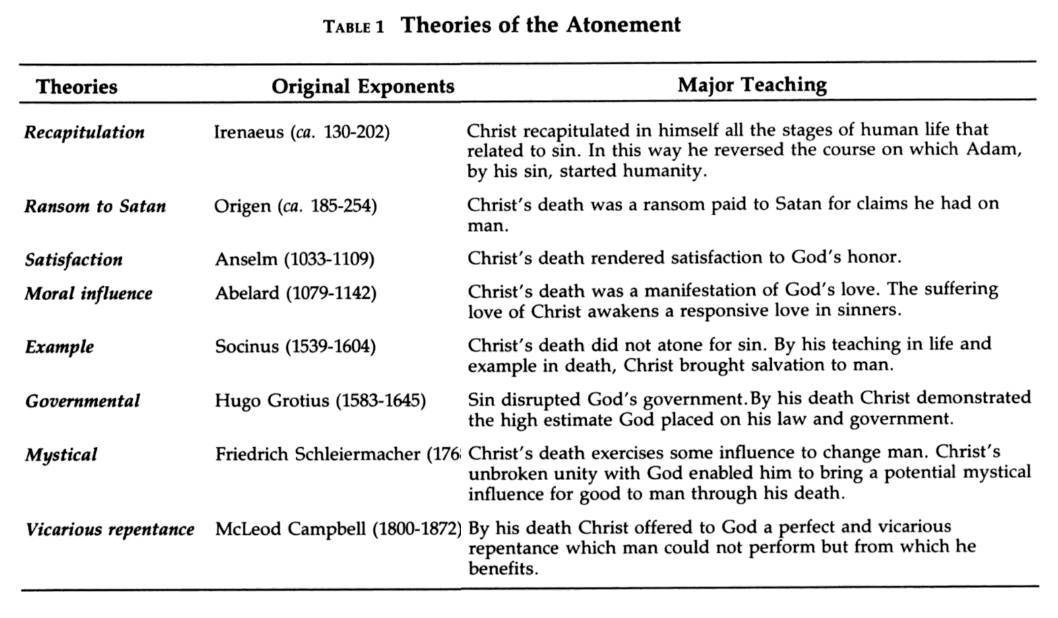
Theories Recapitulation Ransom to Satan Satisfaction Moral influence Example Governmental Mystical Vicarious repentance Theories of the Atonement 1 عمد Original Exponents Major Teaching Irenaeus (ca. 130-202) Origen (ca. 185-254) Anselm (1033-1109) Abelard (1079-1142) Socinus (1539-1604) Hugo Grotius (1583-1645) Christ recapitulated in himself all the stages of human life that related to sin. In this way he reversed the course on which Adam, by his sin, started humanity. Christ’s death was a ransom paid to Satan for claims he had on man. Christ’s death rendered satisfaction to God’s honor. Christ’s death was a manifestation of God’s love. The suffering love of Christ awakens a responsive love in sinners. Christ’s death did not atone for sin. By his teaching in life and example in death, Christ brought salvation to man. Sin disrupted God’s government. By his death Christ demonstrated the high estimate God placed on his law and government. Friedrich Schleiermacher (176 Christ’s death exercises some influence to change man. Christ’s unbroken unity with God enabled him to bring a potential mystical influence for good to man through his death. McLeod Campbell (1800-1872) By his death Christ offered to God a perfect and vicarious repentance which man could not perform but from which he benefits.
Drag to select text in the image, then copy (Ctrl/Cmd+C). ·

| Title | Atonements |
|---|---|
| Description | |
| Posted by | theIslampill |
| Tags | dawah, atonement, atonements, new testament, christianity |
| Slug | — (none yet) |
| Canonical id | 2f57a71a0b98 |
| Type | image/jpeg |
| Dimensions | 1058×618 |
| Size | 91 KB |
| Created | 2026-06-10 08:16 UTC |
| Views | 16 |
Searchable text (OCR)
Theories Recapitulation Ransom to Satan Satisfaction Moral influence Example Governmental Mystical Vicarious repentance Theories of the Atonement 1 عمد Original Exponents Major Teaching Irenaeus (ca. 130-202) Origen (ca. 185-254) Anselm (1033-1109) Abelard (1079-1142) Socinus (1539-1604) Hugo Grotius (1583-1645) Christ recapitulated in himself all the stages of human life that related to sin. In this way he reversed the course on which Adam, by his sin, started humanity. Christ’s death was a ransom paid to Satan for claims he had on man. Christ’s death rendered satisfaction to God’s honor. Christ’s death was a manifestation of God’s love. The suffering love of Christ awakens a responsive love in sinners. Christ’s death did not atone for sin. By his teaching in life and example in death, Christ brought salvation to man. Sin disrupted God’s government. By his death Christ demonstrated the high estimate God placed on his law and government. Friedrich Schleiermacher (176 Christ’s death exercises some influence to change man. Christ’s unbroken unity with God enabled him to bring a potential mystical influence for good to man through his death. McLeod Campbell (1800-1872) By his death Christ offered to God a perfect and vicarious repentance which man could not perform but from which he benefits.