
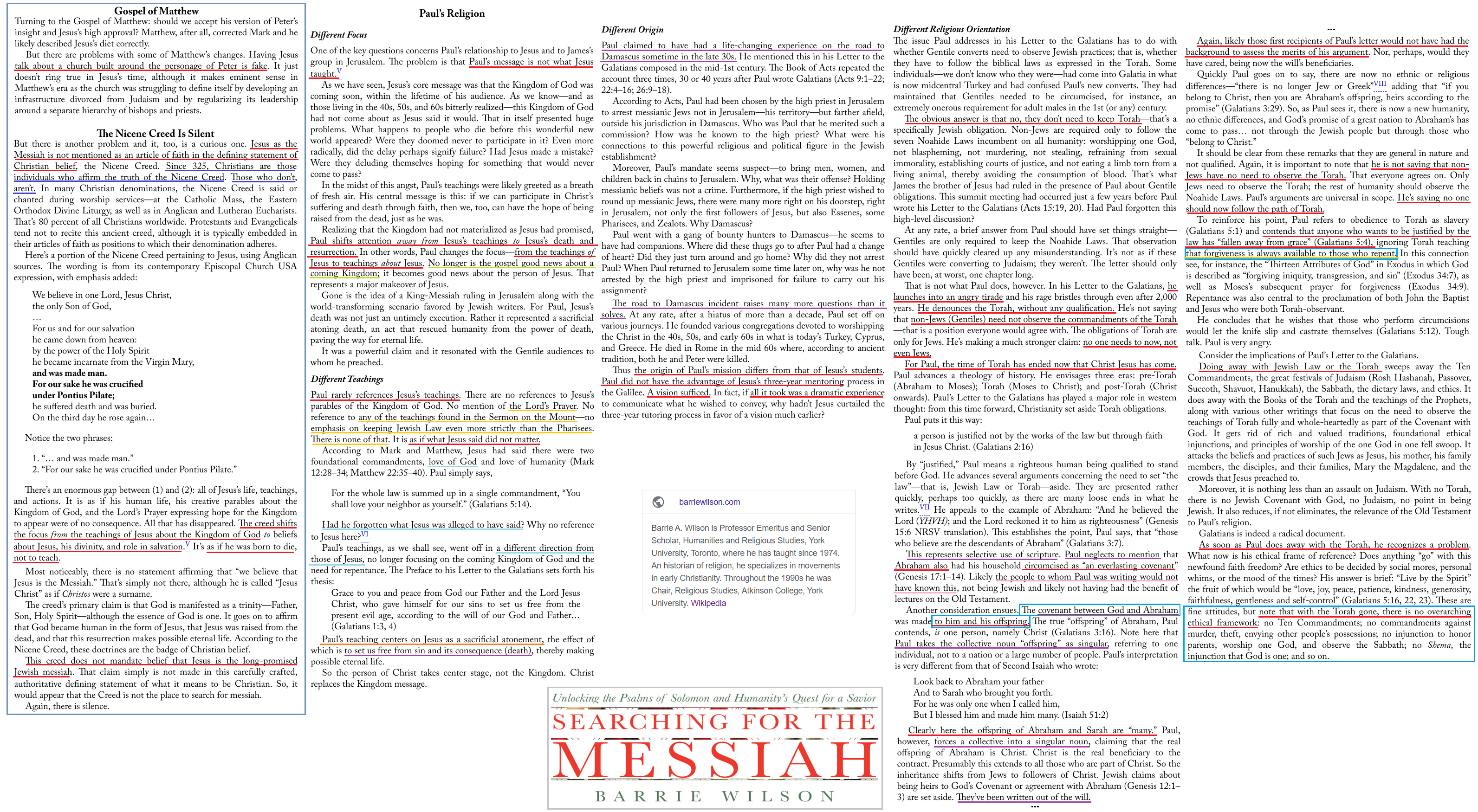
Gospel of Matthew Turning to the Gospel of Matthew: should we accept his version of insight and Jesus’s high approval? Matthew, after all, corrected Mark and he likely described Jesus's diet correctly. But there are problems with some of Matthew’s changes. Having Jesus talk about_a_church built around the personage of Peter is fake. It just doesn't ring true in Jesus's time, although it makes eminent sense in Matthew’s era as the church was struggling to define itself by developing an infrastructure divorced from Judaism and by regularizing its leadership around a separate hierarchy of bishops and priests. The Nicene Creed Is Silent But there is another problem and it, too, is a curious one. Jesus_as_the Messiah is not mentioned as an article of faith in the defining statement of the Nicene Creed. Si 325, Christians _are_those individuals who affirm the truth of the Nicene Creed. don't, aren't. In many Christian denominations, the Nicene Creed is said or chanted during worship services—at the Catholic Mass, the Eastern Orthodox Divine Liturgy, as well as in Anglican and Lutheran Eucharists. That's 80 percent of all Christians worldwide. Protestants and Evangelicals tend not to recite this ancient creed, although it is typically embedded in their articles of faith as positions to which their denomination adheres. Here’s a portion of the Nicene Creed pertaining to Jesus, using Anglican sources. The wording is from its contemporary Episcopal Church USA expression, with emphasis added: We believe in one Lord, Jesus Christ, the only Son of God, For us and for our salvation he came down from heaven: by the power of the Holy Spirit he became incarnate from the Virgin Mary, and was made man. For our sake he was crucified under Pontius Pilate; he suffered death and was buried. On the third day he rose again... Notice the two phrases: 1. “... and was made man.” 2. “For our sake he was crucified under Pontius Pilate.” There’s an enormous gap between (1) and (2): all of life, teachings, and actions. It is as if his human life, his creative parables about the Kingdom of God, and the Lord’s Prayer expressing hope for the Kingdom to appear were of no consequence. All that has disappeared. The creed shifts the focus from the teachings of Jesus about the Kingdom of God م beliefs about Jesus, his divinity, and role in salvation.” It’s as if he was born to die, not to teach. Most noticeably, there is no statement affirming that “we believe that Jesus is the Messiah.” That's simply not there, although he is called “Jesus Christ” as if Christos were a surname. ‘The creed’s primary claim is that God is manifested as a trinity—Father, Son, Holy Spirit—although the essence of God is one. It goes on to affirm that God became human in the form of Jesus, that Jesus was raised from the dead, and that this resurrection makes possible eternal life. According to the Nicene Creed, these doctrines are the badge of Christian belief. ‘This_creed_does_not_mandate belief that long-promised lewish_messiah. That claim simply is not made in this carefully crafted, authoritative defining statement of what it means to be Christian. So, it would appear that the Creed is not the place to search for messiah. Again, there is silence. Religion Different Focus One of the key questions concerns Paul's relationship to Jesus and to James’s group in Jerusalem. The problem is that Paul’s message is not what Jesus taught.” As we have seen, Jesus’s core message was that the Kingdom of God was coming soon, within the lifetime of his audience. As we know—and as those living in the 40s, 50s, and 60s bitterly realized—this Kingdom of God had not come about as Jesus said it would. That in itself presented huge problems. What happens to people who die before this wonderful new world appeared? Were they doomed never to participate in it? Even more radically, did the delay perhaps signify failure? Had Jesus made a mistake? Were they deluding themselves hoping for something that would never come to pass? In the midst of this angst, Paul’s teachings were likely greeted as a breath of fresh air. His central message is this: if we can participate in Christ’s suffering and death through faith, then we, too, can have the hope of being raised from the dead, just as he was. Realizing that the Kingdom had not materialized as Jesus had promised, Paul_shifts_attention away from Jesus's teachings / Jesus's death and resurrection. In other words, Paul changes the focus—from the teachings of jesus to teachings about Jesus. No longer is the gospel good news about a coming Kingdom, it becomes good news about the person of Jesus. That represents a major makeover of Jesus. Gone is the idea of a King-Messiah ruling in Jerusalem along with the world-transforming scenario favored by Jewish writers. For Paul, Jesus's death was not just an untimely execution. Rather it represented a sacrificial atoning death, an act that rescued humanity from the power of death, paving the way for eternal life. It was a powerful claim and it resonated with the Gentile audiences to whom he preached. Different Teachings Paul rarely references Jesus's teachings. ‘There are no references to Jesus’s parables of the Kingdom of God. No mention of the Lord’s Prayer. No reference to any of the teachings found in the Sermon on the Mount—no emphasis on keeping Jewish Law even more strictly than the Pharisees. There is none of that. It is as if what Jesus said did not matter. According to Mark and Matthew, Jesus had said there were two foundational commandments, love of God and love of humanity (Mark 12:28-34; Matthew 22:35—40). Paul simply says, For the whole law is summed up in a single commandment, “You shall love your neighbor as yourself.” (Galatians 5:14). Had he forgotten what Jesus was alleged to have said? Why no reference to Jesus Paul’s teachings, as we shall see, went off in a different direction from those of Jesus, no longer focusing on the coming Kingdom of God and the need for repentance. The Preface to his Letter to the Galatians sets forth his thesis: Grace to you and peace from God our Father and the Lord Jesus Christ, who gave himself for our sins to set us free from the present evil age, according to the will of our God and Father... (Galatians 1:3, 4) Paul’s teaching centers on Jesus as a sacrificial atonement, the effect of which is to set us free from sin and its consequence (death), thereby making possible eternal life. So the person of Christ takes center stage, not the Kingdom. Christ replaces the Kingdom message. Unlocking the Psalms of Solomon and Humanity’s Quest for a S Different Origin have experience_on_the road_to Damascus sometime in the late 30s. He mentioned this in his Letter to the Galatians composed in the mid-1st century. The Book of Acts repeated the account three times, 30 or 40 years after Paul wrote Galatians (Acts 9:1-22; 22:4-16; 26:9-18). According to Acts, Paul had been chosen by the high priest in Jerusalem to arrest messianic Jews not in Jerusalem—his territory—but farther afield, outside his jurisdiction in Damascus. Who was Paul that he merited such a commission? How was he known to the high priest? What were his connections to this powerful religious and political figure in the Jewish establishment? Moreover, Paul’s mandate seems suspect—to bring men, women, and children back in chains to Jerusalem. Why, what was their offense? Holding messianic beliefs was not a crime. Furthermore, if the high priest wished to round up messianic Jews, there were many more right on his doorstep, right in Jerusalem, not only the first followers of Jesus, but also Essenes, some Pharisees, and Zealots. Why Damascus? Paul went with a gang of bounty hunters to Damascus—he seems to have had companions. Where did these thugs go to after Paul had a change of heart? Did they just turn around and go home? Why did they not arrest Paul? When Paul returned to Jerusalem some time later on, why was he not arrested by the high priest and imprisoned for failure to carry out his assignment? The Damascus many more questions than it solves. At any rate, after a hiatus of more than a decade, Paul set off on various journeys. He founded various congregations devoted to worshipping the Christ in the 40s, 50s, and early 60s in what is today’s Turkey, Cyprus, and Greece. He died in Rome in the mid 60s where, according to ancient tradition, both he and Peter were killed. ‘Thus the origin of Paul’s mission differs from that_of Jesus's students. Paul did not have the advantage of Jesus’s three-year mentoring process in the Galilee. A vision sufficed, In fact, if all it took was a dramatic experience to communicate what he wished to convey, why hadn't Jesus curtailed the three-year tutoring process in favor of a vision much earlier? © barriewilson.com Barrie A. Wilson is Professor Emeritus and Senior Scholar, Humanities and Religious Studies, York University, Toronto, where he has taught since 1974. An historian of religion, he specializes in movements in early Christianity. Throughout the 1990s he was Chair, Religious Studies, Atkinson College, York University. Wikipedia or SEARCHING FOR THE MESSIAH BARRIE WILSON Different Religious Orientation The issue Paul addresses in his Letter to the Galatians has to do with whether Gentile converts need to observe Jewish practices; that is, whether they have to follow the biblical laws as expressed in the Torah. Some individuals—we don’t know who they were—had come into Galatia in what is now midcentral Turkey and had confused Paul’s new converts. They had maintained that Gentiles needed to be circumcised, for instance, an extremely onerous requirement for adult males in the 1st (or any) century. ‘The obvious answer is that_no, they don't need to keep Torah—that’s a specifically Jewish obligation. Non-Jews are required only to follow the seven Noahide Laws incumbent on all humanity: worshipping one God, not blaspheming, not murdering, not stealing, refraining from sexual immorality, establishing courts of justice, and not eating a limb torn from a living animal, thereby avoiding the consumption of blood. That’s what James the brother of Jesus had ruled in the presence of Paul about Gentile obligations. This summit meeting had occurred just a few years before Paul wrote his Letter to the Galatians (Acts 15:19, 20). Had Paul forgotten this high-level discussion? At any rate, a brief answer from Paul should have set things straight— Gentiles are only required to keep the Noahide Laws. That observation should have quickly cleared up any misunderstanding. It’s not as if these Gentiles were converting to Judaism; they weren't. The letter should only have been, at worst, one chapter long. ‘That is not what Paul does, however. In his Letter to the Galatians, he, launches into an angry tirade and his rage bristles through even after 2,000 years. He denounces the Torah, without any qualification. He’s not saying that non-Jews (Gentiles) need not observe the commandments of the Torah —that is a position everyone would agree with. The obligations of Torah are only for Jews. He’s making a much stronger claim: even Jews, For Paul, the time of Torah has ended now that Christ Jesus has come. Paul advances a theology of history. He envisages three eras: (Abraham to Moses); Torah (Moses to Christ); and post“Torah (Christ onwards). Paul’s Letter to the Galatians has played a major role in western thought: from this time forward, Christianity set aside Torah obligations. Paul puts it this way: no one needs to now, not a person is justified not by the works of the law but through faith in Jesus Christ. (Galatians 2:16) By “justified,” Paul means a righteous human being qualified to stand before God. He advances several arguments concerning the need to set “the law’—that is, Jewish Law or Torah—aside. They are presented rather quickly, perhaps too quickly, as there are many loose ends in what he He appeals to the example of Abraham: “And he believed the Lord (YHVH); and the Lord reckoned it to him as righteousness” (Genesis 15:6 NRSV translation). This establishes the point, Paul says, that “those who believe are the descendants of Abraham” (Galatians 3:7). ‘This represents selective use_of scripture. Paul neglects to mention that Abraham also had his “an everlasting covenant” (Genesis 17:1-14). Likely the people to whom Paul was writing would not have known this, not being Jewish and likely not having had the benefit of lectures on the Old ‘Testament. Another consideration ensues. The covenant between God and Abraham] was him and his offspring] The true “offspring” of Abraham, Paul contends, is one person, namely Christ (Galatians 3:16). Note here that the “offspring” referring to one individual, not to a nation or a large number of people. interpretation is very different from that of Second Isaiah who wrote: Look back to Abraham your father And to Sarah who brought you forth. For he was only one when I called him, But I blessed him and made him many. (Isaiah 51:2) of are “many.” Paul, however, forces a collective into 2 singular noun, claiming that the real offspring of Abraham is Christ. Christ is the real beneficiary to the contract. Presumably this extends to all those who are part of Christ. So the inheritance shifts from Jews to followers of Christ. Jewish claims about being heirs to God’s Covenant or agreement with Abraham (Genesis 12:1- 3) are set aside. been written out of the will. Again, likely those first recipients of Paul’s letter would not have had the background to assess the merits of his argument. Nor, perhaps, would they have cared, being now the will’s beneficiaries. Quickly Paul goes on to say, there are now no ethnic or religious differences—‘there is no longer Jew or adding that “if you belong to Christ, then you are offspring, heirs according to the promise” (Galatians 3:29). So, as Paul sees it, there is now a new humanity, no ethnic differences, and God’s promise of a great nation to Abraham's has come to pass... not through the Jewish people but through those who “belong to Christ.” It should be clear from these remarks that they are general in nature and not qualified. Again, it is important to note that he is not saying that non- Jews have مم need to observe the Torah. That everyone agrees on. Only Jews need to observe the Torah; the rest of humanity should observe the Noahide Laws. Paul’s arguments are universal in scope. He’s saying no one should now follow the path of Torah, To reinforce his point, Paul refers to obedience to Torah as slavery (Galatians 5:1) and contends that anyone who wants to be justified by the law has “fallen away from Torah teaching In this connection ل see, for instance, the “Thirteen Attributes of God” in dus in which God. is described as “forgiving iniquity, transgression, and sin” (Exodus 34:7), as well as Moses’s subsequent prayer for forgiveness (Exodus 34:9). Repentance was also central to the proclamation of both John the Baptist and Jesus who were both Torah-observant. He concludes that he wishes that those who perform circumcisions would let the knife slip and castrate themselves (Galatians 5:12). Tough talk, Paul is very angry. Consider the implications of Paul’s Letter to the Galatians. Doing away with Jewish Law or the Torah sweeps away the Ten Commandments, the great festivals of Judaism (Rosh Hashanah, Passover, Succoth, Shavuot, Hanukkah), the Sabbath, the dietary laws, and ethics. It does away with the Books of the Torah and the teachings of the Prophets, along with various other writings that focus on the need to observe the teachings of Torah fully and whole-heartedly as part of the Covenant with God. It gets rid of rich and valued traditions, foundational ethical injunctions, and principles of worship of the one God in one fell swoop. It attacks the beliefs and practices of such Jews as Jesus, his mother, his family members, the disciples, and their families, Mary the Magdalene, and the crowds that Jesus preached to. Moreover, it is nothing less than an assault on Judaism. With no Torah, there is no Jewish Covenant with God, no Judaism, no point in being Jewish. It also reduces, if not eliminates, the relevance of the Old Testament to Paul’s religion. Galatians is indeed a radical document. As_soon_as away with the Torah, he recognizes _a_problem. What now is his ethical frame of reference? Does anything “go” with this newfound faith freedom? Are ethics to be decided by social mores, personal whims, or the mood of the times? His answer is brief: “Live by the Spirit” the fruit of which would be “love, joy, peace, patience, kindness, generosity, faithfulness, gentleness and self-control” (Galatians 5:16, 22, 23). These are fine attitudes, but note that with the Torah gone, there is no overarching ethical_framework: no Ten Commandments, no commandments against murder, theft, envying other people’s possessions; no injunction to honor parents, worship one God, and observe the Sabbath; no Shema, the injunction that God is one; and so on.
Drag to select text in the image, then copy (Ctrl/Cmd+C). ·

| Title | Paul |
|---|---|
| Description | |
| Posted by | theIslampill |
| Tags | dawah, paul |
| Slug | — (none yet) |
| Canonical id | 2e29c9d3b6a7 |
| Type | image/png |
| Dimensions | 3184×1750 |
| Size | 2207 KB |
| Created | 2026-06-10 08:42 UTC |
| Views | 20 |
Searchable text (OCR)
Gospel of Matthew Turning to the Gospel of Matthew: should we accept his version of insight and Jesus’s high approval? Matthew, after all, corrected Mark and he likely described Jesus's diet correctly. But there are problems with some of Matthew’s changes. Having Jesus talk about_a_church built around the personage of Peter is fake. It just doesn't ring true in Jesus's time, although it makes eminent sense in Matthew’s era as the church was struggling to define itself by developing an infrastructure divorced from Judaism and by regularizing its leadership around a separate hierarchy of bishops and priests. The Nicene Creed Is Silent But there is another problem and it, too, is a curious one. Jesus_as_the Messiah is not mentioned as an article of faith in the defining statement of the Nicene Creed. Si 325, Christians _are_those individuals who affirm the truth of the Nicene Creed. don't, aren't. In many Christian denominations, the Nicene Creed is said or chanted during worship services—at the Catholic Mass, the Eastern Orthodox Divine Liturgy, as well as in Anglican and Lutheran Eucharists. That's 80 percent of all Christians worldwide. Protestants and Evangelicals tend not to recite this ancient creed, although it is typically embedded in their articles of faith as positions to which their denomination adheres. Here’s a portion of the Nicene Creed pertaining to Jesus, using Anglican sources. The wording is from its contemporary Episcopal Church USA expression, with emphasis added: We believe in one Lord, Jesus Christ, the only Son of God, For us and for our salvation he came down from heaven: by the power of the Holy Spirit he became incarnate from the Virgin Mary, and was made man. For our sake he was crucified under Pontius Pilate; he suffered death and was buried. On the third day he rose again... Notice the two phrases: 1. “... and was made man.” 2. “For our sake he was crucified under Pontius Pilate.” There’s an enormous gap between (1) and (2): all of life, teachings, and actions. It is as if his human life, his creative parables about the Kingdom of God, and the Lord’s Prayer expressing hope for the Kingdom to appear were of no consequence. All that has disappeared. The creed shifts the focus from the teachings of Jesus about the Kingdom of God م beliefs about Jesus, his divinity, and role in salvation.” It’s as if he was born to die, not to teach. Most noticeably, there is no statement affirming that “we believe that Jesus is the Messiah.” That's simply not there, although he is called “Jesus Christ” as if Christos were a surname. ‘The creed’s primary claim is that God is manifested as a trinity—Father, Son, Holy Spirit—although the essence of God is one. It goes on to affirm that God became human in the form of Jesus, that Jesus was raised from the dead, and that this resurrection makes possible eternal life. According to the Nicene Creed, these doctrines are the badge of Christian belief. ‘This_creed_does_not_mandate belief that long-promised lewish_messiah. That claim simply is not made in this carefully crafted, authoritative defining statement of what it means to be Christian. So, it would appear that the Creed is not the place to search for messiah. Again, there is silence. Religion Different Focus One of the key questions concerns Paul's relationship to Jesus and to James’s group in Jerusalem. The problem is that Paul’s message is not what Jesus taught.” As we have seen, Jesus’s core message was that the Kingdom of God was coming soon, within the lifetime of his audience. As we know—and as those living in the 40s, 50s, and 60s bitterly realized—this Kingdom of God had not come about as Jesus said it would. That in itself presented huge problems. What happens to people who die before this wonderful new world appeared? Were they doomed never to participate in it? Even more radically, did the delay perhaps signify failure? Had Jesus made a mistake? Were they deluding themselves hoping for something that would never come to pass? In the midst of this angst, Paul’s teachings were likely greeted as a breath of fresh air. His central message is this: if we can participate in Christ’s suffering and death through faith, then we, too, can have the hope of being raised from the dead, just as he was. Realizing that the Kingdom had not materialized as Jesus had promised, Paul_shifts_attention away from Jesus's teachings / Jesus's death and resurrection. In other words, Paul changes the focus—from the teachings of jesus to teachings about Jesus. No longer is the gospel good news about a coming Kingdom, it becomes good news about the person of Jesus. That represents a major makeover of Jesus. Gone is the idea of a King-Messiah ruling in Jerusalem along with the world-transforming scenario favored by Jewish writers. For Paul, Jesus's death was not just an untimely execution. Rather it represented a sacrificial atoning death, an act that rescued humanity from the power of death, paving the way for eternal life. It was a powerful claim and it resonated with the Gentile audiences to whom he preached. Different Teachings Paul rarely references Jesus's teachings. ‘There are no references to Jesus’s parables of the Kingdom of God. No mention of the Lord’s Prayer. No reference to any of the teachings found in the Sermon on the Mount—no emphasis on keeping Jewish Law even more strictly than the Pharisees. There is none of that. It is as if what Jesus said did not matter. According to Mark and Matthew, Jesus had said there were two foundational commandments, love of God and love of humanity (Mark 12:28-34; Matthew 22:35—40). Paul simply says, For the whole law is summed up in a single commandment, “You shall love your neighbor as yourself.” (Galatians 5:14). Had he forgotten what Jesus was alleged to have said? Why no reference to Jesus Paul’s teachings, as we shall see, went off in a different direction from those of Jesus, no longer focusing on the coming Kingdom of God and the need for repentance. The Preface to his Letter to the Galatians sets forth his thesis: Grace to you and peace from God our Father and the Lord Jesus Christ, who gave himself for our sins to set us free from the present evil age, according to the will of our God and Father... (Galatians 1:3, 4) Paul’s teaching centers on Jesus as a sacrificial atonement, the effect of which is to set us free from sin and its consequence (death), thereby making possible eternal life. So the person of Christ takes center stage, not the Kingdom. Christ replaces the Kingdom message. Unlocking the Psalms of Solomon and Humanity’s Quest for a S Different Origin have experience_on_the road_to Damascus sometime in the late 30s. He mentioned this in his Letter to the Galatians composed in the mid-1st century. The Book of Acts repeated the account three times, 30 or 40 years after Paul wrote Galatians (Acts 9:1-22; 22:4-16; 26:9-18). According to Acts, Paul had been chosen by the high priest in Jerusalem to arrest messianic Jews not in Jerusalem—his territory—but farther afield, outside his jurisdiction in Damascus. Who was Paul that he merited such a commission? How was he known to the high priest? What were his connections to this powerful religious and political figure in the Jewish establishment? Moreover, Paul’s mandate seems suspect—to bring men, women, and children back in chains to Jerusalem. Why, what was their offense? Holding messianic beliefs was not a crime. Furthermore, if the high priest wished to round up messianic Jews, there were many more right on his doorstep, right in Jerusalem, not only the first followers of Jesus, but also Essenes, some Pharisees, and Zealots. Why Damascus? Paul went with a gang of bounty hunters to Damascus—he seems to have had companions. Where did these thugs go to after Paul had a change of heart? Did they just turn around and go home? Why did they not arrest Paul? When Paul returned to Jerusalem some time later on, why was he not arrested by the high priest and imprisoned for failure to carry out his assignment? The Damascus many more questions than it solves. At any rate, after a hiatus of more than a decade, Paul set off on various journeys. He founded various congregations devoted to worshipping the Christ in the 40s, 50s, and early 60s in what is today’s Turkey, Cyprus, and Greece. He died in Rome in the mid 60s where, according to ancient tradition, both he and Peter were killed. ‘Thus the origin of Paul’s mission differs from that_of Jesus's students. Paul did not have the advantage of Jesus’s three-year mentoring process in the Galilee. A vision sufficed, In fact, if all it took was a dramatic experience to communicate what he wished to convey, why hadn't Jesus curtailed the three-year tutoring process in favor of a vision much earlier? © barriewilson.com Barrie A. Wilson is Professor Emeritus and Senior Scholar, Humanities and Religious Studies, York University, Toronto, where he has taught since 1974. An historian of religion, he specializes in movements in early Christianity. Throughout the 1990s he was Chair, Religious Studies, Atkinson College, York University. Wikipedia or SEARCHING FOR THE MESSIAH BARRIE WILSON Different Religious Orientation The issue Paul addresses in his Letter to the Galatians has to do with whether Gentile converts need to observe Jewish practices; that is, whether they have to follow the biblical laws as expressed in the Torah. Some individuals—we don’t know who they were—had come into Galatia in what is now midcentral Turkey and had confused Paul’s new converts. They had maintained that Gentiles needed to be circumcised, for instance, an extremely onerous requirement for adult males in the 1st (or any) century. ‘The obvious answer is that_no, they don't need to keep Torah—that’s a specifically Jewish obligation. Non-Jews are required only to follow the seven Noahide Laws incumbent on all humanity: worshipping one God, not blaspheming, not murdering, not stealing, refraining from sexual immorality, establishing courts of justice, and not eating a limb torn from a living animal, thereby avoiding the consumption of blood. That’s what James the brother of Jesus had ruled in the presence of Paul about Gentile obligations. This summit meeting had occurred just a few years before Paul wrote his Letter to the Galatians (Acts 15:19, 20). Had Paul forgotten this high-level discussion? At any rate, a brief answer from Paul should have set things straight— Gentiles are only required to keep the Noahide Laws. That observation should have quickly cleared up any misunderstanding. It’s not as if these Gentiles were converting to Judaism; they weren't. The letter should only have been, at worst, one chapter long. ‘That is not what Paul does, however. In his Letter to the Galatians, he, launches into an angry tirade and his rage bristles through even after 2,000 years. He denounces the Torah, without any qualification. He’s not saying that non-Jews (Gentiles) need not observe the commandments of the Torah —that is a position everyone would agree with. The obligations of Torah are only for Jews. He’s making a much stronger claim: even Jews, For Paul, the time of Torah has ended now that Christ Jesus has come. Paul advances a theology of history. He envisages three eras: (Abraham to Moses); Torah (Moses to Christ); and post“Torah (Christ onwards). Paul’s Letter to the Galatians has played a major role in western thought: from this time forward, Christianity set aside Torah obligations. Paul puts it this way: no one needs to now, not a person is justified not by the works of the law but through faith in Jesus Christ. (Galatians 2:16) By “justified,” Paul means a righteous human being qualified to stand before God. He advances several arguments concerning the need to set “the law’—that is, Jewish Law or Torah—aside. They are presented rather quickly, perhaps too quickly, as there are many loose ends in what he He appeals to the example of Abraham: “And he believed the Lord (YHVH); and the Lord reckoned it to him as righteousness” (Genesis 15:6 NRSV translation). This establishes the point, Paul says, that “those who believe are the descendants of Abraham” (Galatians 3:7). ‘This represents selective use_of scripture. Paul neglects to mention that Abraham also had his “an everlasting covenant” (Genesis 17:1-14). Likely the people to whom Paul was writing would not have known this, not being Jewish and likely not having had the benefit of lectures on the Old ‘Testament. Another consideration ensues. The covenant between God and Abraham] was him and his offspring] The true “offspring” of Abraham, Paul contends, is one person, namely Christ (Galatians 3:16). Note here that the “offspring” referring to one individual, not to a nation or a large number of people. interpretation is very different from that of Second Isaiah who wrote: Look back to Abraham your father And to Sarah who brought you forth. For he was only one when I called him, But I blessed him and made him many. (Isaiah 51:2) of are “many.” Paul, however, forces a collective into 2 singular noun, claiming that the real offspring of Abraham is Christ. Christ is the real beneficiary to the contract. Presumably this extends to all those who are part of Christ. So the inheritance shifts from Jews to followers of Christ. Jewish claims about being heirs to God’s Covenant or agreement with Abraham (Genesis 12:1- 3) are set aside. been written out of the will. Again, likely those first recipients of Paul’s letter would not have had the background to assess the merits of his argument. Nor, perhaps, would they have cared, being now the will’s beneficiaries. Quickly Paul goes on to say, there are now no ethnic or religious differences—‘there is no longer Jew or adding that “if you belong to Christ, then you are offspring, heirs according to the promise” (Galatians 3:29). So, as Paul sees it, there is now a new humanity, no ethnic differences, and God’s promise of a great nation to Abraham's has come to pass... not through the Jewish people but through those who “belong to Christ.” It should be clear from these remarks that they are general in nature and not qualified. Again, it is important to note that he is not saying that non- Jews have مم need to observe the Torah. That everyone agrees on. Only Jews need to observe the Torah; the rest of humanity should observe the Noahide Laws. Paul’s arguments are universal in scope. He’s saying no one should now follow the path of Torah, To reinforce his point, Paul refers to obedience to Torah as slavery (Galatians 5:1) and contends that anyone who wants to be justified by the law has “fallen away from Torah teaching In this connection ل see, for instance, the “Thirteen Attributes of God” in dus in which God. is described as “forgiving iniquity, transgression, and sin” (Exodus 34:7), as well as Moses’s subsequent prayer for forgiveness (Exodus 34:9). Repentance was also central to the proclamation of both John the Baptist and Jesus who were both Torah-observant. He concludes that he wishes that those who perform circumcisions would let the knife slip and castrate themselves (Galatians 5:12). Tough talk, Paul is very angry. Consider the implications of Paul’s Letter to the Galatians. Doing away with Jewish Law or the Torah sweeps away the Ten Commandments, the great festivals of Judaism (Rosh Hashanah, Passover, Succoth, Shavuot, Hanukkah), the Sabbath, the dietary laws, and ethics. It does away with the Books of the Torah and the teachings of the Prophets, along with various other writings that focus on the need to observe the teachings of Torah fully and whole-heartedly as part of the Covenant with God. It gets rid of rich and valued traditions, foundational ethical injunctions, and principles of worship of the one God in one fell swoop. It attacks the beliefs and practices of such Jews as Jesus, his mother, his family members, the disciples, and their families, Mary the Magdalene, and the crowds that Jesus preached to. Moreover, it is nothing less than an assault on Judaism. With no Torah, there is no Jewish Covenant with God, no Judaism, no point in being Jewish. It also reduces, if not eliminates, the relevance of the Old Testament to Paul’s religion. Galatians is indeed a radical document. As_soon_as away with the Torah, he recognizes _a_problem. What now is his ethical frame of reference? Does anything “go” with this newfound faith freedom? Are ethics to be decided by social mores, personal whims, or the mood of the times? His answer is brief: “Live by the Spirit” the fruit of which would be “love, joy, peace, patience, kindness, generosity, faithfulness, gentleness and self-control” (Galatians 5:16, 22, 23). These are fine attitudes, but note that with the Torah gone, there is no overarching ethical_framework: no Ten Commandments, no commandments against murder, theft, envying other people’s possessions; no injunction to honor parents, worship one God, and observe the Sabbath; no Shema, the injunction that God is one; and so on.