
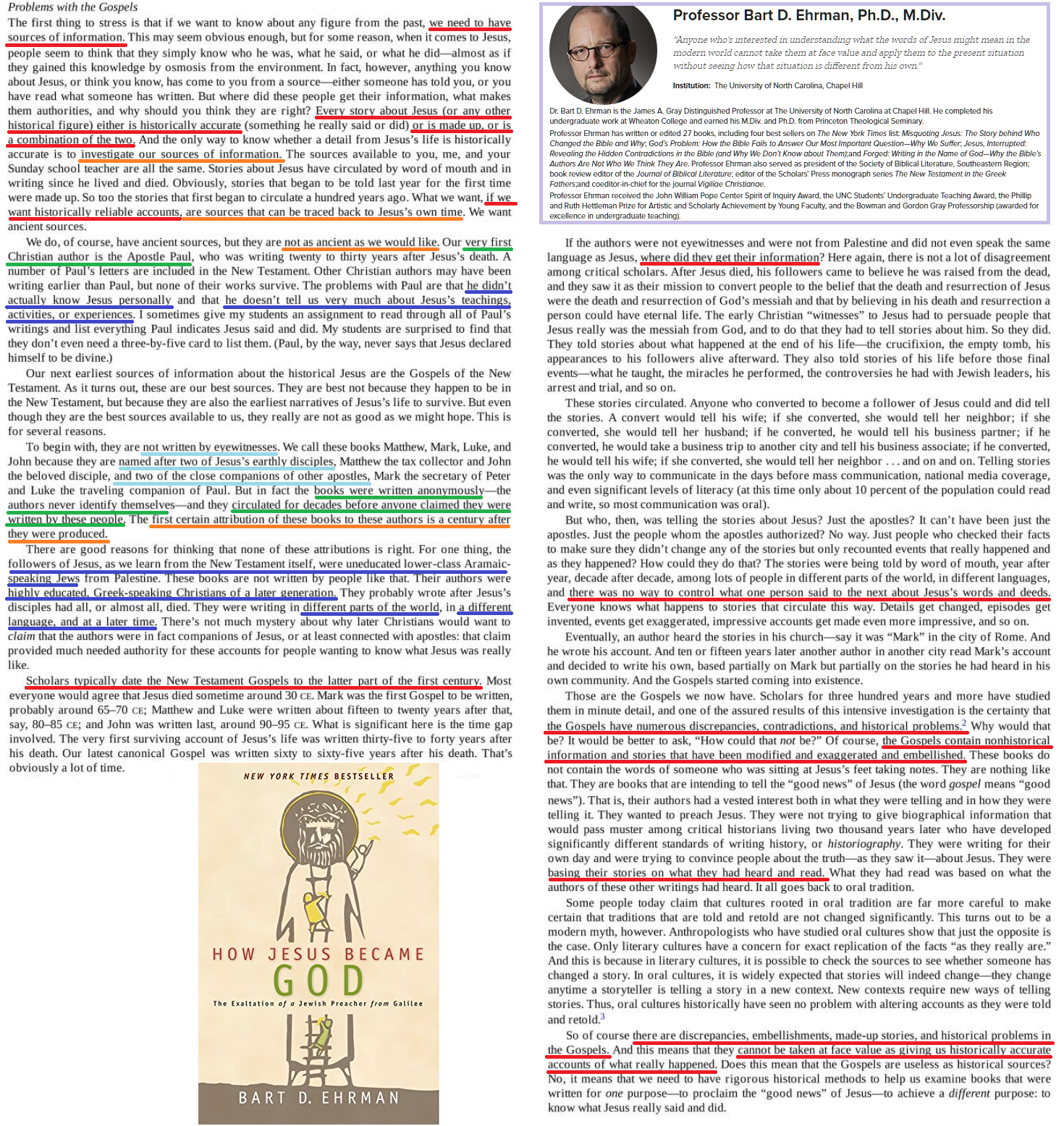
Problems with the Gospels The first thing to stress is that if we want to know about any figure from the past, we need sources of information. This may seem obvious enough, but for some reason, when it comes to Jesus, People seem to think that they simply know who he was, what he said, or what he did—almost as if they gained this knowledge by osmosis from the environment. In fact, however, anything you know about Jesus, or think you know, has come to you from a source—either someone has told you, or you have read what someone has written. But where did these people get their information, what makes them authorities, and why should you think they are right? Every story about Jesus other historical figure) either is historically. accurate (something he really said or did) or is made, up a.combination of the two, And the only way to know whether a detail from life is historically ‘accurate is ما investigate our sources of information. The sources available to you, me, and your Sunday school teacher are all the same. Stories about Jesus have circulated by word of mouth and in writing since he lived and died. Obviously, stories that began to be told last year for the first time were made up. So too the stories that first began to circulate a hundred years ago. What we want, if we want historically reliable accounts, are sources that can be traced back to Jesus’s own time. We want ancient sources. We do, of course, have ancient sources, but they are not as ancient as we would like. Our very first Christian author is the Apostle Paul, who was writing twenty to thirty years after Jesus’s death. A rr of Paul's Teuers are included in the New Testament. Other Christian authors may have been writing earlier than Paul, but none of their works survive. The problems with Paul are that he didn’t know Jesus_personally, and that he doesn’t tell_us_very much about teachings, activities, or experiences. I sometimes give my students an assignment to read through all of Writings and list everything Paul indicates Jesus said and did. My students are surprised to find that they don’t even need a three-by-five card to list them. (Paul, by the way, never says that Jesus declared himself to be divine.) Our next earliest sources of information about the historical Jesus are the Gospels of the New Testament. As it turns out, these are our best sources. They are best not because they happen to be in the New Testament, but because they are also the earliest narratives of Jesus’s life to survive. But even though they are the best sources available to us, they really are not as good as we might hope. This is for several reasons. To begin with, they are not written by eyewitnesses. We call these books Matthew, Mark, Luke, and John because they are named after two of Jesus’s earthly disciples, Matthew the tax collector and John the beloved disciple, and two of the close companions of other apostles, Mark the secretary of Peter asl Like ths Ue ele wees wrt authors never identify themselves—and they circulated for decades before anyone claimed they were ese The Ts certain auributon of books to these authors isa they were produced. There are good reasons for thinking that none of these attributions is right. For one thing, the followers of Jesus, as we learn from the New Testament itself, were uneducated lower-class Aramaic- Speaking Jews from Palestine. These books are not written by people Nike authors were highly educated, Greek-speaking Christians of a later generation, They probably wrote after Jesus’s disciples had all, or almost all, died. They were writing in different parts of the world, in a different language, and_ata There’s not much mystery about why later Christians would want to Claim that the authors were in fact companions of Jesus, or at least connected with apostles: that claim provided much needed authority for these accounts for people wanting to know what Jesus was really like. Scholars typically date the New Testament Gospels latter_part of the first century, Most everyone would agree that Jesus died sometime around 30 cr. Mark was the first Gospel to be written, probably around 65-70 ce; Matthew and Luke were written about fifteen to twenty years after that, say, 80-85 ce; and John was written last, around 90-95 ce. What is significant here is the time gap involved. The very first surviving account of Jesus’s life was written thirty-five to forty years after his death. Our latest canonical Gospel was written sixty to sixty-five years after his death. obviously a lot of time. NEW YORK TIMES و 22 ا BART 0. EHRMAN Professor Bart D. Ehrman, Ph.D., M.Div. “Anyone who's interested in understanding what the words of Jesus might mean in the modern world cannot take them at face value and apply them to the present situation without seeing how that situation is different from his own.” Institution: The University of North Carolina, Chapel Hill Dr. Bart D. Ehrman isthe James A. Gray Distinguished Professor at The University of North Caralina at Chapel Hil. He completed his Undergraduate work at Wheaton College and earned his MDiv. and PhD. from Princeton Theological Seminary. Professor Ehrman has writen or edited 27 books, including four bestsellers on The New York Times list Misquoting Jesus: The Story behind Wino (Changed the Bible and Why, God's Problem: How the Bible Fails to Answer Our Most Important We Suffer. Jesus, ‘Revealing the Contradictions inthe Bible (and Why We Don't Know about Themjand Forged: Writing in the Name of God -Why the Bible's Authors Are Not Who We Think They Are. Professor Ehrman also served as president ofthe Society of Biblical Literature, Southeastern Region; book review editor ofthe Journal of Biblical Literature; editor ofthe Press monograph series The New Testament in the for the journal Vigliae Chrisianae. Professor Ehrman received the John Wiliam Pope Center Sprit of Inquiry Award, the UNC Students’ Undergraduate Teaching Award, the Pillip ‘and Ruth Prize for and Scholarly Achievement by Young and the Bowman and Gordon Gray Professorship (awarded for in undergraduate teaching). If the authors were not eyewitnesses and were not from Palestine and did not even speak the same language as Jesus, where did they get their information? Here again, there is not a lot of disagreement among critical scholars. After Jesus died, his followers came to believe he was raised from the dead, and they saw it as their mission to convert people to the belief that the death and resurrection of Jesus were the death and resurrection of God’s messiah and that by believing in his death and resurrection a person could have eternal life. The early Christian “witnesses” to Jesus had to persuade people that Jesus really was the messiah from God, and to do that they had to tell stories about him. So they did. They told stories about what happened at the end of his life—the crucifixion, the empty tomb, his appearances to his followers alive afterward. They also told stories of his life before those final events—what he taught, the miracles he performed, the controversies he had with Jewish leaders, his arrest and trial, and so on. These stories circulated. Anyone who converted to become a follower of Jesus could and did tell the stories, A convert would tell his wife; if she converted, she would tell her neighbor; if she converted, she would tell her husband; if he converted, he would tell his business parmer; if he converted, he would take a business trip to another city and tell his business associate; if he converted, he would tell his wife; if she converted, she would tell her neighbor . . . and on and on. Telling stories was the only way to communicate in the days before mass communication, national media coverage, and even significant levels of literacy (at this time only about 10 percent of the population could read and write, so most communication was oral). But who, then, was telling the stories about Jesus? Just the apostles? It can’t have been just the apostles. Just the people whom the apostles authorized? No way. Just people who checked their facts to make sure they didn’t change any of the stories but only recounted events that really happened and as they happened? How could they do that? The stories were being told by word of mouth, year after year, decade after decade, among lots of people in different parts of the world, in different languages, and there_was_no_way to control_what one person the next about Jesus’s words and deeds, Everyone knows what happens to stories that circulate this way. Details get changed, episodes get invented, events get exaggerated, impressive accounts get made even more impressive, and so on. Eventually, an author heard the stories in his church—say it was “Mark” in the city of Rome. And he wrote his account. And ten or fifteen years later another author in another city read Mark’s account and decided to write his own, based partially on Mark but partially on the stories he had heard in his own community. And the Gospels started coming into existence, Those are the Gospels we now have. Scholars for three hundred years and more have studied them in minute detail, and one of the assured results of this intensive investigation is the certainty that the Gospels have numerous discrepancies, contradictions, and historical problems. Why would that be? It would be better to ask, “How could that not be?” Of course, the Gospels contain nonhistorical stories that have been modified and exaggerated and embellished, These books do ot contain the words of someone who was sitting at Jesus’s feet taking notes. They are nothing like that. They are books that are intending to tell the “good news” of Jesus (the word gospel means “good news”). That is, their authors had a vested interest both in what they were telling and in how they were telling it. They wanted to preach Jesus. They were not trying to give biographical information that would pass muster among critical historians living two thousand years later who have developed significantly different standards of writing history, or historiography. They were writing for their ‘own day and were trying to convince people about the truth—as they saw it—about Jesus. They were basing their_stories_on_what they had_heard and read. What they had read was based on what the authors of these other writings had heard. Itall goes back to oral tradition. Some people today claim that cultures rooted in oral tradition are far more careful to make certain that traditions that are told and retold are not changed significantly. This turns out to be a modern myth, however. Anthropologists who have studied oral cultures show that just the opposite is the case. Only literary cultures have a concern for exact replication of the facts “as they really are.” And this is because in literary cultures, it is possible to check the sources to see whether someone has changed a story. In oral cultures, it is widely expected that stories will indeed change—they change anytime a storyteller is telling a story in a new context. New contexts require new ways of telling stories. Thus, oral cultures historically have seen no problem with altering accounts as they were told and retold? So of course there are discrepancies, embellishments, made-up stories, and historical problems in the Gospels, And Tat Tey connor be ae ising us accounts of what really happened. Does this mean that the Gospels are useless as historical sources? rigorous historical methods to help us examine books that were written for one purpose—to proclaim the “good news” of Jesus—to achieve a different purpose: to know what Jesus really said and did.
Drag to select text in the image, then copy (Ctrl/Cmd+C). ·

| Title | Problems with the Gospels |
|---|---|
| Description | |
| Posted by | theIslampill |
| Tags | dawah, new testament, christianity |
| Slug | — (none yet) |
| Canonical id | 100119fafd54 |
| Type | image/png |
| Dimensions | 1470×1556 |
| Size | 2040 KB |
| Created | 2026-06-10 08:35 UTC |
| Views | 20 |
Searchable text (OCR)
Problems with the Gospels The first thing to stress is that if we want to know about any figure from the past, we need sources of information. This may seem obvious enough, but for some reason, when it comes to Jesus, People seem to think that they simply know who he was, what he said, or what he did—almost as if they gained this knowledge by osmosis from the environment. In fact, however, anything you know about Jesus, or think you know, has come to you from a source—either someone has told you, or you have read what someone has written. But where did these people get their information, what makes them authorities, and why should you think they are right? Every story about Jesus other historical figure) either is historically. accurate (something he really said or did) or is made, up a.combination of the two, And the only way to know whether a detail from life is historically ‘accurate is ما investigate our sources of information. The sources available to you, me, and your Sunday school teacher are all the same. Stories about Jesus have circulated by word of mouth and in writing since he lived and died. Obviously, stories that began to be told last year for the first time were made up. So too the stories that first began to circulate a hundred years ago. What we want, if we want historically reliable accounts, are sources that can be traced back to Jesus’s own time. We want ancient sources. We do, of course, have ancient sources, but they are not as ancient as we would like. Our very first Christian author is the Apostle Paul, who was writing twenty to thirty years after Jesus’s death. A rr of Paul's Teuers are included in the New Testament. Other Christian authors may have been writing earlier than Paul, but none of their works survive. The problems with Paul are that he didn’t know Jesus_personally, and that he doesn’t tell_us_very much about teachings, activities, or experiences. I sometimes give my students an assignment to read through all of Writings and list everything Paul indicates Jesus said and did. My students are surprised to find that they don’t even need a three-by-five card to list them. (Paul, by the way, never says that Jesus declared himself to be divine.) Our next earliest sources of information about the historical Jesus are the Gospels of the New Testament. As it turns out, these are our best sources. They are best not because they happen to be in the New Testament, but because they are also the earliest narratives of Jesus’s life to survive. But even though they are the best sources available to us, they really are not as good as we might hope. This is for several reasons. To begin with, they are not written by eyewitnesses. We call these books Matthew, Mark, Luke, and John because they are named after two of Jesus’s earthly disciples, Matthew the tax collector and John the beloved disciple, and two of the close companions of other apostles, Mark the secretary of Peter asl Like ths Ue ele wees wrt authors never identify themselves—and they circulated for decades before anyone claimed they were ese The Ts certain auributon of books to these authors isa they were produced. There are good reasons for thinking that none of these attributions is right. For one thing, the followers of Jesus, as we learn from the New Testament itself, were uneducated lower-class Aramaic- Speaking Jews from Palestine. These books are not written by people Nike authors were highly educated, Greek-speaking Christians of a later generation, They probably wrote after Jesus’s disciples had all, or almost all, died. They were writing in different parts of the world, in a different language, and_ata There’s not much mystery about why later Christians would want to Claim that the authors were in fact companions of Jesus, or at least connected with apostles: that claim provided much needed authority for these accounts for people wanting to know what Jesus was really like. Scholars typically date the New Testament Gospels latter_part of the first century, Most everyone would agree that Jesus died sometime around 30 cr. Mark was the first Gospel to be written, probably around 65-70 ce; Matthew and Luke were written about fifteen to twenty years after that, say, 80-85 ce; and John was written last, around 90-95 ce. What is significant here is the time gap involved. The very first surviving account of Jesus’s life was written thirty-five to forty years after his death. Our latest canonical Gospel was written sixty to sixty-five years after his death. obviously a lot of time. NEW YORK TIMES و 22 ا BART 0. EHRMAN Professor Bart D. Ehrman, Ph.D., M.Div. “Anyone who's interested in understanding what the words of Jesus might mean in the modern world cannot take them at face value and apply them to the present situation without seeing how that situation is different from his own.” Institution: The University of North Carolina, Chapel Hill Dr. Bart D. Ehrman isthe James A. Gray Distinguished Professor at The University of North Caralina at Chapel Hil. He completed his Undergraduate work at Wheaton College and earned his MDiv. and PhD. from Princeton Theological Seminary. Professor Ehrman has writen or edited 27 books, including four bestsellers on The New York Times list Misquoting Jesus: The Story behind Wino (Changed the Bible and Why, God's Problem: How the Bible Fails to Answer Our Most Important We Suffer. Jesus, ‘Revealing the Contradictions inthe Bible (and Why We Don't Know about Themjand Forged: Writing in the Name of God -Why the Bible's Authors Are Not Who We Think They Are. Professor Ehrman also served as president ofthe Society of Biblical Literature, Southeastern Region; book review editor ofthe Journal of Biblical Literature; editor ofthe Press monograph series The New Testament in the for the journal Vigliae Chrisianae. Professor Ehrman received the John Wiliam Pope Center Sprit of Inquiry Award, the UNC Students’ Undergraduate Teaching Award, the Pillip ‘and Ruth Prize for and Scholarly Achievement by Young and the Bowman and Gordon Gray Professorship (awarded for in undergraduate teaching). If the authors were not eyewitnesses and were not from Palestine and did not even speak the same language as Jesus, where did they get their information? Here again, there is not a lot of disagreement among critical scholars. After Jesus died, his followers came to believe he was raised from the dead, and they saw it as their mission to convert people to the belief that the death and resurrection of Jesus were the death and resurrection of God’s messiah and that by believing in his death and resurrection a person could have eternal life. The early Christian “witnesses” to Jesus had to persuade people that Jesus really was the messiah from God, and to do that they had to tell stories about him. So they did. They told stories about what happened at the end of his life—the crucifixion, the empty tomb, his appearances to his followers alive afterward. They also told stories of his life before those final events—what he taught, the miracles he performed, the controversies he had with Jewish leaders, his arrest and trial, and so on. These stories circulated. Anyone who converted to become a follower of Jesus could and did tell the stories, A convert would tell his wife; if she converted, she would tell her neighbor; if she converted, she would tell her husband; if he converted, he would tell his business parmer; if he converted, he would take a business trip to another city and tell his business associate; if he converted, he would tell his wife; if she converted, she would tell her neighbor . . . and on and on. Telling stories was the only way to communicate in the days before mass communication, national media coverage, and even significant levels of literacy (at this time only about 10 percent of the population could read and write, so most communication was oral). But who, then, was telling the stories about Jesus? Just the apostles? It can’t have been just the apostles. Just the people whom the apostles authorized? No way. Just people who checked their facts to make sure they didn’t change any of the stories but only recounted events that really happened and as they happened? How could they do that? The stories were being told by word of mouth, year after year, decade after decade, among lots of people in different parts of the world, in different languages, and there_was_no_way to control_what one person the next about Jesus’s words and deeds, Everyone knows what happens to stories that circulate this way. Details get changed, episodes get invented, events get exaggerated, impressive accounts get made even more impressive, and so on. Eventually, an author heard the stories in his church—say it was “Mark” in the city of Rome. And he wrote his account. And ten or fifteen years later another author in another city read Mark’s account and decided to write his own, based partially on Mark but partially on the stories he had heard in his own community. And the Gospels started coming into existence, Those are the Gospels we now have. Scholars for three hundred years and more have studied them in minute detail, and one of the assured results of this intensive investigation is the certainty that the Gospels have numerous discrepancies, contradictions, and historical problems. Why would that be? It would be better to ask, “How could that not be?” Of course, the Gospels contain nonhistorical stories that have been modified and exaggerated and embellished, These books do ot contain the words of someone who was sitting at Jesus’s feet taking notes. They are nothing like that. They are books that are intending to tell the “good news” of Jesus (the word gospel means “good news”). That is, their authors had a vested interest both in what they were telling and in how they were telling it. They wanted to preach Jesus. They were not trying to give biographical information that would pass muster among critical historians living two thousand years later who have developed significantly different standards of writing history, or historiography. They were writing for their ‘own day and were trying to convince people about the truth—as they saw it—about Jesus. They were basing their_stories_on_what they had_heard and read. What they had read was based on what the authors of these other writings had heard. Itall goes back to oral tradition. Some people today claim that cultures rooted in oral tradition are far more careful to make certain that traditions that are told and retold are not changed significantly. This turns out to be a modern myth, however. Anthropologists who have studied oral cultures show that just the opposite is the case. Only literary cultures have a concern for exact replication of the facts “as they really are.” And this is because in literary cultures, it is possible to check the sources to see whether someone has changed a story. In oral cultures, it is widely expected that stories will indeed change—they change anytime a storyteller is telling a story in a new context. New contexts require new ways of telling stories. Thus, oral cultures historically have seen no problem with altering accounts as they were told and retold? So of course there are discrepancies, embellishments, made-up stories, and historical problems in the Gospels, And Tat Tey connor be ae ising us accounts of what really happened. Does this mean that the Gospels are useless as historical sources? rigorous historical methods to help us examine books that were written for one purpose—to proclaim the “good news” of Jesus—to achieve a different purpose: to know what Jesus really said and did.