
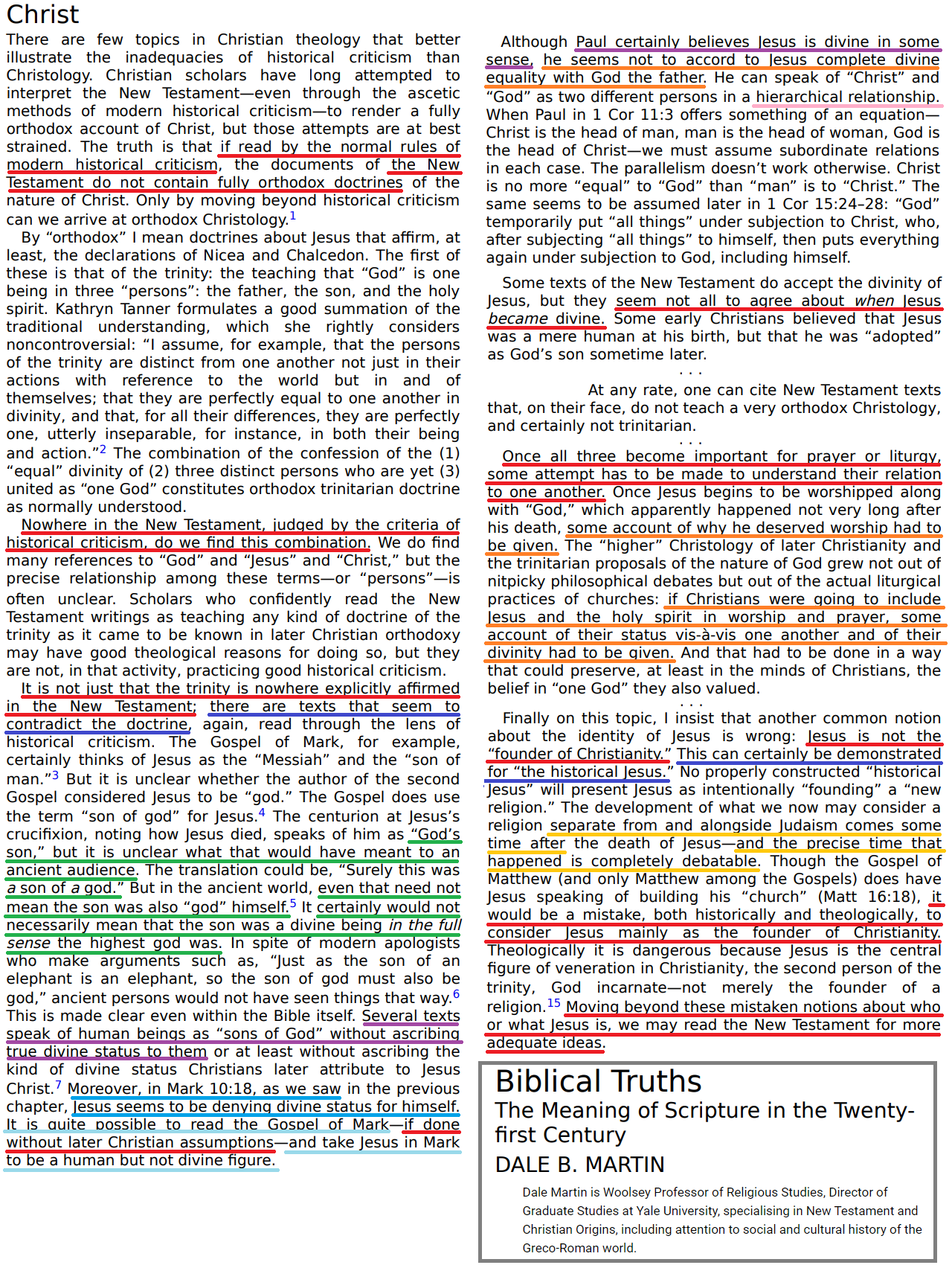
Christ
There are few topics in Christian theology that better
illustrate the inadequacies of historical criticism than
Christology. Christian scholars have long attempted to
interpret the New Testament—even through the ascetic
methods of modern historical criticism—to render a fully
orthodox account of Christ, but those attempts are at best
strained. The truth is that if read_by the
the documents of the New
Testament_do_not_contain fully orthodox doctrines of the
nature of Christ. Only by moving beyond historical criticism
can we arrive at orthodox Christology.!
By “orthodox” | mean doctrines about Jesus that affirm, at
least, the declarations of Nicea and Chalcedon. The first of
these is that of the trinity: the teaching that “God” is one
being in three “persons”: the father, the son, and the holy
spirit. Kathryn Tanner formulates a good summation of the
traditional understanding, which she rightly considers
noncontroversial: “| assume, for example, that the persons
of the trinity are distinct from one another not just in their
actions with reference to the world but in and of
themselves; that they are perfectly equal to one another in
divinity, and that, for all their differences, they are perfectly
one, utterly inseparable, for instance, in both their being
The combination of the confession of the (1)
ity of (2) three distinct persons who are yet (3)
united as “one God” constitutes orthodox trinitarian doctrine
as normally understood.
Nowhere _in the New Testament, judged by the criteria of
historical criticism, do_we find this combination, We do find
many references to “God” and “Jesus” and “Christ,” but the
precise relationship among these terms—or “persons”—is
often unclear. Scholars who confidently read the New
Testament writings as teaching any kind of doctrine of the
trinity as it came to be known in later Christian orthodoxy
may have good theological reasons for doing so, but they
are not, in that activity, practicing good historical criticism.
Itis not just that the trinity is nowhere explicitly affirmed
in_the New
doctrine, again, read through the lens of
historical criticism. The Gospel of Mark, for example,
certainly thinks of Jesus as the “Messiah” and the “son of
man.”? But it is unclear whether the author of the second
Gospel considered Jesus to be “god.” The Gospel does use
the term “son of god” for Jesus.* The centurion at Jesus’s
crucifixion, noting how Jesus died, speaks of him as “God's
son,” but it is unclear what_that_would have meant to_an
ancient audience. The translation could be, “Surely this was
of a god.” But in the ancient world, even that need not
mean the son was also “god” It certainly would not
necessarily mean that the son was a divine being in the full
Sense the god Ir oF apologies
make arguments such as, the son of an
elephant is an elephant, so the son of god must also be
god,” ancient persons would not have seen things that way.®
This is made clear even within the Bible itself. Several texts
speak of human beings as “sons of God”
true divine status to them or at least without ascribing the
kind of divine status Christians later attribute to Jesus
Moreover, in Mark 10:18, as we saw in the previous
chapter, Jesus seems to be denying divine status for himself,
It_is quite possible to read the Mark—if_done
without later Christian assumptions—and take Jesus in Mark
to be a human but not divine figure.
Although Paul certainly believes some
sense, he accord complete divine
equality with God the father. He can speak of “Christ” and
“God” as two different persons in a hierarchical relationship.
When Paul in 1 Cor 11:3 offers something of an equation—
Christ is the head of man, man is the head of woman, God is
the head of Christ—we must assume subordinate relations
in each case. The parallelism doesn’t work otherwise. Christ
is no more “equal” to “God” than “man” is to “Christ.” The
same seems to be assumed later in 1 Cor 15:24-28: “God”
temporarily put “all things” under subjection to Christ, who,
after subjecting “all things” to himself, then puts everything
again under subjection to God, including himself.
Some texts of the New Testament do accept the divinity of
Jesus, but they seem_not_all_to_agree about_when Jesus
became divine. Some early Christians believed that Jesus
was a mere human at his birth, but that he was “adopted”
as God’s son sometime later.
At any rate, one can cite New Testament texts
that, on their face, do not teach a very orthodox Christology,
and certainly not trinitarian.
important_for
has to_ be made their relation
to_one another. Once Jesus begins to be worshipped along
with “God,” which apparently happened not very long after
his death, some account of why he deserved worship had to
be given. The “higher” Christology of later Christianity and
the trinitarian proposals of the nature of God grew not out of
nitpicky philosophical debates but out of the actual liturgical
practices of churches: if Christians were going to_include
lesus_and_the_holy_spirit_in_worship some
their status vis-a-vis and_of their
divinity had to be given. And that had to be done in a way
that could preserve, at least in the minds of Christians, the
belief in “one God” they also valued.
Finally on this topic, | insist that another common notion
about the identity of Jesus is wrong: Jesus_is_not_the
“founder of Christianity.” This can certainly be demonstrated
for “the historical Jesus.” No properly constructed “historical
“Jesus” will present Jesus as intentionally “founding” a “new
ion.” The development of what we now may consider a
religion separate Judaism comes some
the death of Jesus—and the precise time that
happened is completely debatable. Though the Gospel of
Matthew (and only Matthew among the Gospels) does have
Jesus speaking of building his “church” (Matt 16:18), Jit,
would be a mistake, both historically and theologically, to
ristianity.
Theologically it is dangerous because Jesus is the central
figure of veneration in Christianity, the second person of the
trinity, God incarnate—not merely the founder of a
Moving beyond these mistaken notions about who
or what Jesus is, we may read the New Testament for more
adequate ideas.
Biblical Truths
The Meaning of Scripture in the Twenty-
first Century
DALE B. MARTIN
Dale Martin is Woolsey Professor of Religious Studies, Director of
Graduate Studies at Yale University, specialising in New Testament and
Christian Origins, including attention to social and cultural history of the
Greco-Roman world.
Drag to select text in the image, then copy (Ctrl/Cmd+C). ·

| Title | Christ, Trinity, Divinity |
|---|---|
| Description | |
| Posted by | theIslampill |
| Tags | dawah, trinity, new testament |
| Slug | — (none yet) |
| Canonical id | 04f2ab7b08a3 |
| Type | image/png |
| Dimensions | 1280×1700 |
| Size | 975 KB |
| Created | 2026-06-10 09:37 UTC |
| Views | 19 |
Searchable text (OCR)
Christ There are few topics in Christian theology that better illustrate the inadequacies of historical criticism than Christology. Christian scholars have long attempted to interpret the New Testament—even through the ascetic methods of modern historical criticism—to render a fully orthodox account of Christ, but those attempts are at best strained. The truth is that if read_by the the documents of the New Testament_do_not_contain fully orthodox doctrines of the nature of Christ. Only by moving beyond historical criticism can we arrive at orthodox Christology.! By “orthodox” | mean doctrines about Jesus that affirm, at least, the declarations of Nicea and Chalcedon. The first of these is that of the trinity: the teaching that “God” is one being in three “persons”: the father, the son, and the holy spirit. Kathryn Tanner formulates a good summation of the traditional understanding, which she rightly considers noncontroversial: “| assume, for example, that the persons of the trinity are distinct from one another not just in their actions with reference to the world but in and of themselves; that they are perfectly equal to one another in divinity, and that, for all their differences, they are perfectly one, utterly inseparable, for instance, in both their being The combination of the confession of the (1) ity of (2) three distinct persons who are yet (3) united as “one God” constitutes orthodox trinitarian doctrine as normally understood. Nowhere _in the New Testament, judged by the criteria of historical criticism, do_we find this combination, We do find many references to “God” and “Jesus” and “Christ,” but the precise relationship among these terms—or “persons”—is often unclear. Scholars who confidently read the New Testament writings as teaching any kind of doctrine of the trinity as it came to be known in later Christian orthodoxy may have good theological reasons for doing so, but they are not, in that activity, practicing good historical criticism. Itis not just that the trinity is nowhere explicitly affirmed in_the New doctrine, again, read through the lens of historical criticism. The Gospel of Mark, for example, certainly thinks of Jesus as the “Messiah” and the “son of man.”? But it is unclear whether the author of the second Gospel considered Jesus to be “god.” The Gospel does use the term “son of god” for Jesus.* The centurion at Jesus’s crucifixion, noting how Jesus died, speaks of him as “God's son,” but it is unclear what_that_would have meant to_an ancient audience. The translation could be, “Surely this was of a god.” But in the ancient world, even that need not mean the son was also “god” It certainly would not necessarily mean that the son was a divine being in the full Sense the god Ir oF apologies make arguments such as, the son of an elephant is an elephant, so the son of god must also be god,” ancient persons would not have seen things that way.® This is made clear even within the Bible itself. Several texts speak of human beings as “sons of God” true divine status to them or at least without ascribing the kind of divine status Christians later attribute to Jesus Moreover, in Mark 10:18, as we saw in the previous chapter, Jesus seems to be denying divine status for himself, It_is quite possible to read the Mark—if_done without later Christian assumptions—and take Jesus in Mark to be a human but not divine figure. Although Paul certainly believes some sense, he accord complete divine equality with God the father. He can speak of “Christ” and “God” as two different persons in a hierarchical relationship. When Paul in 1 Cor 11:3 offers something of an equation— Christ is the head of man, man is the head of woman, God is the head of Christ—we must assume subordinate relations in each case. The parallelism doesn’t work otherwise. Christ is no more “equal” to “God” than “man” is to “Christ.” The same seems to be assumed later in 1 Cor 15:24-28: “God” temporarily put “all things” under subjection to Christ, who, after subjecting “all things” to himself, then puts everything again under subjection to God, including himself. Some texts of the New Testament do accept the divinity of Jesus, but they seem_not_all_to_agree about_when Jesus became divine. Some early Christians believed that Jesus was a mere human at his birth, but that he was “adopted” as God’s son sometime later. At any rate, one can cite New Testament texts that, on their face, do not teach a very orthodox Christology, and certainly not trinitarian. important_for has to_ be made their relation to_one another. Once Jesus begins to be worshipped along with “God,” which apparently happened not very long after his death, some account of why he deserved worship had to be given. The “higher” Christology of later Christianity and the trinitarian proposals of the nature of God grew not out of nitpicky philosophical debates but out of the actual liturgical practices of churches: if Christians were going to_include lesus_and_the_holy_spirit_in_worship some their status vis-a-vis and_of their divinity had to be given. And that had to be done in a way that could preserve, at least in the minds of Christians, the belief in “one God” they also valued. Finally on this topic, | insist that another common notion about the identity of Jesus is wrong: Jesus_is_not_the “founder of Christianity.” This can certainly be demonstrated for “the historical Jesus.” No properly constructed “historical “Jesus” will present Jesus as intentionally “founding” a “new ion.” The development of what we now may consider a religion separate Judaism comes some the death of Jesus—and the precise time that happened is completely debatable. Though the Gospel of Matthew (and only Matthew among the Gospels) does have Jesus speaking of building his “church” (Matt 16:18), Jit, would be a mistake, both historically and theologically, to ristianity. Theologically it is dangerous because Jesus is the central figure of veneration in Christianity, the second person of the trinity, God incarnate—not merely the founder of a Moving beyond these mistaken notions about who or what Jesus is, we may read the New Testament for more adequate ideas. Biblical Truths The Meaning of Scripture in the Twenty- first Century DALE B. MARTIN Dale Martin is Woolsey Professor of Religious Studies, Director of Graduate Studies at Yale University, specialising in New Testament and Christian Origins, including attention to social and cultural history of the Greco-Roman world.